
人乳头瘤病毒感染会影响阴茎癌中的免疫微环境和抗原呈递。
Human papillomavirus infection affects the immune microenvironment and antigen presentation in penile cancer.
作者信息
Guimarães Sulayne Janayna Araujo, Vale André Alvares Marques, Rocha Mirtes Castelo Branco, Butarelli Ana Luiza de Araújo, da Silva Jenilson Mota, de Deus Amanda Jordão Silva, Nogueira Leudivan, Coelho Ronald Wagner Pereira, Pereira Silma Regina, Azevedo-Santos Ana Paula Silva
机构信息
Postgraduate Program in Health Science, Federal University of Maranhão, São Luís, Brazil.
Laboratory of Immunology Applied to Cancer, Department of Physiological Sciences, Biological and Health Sciences Center, Federal University of Maranhão, São Luís, MA, Brazil.
出版信息
Front Oncol. 2024 Oct 18;14:1463445. doi: 10.3389/fonc.2024.1463445. eCollection 2024.
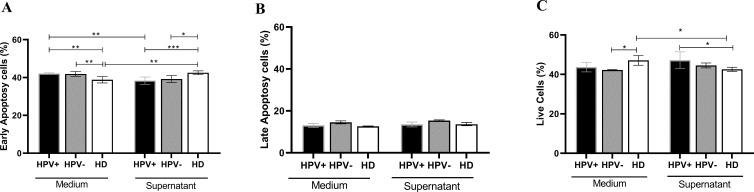
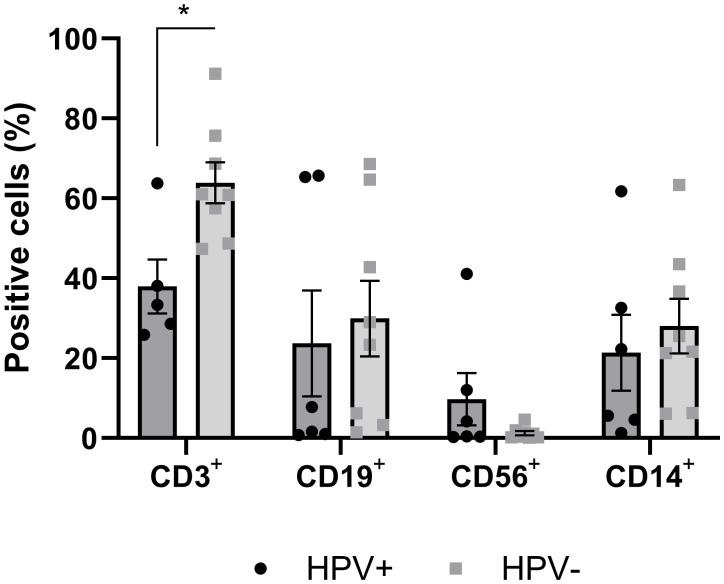
Penile squamous cell carcinoma (PSCC) is a largely neglected condition, predominantly affecting underdeveloped regions, and is associated with risk factors such as low socioeconomic status, phimosis, and human papillomavirus (HPV) infection. Unlike other urogenital cancers, its pathophysiology and therapeutic targets remain poorly understood, particularly regarding the immune response to the tumor microenvironment. This study aims to investigate immune cell infiltration profiles, dendritic cell maturation, and lymphocyte apoptosis in both HPV-positive and HPV-negative PSCC. Clinical and histopathological data, along with peripheral blood and tumor tissue samples, were collected from 30 patients (66.6% were HPV-positive and 33.3% HPV-negative), with an additional 19 healthy donors serving as controls. Tumor-infiltrating immune cells were analyzed following enzymatic digestion of tumor tissue, enabling detailed phenotypic characterization. A simulated tumor microenvironment was created using supernatants derived from primary cultures of HPV-positive PSCC tumors. Peripheral blood mononuclear cells were isolated and differentiated into dendritic cells (Mo-DCs) for further phenotyping and lymphoproliferation assays. Lymphocytes from healthy donors and patients were exposed to tumor culture supernatants to evaluate apoptosis induced by the tumor microenvironment. Results showed that HPV-positive tumors exhibited lower T lymphocyte frequencies compared to HPV-negative tumors. Additionally, patients infected with high-risk HPV demonstrated reduced maturation rates of Mo-DCs and decreased expression of co-stimulatory molecules on these cells compared to healthy donors. Furthermore, Mo-DCs from hrHPV-positive patients showed impaired lymphoproliferation capacity relative to controls, while HPV-negative patients exhibited a trend towards reduced lymphoproliferative ability. Regarding the simulated tumor microenvironment, lymphocytes from healthy donors underwent apoptosis, contrasting with patients' lymphocytes, which showed increased viability when cultured with tumor supernatants. These results underscore the impact of HPV infection on T lymphocyte infiltration, Mo-DC maturation, and lymphocyte survival in PSCC, offering critical insights for advancing our understanding of the tumor microenvironment and guiding the development of immunotherapy strategies.
阴茎鳞状细胞癌(PSCC)在很大程度上是一种被忽视的疾病,主要影响欠发达地区,并且与社会经济地位低下、包茎和人乳头瘤病毒(HPV)感染等风险因素相关。与其他泌尿生殖系统癌症不同,其病理生理学和治疗靶点仍知之甚少,尤其是关于肿瘤微环境的免疫反应方面。本研究旨在调查HPV阳性和HPV阴性PSCC中的免疫细胞浸润情况、树突状细胞成熟度以及淋巴细胞凋亡情况。收集了30例患者(66.6%为HPV阳性,33.3%为HPV阴性)的临床和组织病理学数据以及外周血和肿瘤组织样本,另外选取19名健康供者作为对照。对肿瘤组织进行酶消化后分析肿瘤浸润免疫细胞,从而能够进行详细的表型特征分析。使用HPV阳性PSCC肿瘤原代培养物的上清液创建模拟肿瘤微环境。分离外周血单核细胞并将其分化为树突状细胞(Mo-DC),用于进一步的表型分析和淋巴细胞增殖试验。将健康供者和患者的淋巴细胞暴露于肿瘤培养上清液中,以评估肿瘤微环境诱导的凋亡情况。结果显示,与HPV阴性肿瘤相比,HPV阳性肿瘤的T淋巴细胞频率较低。此外,与健康供者相比,感染高危HPV的患者Mo-DC的成熟率降低,且这些细胞上共刺激分子的表达减少。此外,与对照组相比,hrHPV阳性患者的Mo-DC的淋巴细胞增殖能力受损,而HPV阴性患者则呈现淋巴细胞增殖能力降低的趋势。关于模拟肿瘤微环境,健康供者的淋巴细胞发生凋亡,而患者的淋巴细胞在与肿瘤上清液一起培养时活力增加,形成对比。这些结果强调了HPV感染对PSCC中T淋巴细胞浸润、Mo-DC成熟和淋巴细胞存活的影响,为增进我们对肿瘤微环境的理解和指导免疫治疗策略的制定提供了关键见解。

 Zotero 插件