
尿酸与心肌梗死风险增加相关:来自 NHANES 2009-2018 年的结果和双向两样本 Mendelian 随机化分析。
Uric acid is associated with increased risk of myocardial infarction: results from NHANES 2009-2018 and bidirectional two-sample Mendelian randomization analysis.
机构信息
Department of General Practice, The First Affiliated Hospital of Dalian Medical University, Dalian, China.
Cadre Health Center, The First People's Hospital of Aksu Prefecture of Xinjiang, Aksu, China.
出版信息
Front Endocrinol (Lausanne). 2024 Oct 18;15:1424070. doi: 10.3389/fendo.2024.1424070. eCollection 2024.
AIM
Although a growing number of studies have shown that elevated uric acid (UA) levels are associated with multiple cardiovascular risk factors and progression of coronary artery disease, the causal relationship between UA and the occurrence of myocardial infarction (MI) remains uncertain. The aim of this study was to investigate the relationship between UA and the risk of MI.
METHODS
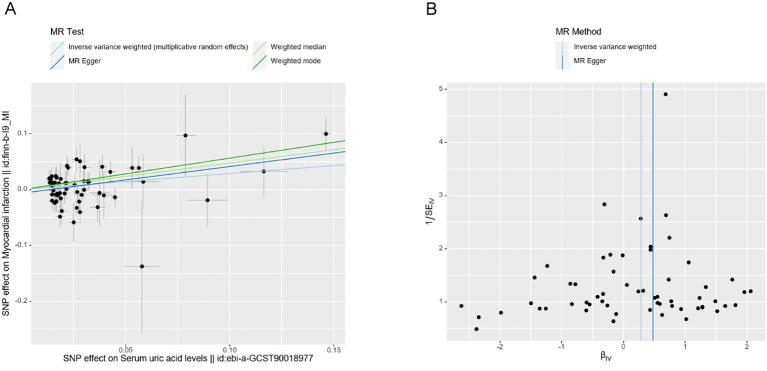
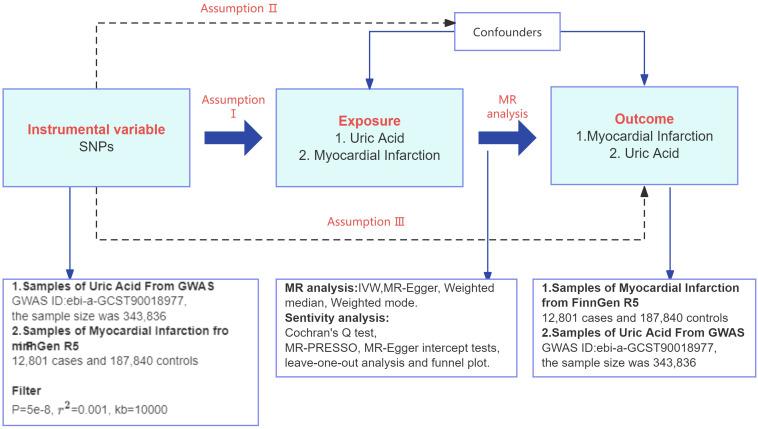
We screened 23,080 patients in the National Health and Nutrition Examination Survey (NHANES) database for 2009-2018 and explored the association between UA and MI risk using multivariate logistic regression model. In addition, a two-way two-sample Mendelian randomization (TSMR) analysis was performed to examine the causal relationship of UA on MI, and inverse variance-weighted (IVW) results were used as the primary outcome in this study. Sensitivity analysis and horizontal multiple validity test were also performed to verify the reliability of the results.
RESULTS
After multivariable adjustment, individuals with the severe elevation of UA levels have a significantly increased risk of MI (OR=2.843, 95%CI: 1.296-6.237, =0.010). In TSMR analysis, the IVW method demonstrated a significant association between UA and increased risk of MI (OR=1.333, 95%CI: 1.079-1.647, =0.008). Results from the MR-Egger intercept test, Cochran's Q test, and MR-PRESSO test all suggest the reliability of the IVW analysis. Reverse TSMR analysis did not indicate a causal relationship between genetic susceptibility to MI and UA levels (IVW: OR=1.001, 95%CI: 0.989-1.012, =0.922).
CONCLUSION
Based on cross-sectional study and Mendelian randomization analysis, it has been demonstrated that UA is an independent risk factor for MI. Elevated levels of UA increase the risk of MI, particularly in cases of severe elevation.
目的
尽管越来越多的研究表明尿酸(UA)水平升高与多种心血管危险因素和冠状动脉疾病的进展有关,但 UA 与心肌梗死(MI)发生之间的因果关系仍不确定。本研究旨在探讨 UA 与 MI 风险之间的关系。
方法
我们在 2009 年至 2018 年的国家健康和营养调查(NHANES)数据库中筛选了 23080 名患者,并使用多变量逻辑回归模型探讨了 UA 与 MI 风险之间的关系。此外,还进行了双向两样本 Mendelian 随机化(TSMR)分析,以检验 UA 对 MI 的因果关系,本研究的主要结果采用逆方差加权(IVW)结果。还进行了敏感性分析和水平多重有效性检验,以验证结果的可靠性。
结果
经过多变量调整后,UA 水平严重升高的个体发生 MI 的风险显著增加(OR=2.843,95%CI:1.296-6.237,=0.010)。在 TSMR 分析中,IVW 方法表明 UA 与 MI 风险增加之间存在显著关联(OR=1.333,95%CI:1.079-1.647,=0.008)。MR-Egger 截距检验、Cochran's Q 检验和 MR-PRESSO 检验的结果均表明 IVW 分析的可靠性。反向 TSMR 分析并未表明 MI 的遗传易感性与 UA 水平之间存在因果关系(IVW:OR=1.001,95%CI:0.989-1.012,=0.922)。
结论
基于横断面研究和 Mendelian 随机化分析,已经证明 UA 是 MI 的独立危险因素。UA 水平升高会增加 MI 的风险,尤其是在严重升高的情况下。

 Zotero 插件