
使用机器学习和重金属暴露生物标志物对20岁及以上成年人认知障碍进行早期预测。
Early prediction of cognitive impairment in adults aged 20 years and older using machine learning and biomarkers of heavy metal exposure.
作者信息
Nabavi Ali, Safari Farimah, Kashkooli Mohammad, Sadat Nabavizadeh Sara, Molavi Vardanjani Hossein
机构信息
Student Research Committee, Shiraz University of Medical Sciences, Shiraz, Iran.
Department of Otolaryngology, Otolaryngology Research Center, Shiraz University of Medical Sciences, Shiraz, Iran.
出版信息
Curr Res Toxicol. 2024 Oct 18;7:100198. doi: 10.1016/j.crtox.2024.100198. eCollection 2024.
BACKGROUND
Cognitive impairment poses a growing health challenge as populations age. Heavy metals are implicated as environmental risk factors, but their role is not fully understood. Machine learning can integrate multi-factorial data to predict cognitive outcomes.
OBJECTIVE
To develop and validate machine learning models for early prediction of cognitive impairment risk using demographics, clinical factors, and biomarkers of heavy metal exposure.
METHOD
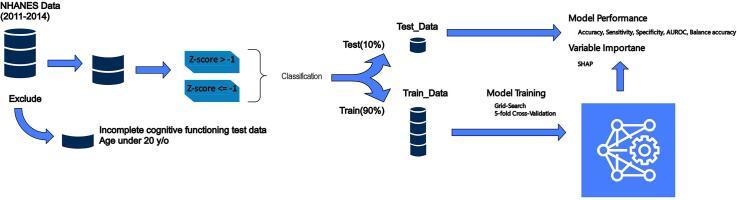
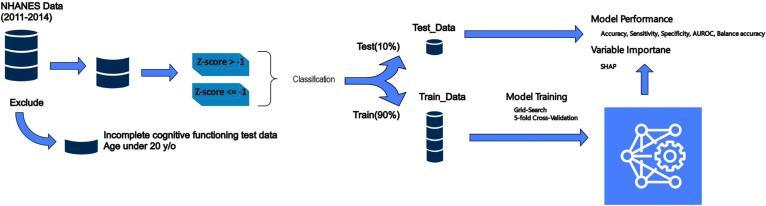
A retrospective analysis was conducted using 2011-2014 NHANES data. Participants aged ≥ 20 underwent cognitive testing. Variables included demographics, medical history, lifestyle factors, and blood and urine levels of lead, cadmium, manganese, and other metals. Machine learning algorithms were trained on 90 % of data and evaluated on 10 %. Performance was assessed using metrics like accuracy, AUC, and sensitivity.
RESULT
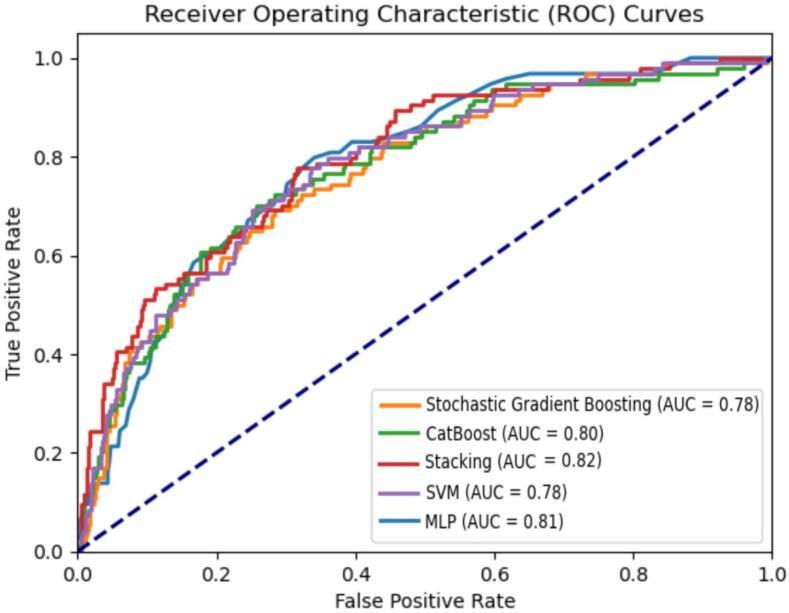
A final sample of 2,933 participants was analyzed. The stacking ensemble model achieved the best performance with an AUC of 0.778 for test data, sensitivity of 0.879. Important predictors included age, gender, hypertension, education, urinary cadmium and blood manganese levels.
CONCLUSION
Machine learning can effectively predict cognitive impairment risk using comprehensive clinical and exposure data. Incorporating heavy metal biomarkers enhanced prediction and provided insights into environmental contributions to cognitive decline. Prospective studies are needed to validate models over time.
背景
随着人口老龄化,认知障碍对健康构成了日益严峻的挑战。重金属被认为是环境风险因素,但其作用尚未完全明确。机器学习可以整合多因素数据来预测认知结果。
目的
利用人口统计学、临床因素和重金属暴露生物标志物,开发并验证用于早期预测认知障碍风险的机器学习模型。
方法
使用2011 - 2014年美国国家健康与营养检查调查(NHANES)数据进行回顾性分析。年龄≥20岁的参与者接受了认知测试。变量包括人口统计学、病史、生活方式因素以及血液和尿液中铅、镉、锰及其他金属的水平。机器学习算法在90%的数据上进行训练,并在10%的数据上进行评估。使用准确率、曲线下面积(AUC)和灵敏度等指标评估性能。
结果
对2933名参与者的最终样本进行了分析。堆叠集成模型表现最佳,测试数据的AUC为0.778,灵敏度为0.879。重要的预测因素包括年龄、性别、高血压、教育程度、尿镉和血锰水平。
结论
机器学习可以利用综合的临床和暴露数据有效预测认知障碍风险。纳入重金属生物标志物可增强预测能力,并为环境对认知衰退的影响提供见解。需要进行前瞻性研究以长期验证模型。

 Zotero 插件