
摄入乳清加胶原蛋白蛋白混合物可提高肌原纤维和肌肉结缔组织蛋白的合成率。
Ingestion of a Whey Plus Collagen Protein Blend Increases Myofibrillar and Muscle Connective Protein Synthesis Rates.
作者信息
Aussieker Thorben, Kaiser Jeremias, Hermans Wesley J H, Hendriks Floris K, Holwerda Andrew M, Senden Joan M, VAN Kranenburg Janneau M X, Goessens Joy P B, Braun Ulrike, Baar Keith, Snijders Tim, VAN Loon Luc J C
机构信息
Department of Human Biology, NUTRIM, Institute for Nutrition and Translational Research in Metabolism, Maastricht University, Maastricht, THE NETHERLANDS.
GELITA AG, Eberbach, GERMANY.
出版信息
Med Sci Sports Exerc. 2025 Mar 1;57(3):544-554. doi: 10.1249/MSS.0000000000003596. Epub 2024 Nov 6.
PURPOSE
Ingestion of whey protein increases myofibrillar but not muscle connective protein synthesis rates. Recently, we defined a whey and collagen protein blend (5:1 ratio) to optimize post-prandial plasma amino acid availability. Here, we assessed the ability of this blend to increase myofibrillar and muscle connective protein synthesis rates at rest and during early recovery from exercise.
METHODS
In a randomized, double-blind, parallel design, 28 men (age: 25 ± 5 yr; body mass index: 23.6 ± 2.3 kg·m -2 ) were randomly allocated to ingest either 30 g of protein (25 g whey/5 g collagen; BLEND, n = 14) or a noncaloric placebo (PLA, n = 14) following a single session of unilateral leg resistance-type exercise. Participants received primed continuous l -[ ring - 13 C 6 ]-phenylalanine infusions with blood and muscle biopsy samples collection for 5 h post-prandially to assess myofibrillar and muscle connective protein synthesis rates.
RESULTS
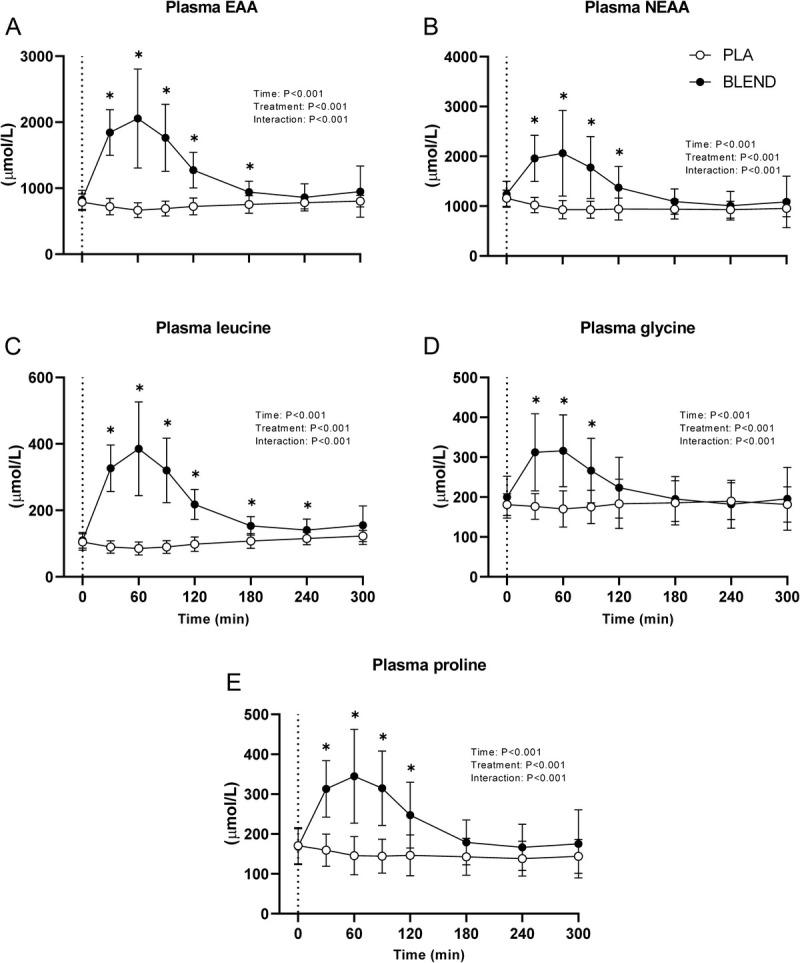
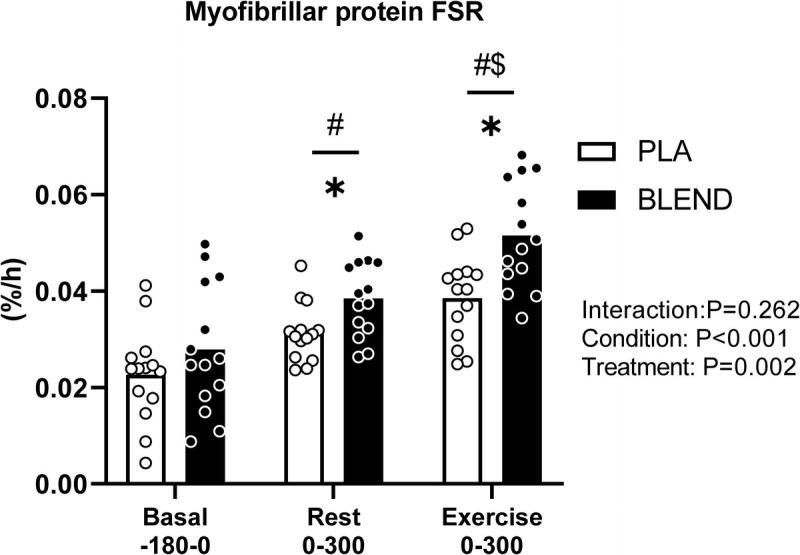
Protein ingestion strongly increased plasma amino acid concentrations, including plasma leucine and glycine concentrations ( P < 0.001), with no changes following placebo ingestion ( P > 0.05). Post-prandial myofibrillar and muscle connective protein synthesis rates were higher in the exercised compared with the rested leg ( P < 0.001). In addition, myofibrillar protein synthesis rates were higher in BLEND compared with PLA in both the rested (0.038 ± 0.008 and 0.031 ± 0.006%·h -1 , respectively; P < 0.05) and exercised (0.052 ± 0.011 and 0.039 ± 0.009%·h -1 , respectively; P < 0.01) leg. Muscle connective protein synthesis rates were higher in BLEND compared with PLA in the rested (0.062 ± 0.013 and 0.051 ± 0.010%·h -1 , respectively; P < 0.05), but not the exercised (0.090 ± 0.021 and 0.079 ± 0.016%·h -1 , respectively; P = 0.11) leg.
CONCLUSIONS
Ingestion of a whey (25 g) plus collagen (5 g) protein blend increases both myofibrillar and muscle connective protein synthesis rates at rest and further increases myofibrillar but not muscle connective protein synthesis rates during recovery from exercise in recreationally active, young men.
目的
摄入乳清蛋白可提高肌原纤维蛋白而非肌肉结缔组织蛋白的合成速率。最近,我们确定了一种乳清蛋白与胶原蛋白的混合蛋白(比例为5:1),以优化餐后血浆氨基酸的可用性。在此,我们评估了这种混合蛋白在静息状态和运动后早期恢复期间提高肌原纤维蛋白和肌肉结缔组织蛋白合成速率的能力。
方法
采用随机、双盲、平行设计,将28名男性(年龄:25±5岁;体重指数:23.6±2.3kg·m-2)随机分配,在单侧腿部进行一次抗阻训练后,分别摄入30g蛋白质(25g乳清蛋白/5g胶原蛋白;混合蛋白组,n = 14)或无热量安慰剂(安慰剂组,n = 14)。参与者在餐后接受静脉注射[ring-13C6]-苯丙氨酸,并在餐后5小时采集血液和肌肉活检样本,以评估肌原纤维蛋白和肌肉结缔组织蛋白的合成速率。
结果
摄入蛋白质后,血浆氨基酸浓度显著升高,包括血浆亮氨酸和甘氨酸浓度(P<0.001),而摄入安慰剂后无变化(P>0.05)。与静息腿相比,运动后腿部的餐后肌原纤维蛋白和肌肉结缔组织蛋白合成速率更高(P<0.001)。此外,在静息腿(分别为0.038±0.008和0.031±0.006%·h-1;P<0.05)和运动腿(分别为0.052±0.011和0.039±0.009%·h-1;P<0.01)中,混合蛋白组的肌原纤维蛋白合成速率均高于安慰剂组。在静息腿中,混合蛋白组的肌肉结缔组织蛋白合成速率高于安慰剂组(分别为0.062±0.013和0.051±0.010%·h-1;P<0.05),但在运动腿中无差异(分别为0.090±0.021和0.079±0.016%·h-1;P = 0.11)。
结论
对于有运动习惯的年轻男性,摄入含有25g乳清蛋白加5g胶原蛋白的混合蛋白,可提高静息状态下肌原纤维蛋白和肌肉结缔组织蛋白的合成速率,并进一步提高运动恢复期间肌原纤维蛋白而非肌肉结缔组织蛋白的合成速率。



 Zotero 插件