
代谢功能障碍相关脂肪性肝病患者肝细胞癌的风险预测与早期检测
Hepatocellular carcinoma risk prediction and early detection in patients with metabolic dysfunction associated steatotic liver disease.
作者信息
Liang Jeff, Kim Naomy, Yang Ju Dong
机构信息
Department of Internal Medicine, Cedars-Sinai Medical Center, Los Angeles, CA, USA.
Karsh Division of Gastroenterology and Hepatology, Cedars-Sinai Medical Center, Los Angeles, CA, USA.
出版信息
Transl Gastroenterol Hepatol. 2024 Oct 12;9:67. doi: 10.21037/tgh-24-41. eCollection 2024.
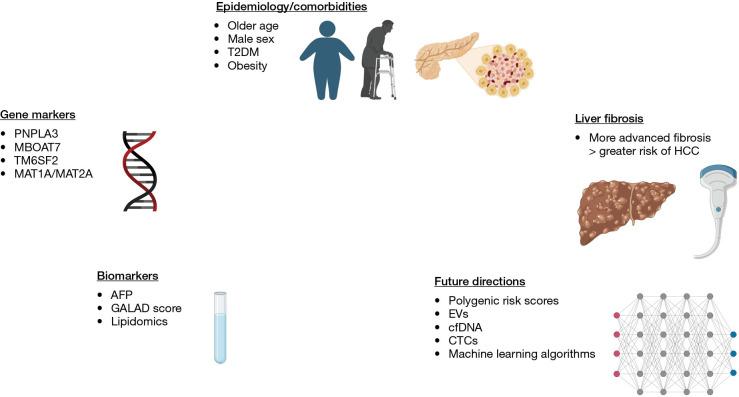
The rising prevalence of metabolic dysfunction-associated steatotic liver disease (MASLD) and its more severe form, metabolic dysfunction-associated steatohepatitis (MASH), is closely linked with a heightened risk of hepatocellular carcinoma (HCC), the fourth leading cause of cancer-related deaths worldwide. Despite the elevated risk of HCC in patients with MASLD, the existing surveillance guidelines are inadequate, particularly for those without cirrhosis. This review evaluates current HCC surveillance practices in patients with MASLD and their shortcomings. It also highlights the critical need for enhanced HCC risk stratification and diagnostic accuracy through new techniques. In this review article, we performed a comprehensive literature review of studies focusing on HCC risk factors in MASLD/MASH patients from 2000 to 2023. We discussed that demographics, comorbidities, liver fibrosis, and genetic markers play critical roles in HCC risk stratification. Additionally, non-invasive tests (NITs) for fibrosis may improve the accuracy for HCC risk stratification and diagnosis. More recently, innovative approaches, such as machine learning techniques and liquid biopsy utilizing extracellular vesicles, cell-free DNA, and circulating tumor cells show promise in redefining early HCC detection. Thus, integrating these various risk factors could optimize early detection of HCC for the growing MASLD/MASH patient population. However, further research is needed to confirm their effectiveness and practical implementation in clinical settings.
代谢功能障碍相关脂肪性肝病(MASLD)及其更严重形式——代谢功能障碍相关脂肪性肝炎(MASH)的患病率不断上升,这与肝细胞癌(HCC)风险增加密切相关,肝细胞癌是全球癌症相关死亡的第四大主要原因。尽管MASLD患者患HCC的风险升高,但现有的监测指南并不完善,尤其是对于那些没有肝硬化的患者。本综述评估了MASLD患者当前的HCC监测实践及其不足之处。它还强调了通过新技术加强HCC风险分层和诊断准确性的迫切需求。在这篇综述文章中,我们对2000年至2023年期间聚焦于MASLD/MASH患者HCC危险因素的研究进行了全面的文献综述。我们讨论了人口统计学、合并症、肝纤维化和基因标志物在HCC风险分层中起着关键作用。此外,用于纤维化的非侵入性检测(NITs)可能会提高HCC风险分层和诊断的准确性。最近,创新方法,如机器学习技术以及利用细胞外囊泡、游离DNA和循环肿瘤细胞的液体活检,在重新定义早期HCC检测方面显示出前景。因此,整合这些不同的危险因素可以优化对不断增加的MASLD/MASH患者群体的HCC早期检测。然而,需要进一步研究来证实它们在临床环境中的有效性和实际应用。
 Zotero 插件