
美国成年人中心血管代谢指数(CMI)与牙周炎的关系:NHANES 数据分析(2009-2014 年)。
Association between cardiometabolic index (CMI) and periodontitis in US adults: analysis of NHANES data (2009-2014).
机构信息
School of Stomatology, Zunyi Medical University, Dalian Road, Huichuan District, Zunyi, Guizhou, 563000, China.
Department of Prosthodontics, Guiyang Stomatological Hospital, 253 Jiefang Road, Nanming District, Guiyang, Guizhou, 550005, China.
出版信息
BMC Oral Health. 2024 Nov 6;24(1):1346. doi: 10.1186/s12903-024-05119-3.
BACKGROUND
The cardiometabolic index (CMI) is a new predictor of obesity-related diseases, but its link to periodontitis is under-researched. This study aims to examine the potential association between the CMI and periodontitis.
METHODS
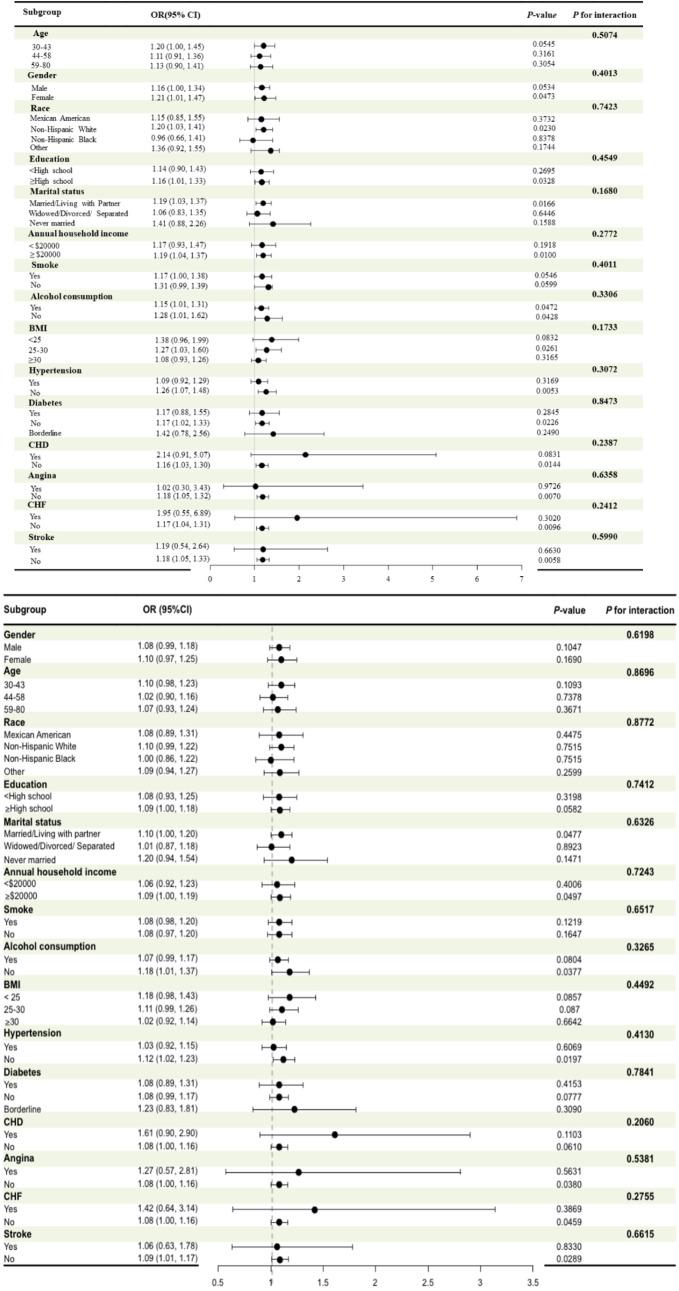
We conducted a cross-sectional study using the National Health and Nutrition Examination Survey (NHANES) database (2009-2014) to examine the potential association between CMI and periodontitis. The study utilized a weighted multivariate logistic model to assess the association between TG, HDL-C, TG/HDL-C, obesity indices (BMI, WC, WHtR, CMI), and periodontitis, employing the area under the receiver operating characteristic curves (ROC) to estimate areas under the curve (AUC). Furthermore, generalized smooth curve fitting was conducted to examine the relationship between CMI and periodontitis. Finally, the study incorporated subgroup analysis and interaction tests to examine consistency across different populations.
RESULTS
TG/HDL-C, WHtR, and CMI were positively associated with periodontitis in the fully adjusted classification model. It was observed that for each unit increase in CMI, there was a corresponding 17.8% increase in the prevalence of periodontitis [1.178 (1.049, 1.322) 0.00562] and 18.7% increase in the prevalence of moderate/severe [1.187 (1.057, 1.334) 0.00376] in the fully adjusted model. When CMI was used as a categorical variable, the adjusted OR for periodontitis prevalence increased significantly with increasing CMI after adjusting for all potential covariates (T3 vs. T1: OR, 1.28 [1.06, 1.55], p < 0.05). The ROC analysis indicated that a larger area under the curve was found in the CMI [0.554 (0.538-0.570)] than in the WC [0.544 (0.528-0.560)] and WHtR [0.544 (0.528-0.561)]. Nonetheless, the discrepancy observed did not reach statistical significance (all p > 0.05). Further generalized smooth curve fitting and threshold effect models indicated a positive linear correlation between CMI and periodontitis. Moreover, there is no interactive association between TG/HDL-C, WHtR, CMI, and periodontitis.
CONCLUSIONS
This cross-sectional study revealed a positive relationship between CMI and periodontitis. Further prospective studies are warranted to validate our findings.
背景
代谢心血管风险指数(CMI)是肥胖相关疾病的新预测指标,但它与牙周炎的关系尚未得到充分研究。本研究旨在探讨 CMI 与牙周炎之间的潜在关联。
方法
我们使用国家健康和营养检查调查(NHANES)数据库(2009-2014 年)进行了一项横断面研究,以检查 CMI 与牙周炎之间的潜在关联。该研究采用加权多变量逻辑模型来评估 TG、HDL-C、TG/HDL-C、肥胖指数(BMI、WC、WHtR、CMI)与牙周炎之间的关联,并使用受试者工作特征曲线下的面积(ROC)来估计曲线下的面积(AUC)。此外,还进行了广义平滑曲线拟合,以检查 CMI 与牙周炎之间的关系。最后,进行了亚组分析和交互测试,以检查不同人群之间的一致性。
结果
在完全调整的分类模型中,TG/HDL-C、WHtR 和 CMI 与牙周炎呈正相关。观察到,CMI 每增加一个单位,牙周炎的患病率就会相应增加 17.8%[1.178(1.049,1.322)0.00562],中度/重度牙周炎的患病率也会增加 18.7%[1.187(1.057,1.334)0.00376]。在完全调整的模型中,当 CMI 作为分类变量时,在调整所有潜在协变量后,CMI 与牙周炎患病率之间的调整比值比(OR)随着 CMI 的增加而显著增加(T3 与 T1:OR,1.28[1.06,1.55],p<0.05)。ROC 分析表明,CMI 的 AUC 较大[0.554(0.538-0.570)],而 WC[0.544(0.528-0.560)]和 WHtR[0.544(0.528-0.561)]的 AUC 较小。然而,观察到的差异没有达到统计学意义(均 p>0.05)。进一步的广义平滑曲线拟合和阈值效应模型表明,CMI 与牙周炎之间存在正线性关系。此外,TG/HDL-C、WHtR、CMI 与牙周炎之间不存在交互关联。
结论
本横断面研究揭示了 CMI 与牙周炎之间的正相关关系。需要进一步的前瞻性研究来验证我们的发现。


 Zotero 插件