
在加拿大,从事成年长期新冠患者工作的物理治疗师的经验:一项定性研究。
Experiences of physiotherapists working with adults living with Long COVID in Canada: a qualitative study.
机构信息
Department of Physical Therapy, Temerty Faculty of Medicine, University of Toronto, Toronto, Ontario, Canada.
Long COVID Physio, London, UK.
出版信息
BMJ Open. 2024 Nov 7;14(11):e086357. doi: 10.1136/bmjopen-2024-086357.
OBJECTIVES
To explore experiences of physiotherapists working with adults living with Long COVID in Canada.
DESIGN
Cross-sectional descriptive qualitative study involving online semi-structured interviews.
PARTICIPANTS
We recruited physiotherapists in Canada who self-identified as having clinically treated one or more adults living with Long COVID in the past year.
DATA COLLECTION
Using an interview guide, we inquired about physiotherapists' knowledge of Long COVID, assessment and treatment experiences, perspectives on physiotherapists' roles, contextual and implementation factors influencing rehabilitative outcomes, and their recommendations for Long COVID rehabilitation. Interviews were audio-recorded, transcribed verbatim and analysed using a group-based thematic analytical approach. We administered a demographic questionnaire to describe sample characteristics.
RESULTS
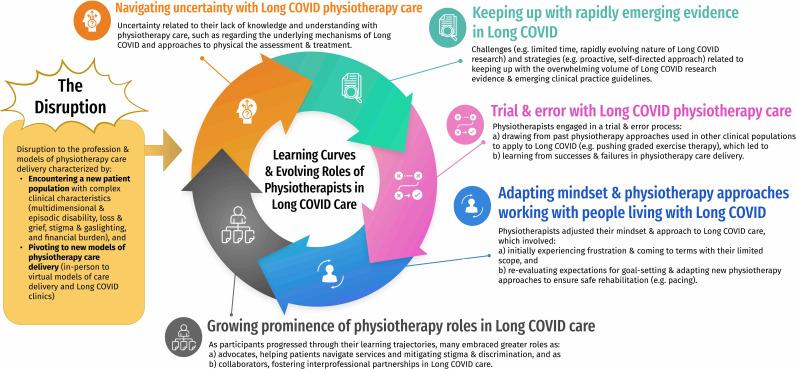
13 physiotherapists from five provinces participated; most were women (n=8; 62%) and practised in urban settings (n=11; 85%). Participants reported variable amounts of knowledge of existing guidelines and experiences working with adults living with Long COVID in the past year. Physiotherapists characterised their experiences working with adults living with Long COVID as a dynamic process involving: (1) a disruption to the profession (encountering a new patient population and pivoting to new models of care delivery), followed by (2) a cyclical process of learning curves and evolving roles of physiotherapists working with persons living with Long COVID (navigating uncertainty, keeping up with rapidly emerging evidence, trial and error, adapting mindset and rehabilitative approaches and growing prominence of roles as advocate and collaborator). Participants recommended the need for education and training, active and open-minded listening with patients, interdisciplinary models of care, and organisational- and system-level improvements to foster access to care.
CONCLUSIONS
Physiotherapists' experiences involved a disruption to the profession followed by a dynamic process of learning curves and evolving roles in Long COVID rehabilitation. Not all participants demonstrated an in-depth understanding of existing Long COVID rehabilitation guidelines. Results may help inform physiotherapy education in Long COVID rehabilitation.
目的
探索加拿大从事新冠肺炎长期患者治疗的物理治疗师的经验。
设计
涉及在线半结构式访谈的横断面描述性定性研究。
参与者
我们招募了自我认同在过去一年中临床治疗过一名或多名新冠肺炎长期患者的加拿大物理治疗师。
数据收集
使用访谈指南,我们询问了物理治疗师对新冠肺炎长期患者的了解、评估和治疗经验、对物理治疗师角色的看法、影响康复结果的背景和实施因素,以及他们对新冠肺炎长期康复的建议。访谈进行了录音、逐字转录,并采用基于群体的主题分析方法进行分析。我们还进行了一份人口统计学问卷,以描述样本特征。
结果
来自五个省份的 13 名物理治疗师参与了研究;大多数为女性(n=8;62%),在城市环境中工作(n=11;85%)。参与者报告了对现有指南的知识和过去一年治疗新冠肺炎长期患者的经验程度不一。物理治疗师将他们与新冠肺炎长期患者合作的经验描述为一个动态的过程,包括:(1)职业的颠覆(遇到新的患者群体并转向新的护理提供模式),随后是(2)物理治疗师与新冠肺炎长期患者合作的学习曲线和角色演变的循环过程(应对不确定性、紧跟快速出现的证据、试错、调整思维和康复方法以及倡导和合作角色的重要性不断提高)。参与者建议需要教育和培训、与患者进行积极和开放的倾听、跨学科的护理模式以及组织和系统层面的改进,以促进获得护理。
结论
物理治疗师的经验涉及职业的颠覆,随后是新冠肺炎康复中学习曲线和角色演变的动态过程。并非所有参与者都对现有的新冠肺炎康复指南有深入的了解。研究结果可能有助于为新冠肺炎康复中的物理治疗教育提供信息。
 Zotero 插件