
挖掘塞尔维亚老年人口的潜力:一项关于肌肉骨骼疾病及其相关因素的建模研究。
Unlocking the Potential of the Elderly Population in Serbia: A Modeling Study on Musculoskeletal Disorders and Associated Factors.
作者信息
Radovic Diana, Santric-Milicevic Milena, Nikolic Dejan, Filipovic Tamara, Ducic Jovan, Nikcevic Ljubica, Jovicic Milica, Tulic Ivan, Tulic Goran
机构信息
Institute of Rehabilitation, 11000 Belgrade, Serbia.
Faculty of Medicine, University of Belgrade, 11000 Belgrade, Serbia.
出版信息
J Clin Med. 2024 Oct 31;13(21):6541. doi: 10.3390/jcm13216541.
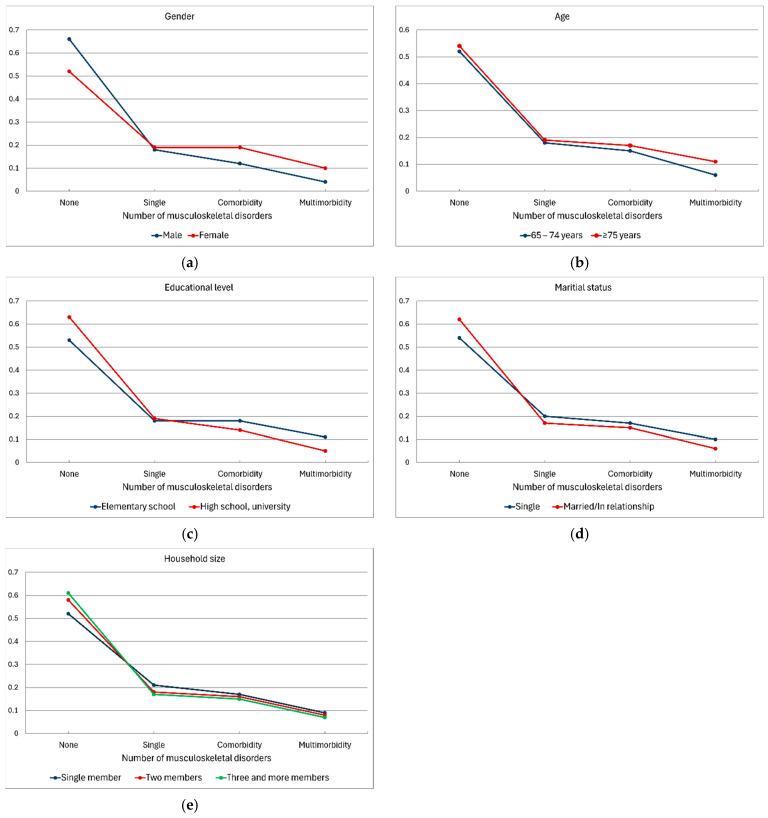
A properly functioning musculoskeletal system is imperative for human well-being at every stage of life, including at an older age. This study's aim was to assess the relationship between sociodemographic and physical functioning variables and the presence of individual musculoskeletal disorders (MSDs), MSD comorbidity, and multimorbidity, as well as to determine factors that are independent predictors of the presence of MSDs in people over 65 years old. This population-based study included 3701 participants aged 65 years and older. Data on individual MSDs addressed cervical and lumbosacral spine regions and degenerative joint disease (arthrosis). The subjects were categorized into four groups: those without any diseases; those with one MSD; those with two MSDs (comorbidities); and those with three MSDs (multimorbidities). The sociodemographic and physical functioning variables were analyzed. Females were more likely to have MSDs (two: OR 1.95 and three: OR 2.25) than men. Elderly people aged 75 and above were 1.49 times more likely to have three MSDs. Elderly people with elementary school education were more likely to have MSDs (two: OR 1.34 and three: OR 2.06) than those with high school/university education. The low-income population was 2.47 times more likely to have three MSDs. Individuals with partial activity limitations because of health problems had greater chances of having one, two, or three MSDs (OR 1.60, 1.59, and 1.94, respectively), and elderly individuals with severe limitations had an OR of 1.43, 2.17, and 4.12, respectively. Individuals with some/many difficulties in walking up or down 12 steps were more likely to have MSDs (two: OR 2.26 and three: OR 2.28). The significant predictors of experiencing a single MSD, MSD comorbidity, or MSD multimorbidity include residing in the Serbian capital city and having limitations in activities due to health problems. A significant predictor of having a single MSD or MSD comorbidity is residing in the northern region of Serbia. A significant predictor of MSD comorbidity is residing in the southeastern region of Serbia. Significant predictors of MSD comorbidity or MSD multimorbidity include female gender, an elementary school educational level, and experiencing difficulty in walking up or down 12 steps. Significant predictors of MSD multimorbidity are being 75 years of age and above and having a lower income.
一个功能正常的肌肉骨骼系统对于人生每个阶段的人类福祉而言都是必不可少的,包括老年阶段。本研究的目的是评估社会人口统计学和身体功能变量与个体肌肉骨骼疾病(MSD)、MSD共病和多病共存之间的关系,并确定65岁以上人群中MSD存在的独立预测因素。这项基于人群的研究纳入了3701名65岁及以上的参与者。关于个体MSD的数据涉及颈椎和腰骶椎区域以及退行性关节疾病(骨关节炎)。受试者被分为四组:无任何疾病者;患有一种MSD者;患有两种MSD(共病)者;患有三种MSD(多病共存)者。对社会人口统计学和身体功能变量进行了分析。女性比男性更易患MSD(两种:比值比1.95;三种:比值比2.25)。75岁及以上的老年人患三种MSD的可能性是其他人的1.49倍。接受小学教育的老年人比接受高中/大学教育的老年人更易患MSD(两种:比值比1.34;三种:比值比2.06)。低收入人群患三种MSD的可能性是其他人的2.47倍。因健康问题存在部分活动受限的个体患一种、两种或三种MSD的几率更高(分别为比值比1.60、1.59和1.94),而存在严重活动受限的老年人的比值比分别为1.43、2.17和4.12。在上、下12级台阶时存在一些/许多困难的个体更易患MSD(两种:比值比2.26;三种:比值比2.28)。经历单一MSD、MSD共病或MSD多病共存的显著预测因素包括居住在塞尔维亚首都以及因健康问题存在活动受限。患单一MSD或MSD共病的一个显著预测因素是居住在塞尔维亚北部地区。MSD共病的一个显著预测因素是居住在塞尔维亚东南部地区。MSD共病或MSD多病共存的显著预测因素包括女性性别、小学教育水平以及在上、下12级台阶时存在困难。MSD多病共存的显著预测因素是年龄在75岁及以上以及收入较低。

 Zotero 插件