
宠物龙猫的饲养条件与福利状况()以及饲养者对压力的感知和与动物的情感亲密程度
Husbandry Conditions and Welfare State of Pet Chinchillas () and Caretakers' Perceptions of Stress and Emotional Closeness to Their Animals.
作者信息
Gilhofer Elisabeth M, Hebesberger Denise V, Waiblinger Susanne, Künzel Frank, Rouha-Mülleder Cornelia, Mariti Chiara, Windschnurer Ines
机构信息
Centre for Animal Nutrition and Welfare, Clinical Department for Farm Animals and Food System Science, University of Veterinary Medicine Vienna (Vetmeduni), Veterinärplatz 1, 1210 Vienna, Austria.
Clinical Centre for Small Animal Health and Research, Clinical Department for Small Animals and Horses, University of Veterinary Medicine Vienna (Vetmeduni), Veterinärplatz 1, 1210 Vienna, Austria.
出版信息
Animals (Basel). 2024 Nov 3;14(21):3155. doi: 10.3390/ani14213155.
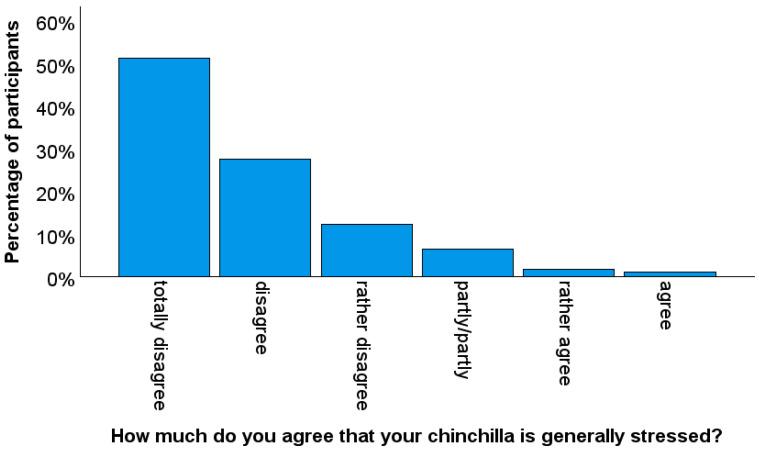
For pet chinchillas, limited data are available on husbandry and the human-animal relationship despite their impact on health, behavior, and welfare. We conducted an online survey with pet chinchilla caretakers ( = 336), targeting husbandry practices, health, behavioral indicators of welfare, and human-chinchilla relationships. We further investigated associations between caretakers' perceptions of stress in their chinchillas and emotional closeness to their animals. Basic needs such as keeping with conspecifics, constant access to water and hay, or offering dust baths were mostly fulfilled. Potential welfare issues included individual keeping (14.3%), undersized cages/enclosures (reported by 27.6% of the Austrian respondents), and suffering from a disease (14.7%). Behavioral indicators of good welfare, such as playing and cuddling with conspecifics, were observed several times per day by 40.9% and 87.9% of the respondents, respectively. Repetitive and unwanted behaviors were less common (fur biting, for instance, occurred 'never' in 82.9%). Caretakers rated their animals as generally more stressed if the animal was ill and more often showed fearful behavior toward them. Caretakers feeling closer to their animals spent more time engaging with them. Correct identification of this kind of association could be used as guidance for recommendations to improve chinchilla welfare at home and in the veterinary setting.
对于宠物龙猫,尽管饲养管理以及人与动物的关系会对其健康、行为和福利产生影响,但相关数据有限。我们对336名宠物龙猫饲养者进行了一项在线调查,内容涉及饲养管理方法、健康状况、福利的行为指标以及人与龙猫的关系。我们进一步调查了饲养者对龙猫压力的认知与他们和动物之间情感亲密度之间的关联。诸如与同类饲养在一起、随时能获取水和干草或者提供沙浴等基本需求大多都能得到满足。潜在的福利问题包括单独饲养(14.3%)、笼子/饲养场地过小(27.6%的奥地利受访者提到)以及患病(14.7%)。分别有40.9%和87.9%的受访者表示,每天能多次观察到良好福利的行为指标,比如与同类玩耍和依偎。重复性和不良行为较少见(例如,82.9%的龙猫“从不”咬毛)。如果动物生病且更频繁地对饲养者表现出恐惧行为,饲养者会认为它们总体压力更大。与动物关系更亲密的饲养者会花更多时间与它们互动。正确识别这种关联可为改善家庭和兽医环境中龙猫福利的建议提供指导。

 Zotero 插件