
基于自噬作用角色变化的抗肿瘤策略取决于生存环境和肿瘤发生阶段。
Anti-Cancer Strategy Based on Changes in the Role of Autophagy Depending on the Survival Environment and Tumorigenesis Stages.
机构信息
Division of Life Sciences, College of Life Sciences and Bioengineering, Incheon National University, Incheon 22012, Republic of Korea.
Institute for New Drug Development, Incheon National University, Incheon 22012, Republic of Korea.
出版信息
Molecules. 2024 Oct 30;29(21):5134. doi: 10.3390/molecules29215134.
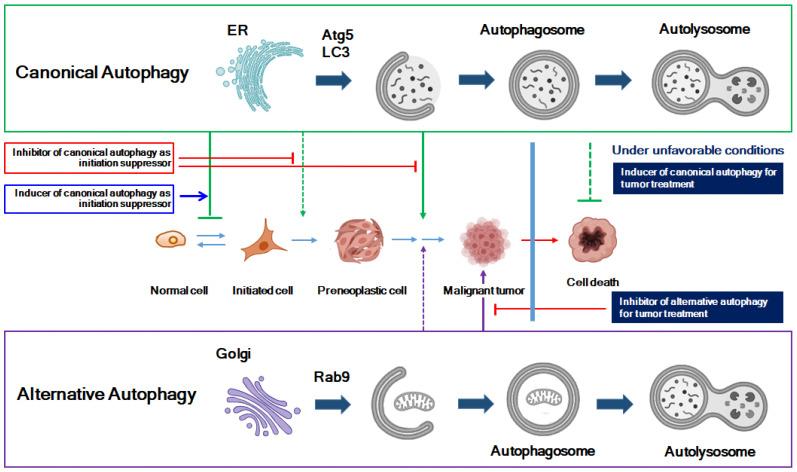
Autophagy is a crucial mechanism for recycling intracellular materials, and under normal metabolic conditions, it is maintained at low levels in cells. However, when nutrients are deficient or under hypoxic conditions, the level of autophagy significantly increases. Particularly in cancer cells, which grow more rapidly than normal cells and tend to grow in a three-dimensional manner, cells inside the cell mass often face limited oxygen supply, leading to inherently higher levels of autophagy. Therefore, the initial development of anticancer drugs targeting autophagy was based on a strategy to suppress these high levels of autophagy. However, anticancer drugs that inhibit autophagy have not shown promising results in clinical trials, as it has been revealed that autophagy does not always play a role that favors cancer cell survival. Hence, this review aims to suggest anticancer strategies based on the changes in the role of autophagy according to survival conditions and tumorigenesis stage.
自噬是细胞内物质循环的关键机制,在正常代谢条件下,细胞内自噬处于低水平。然而,当营养物质缺乏或处于缺氧条件下时,自噬水平会显著增加。特别是在癌细胞中,由于其生长速度比正常细胞快,并且往往呈三维生长方式,细胞团内的细胞常常面临有限的氧气供应,导致自噬水平本来就较高。因此,最初针对自噬的抗癌药物的开发是基于抑制这些高水平自噬的策略。然而,抑制自噬的抗癌药物在临床试验中并未显示出良好的效果,因为已经发现自噬并不总是有利于癌细胞存活的角色。因此,本综述旨在根据生存条件和肿瘤发生阶段自噬作用的变化,提出抗癌策略。

 Zotero 插件