
分析哈尔达河水中的重金属污染:孟加拉国鲤鱼鱼的独特繁殖栖息地。
Analysis of Heavy Metal Pollution in the Water of the Halda River: A Distinctive Breeding Habitat for Carp Fish in Bangladesh.
机构信息
Department of Zoology, University of Chittagong, Chattogram, Bangladesh.
Atomic Energy Centre, Chattogram, Bangladesh Atomic Energy Commission.
出版信息
Vet Med Sci. 2024 Nov;10(6):e70078. doi: 10.1002/vms3.70078.
BACKGROUND
The present study aimed to assess the heavy metal concentrations in water from different sampling sites of the Halda River, the only natural breeding ground of Indian major carps.
OBJECTIVES
We have analysed the contamination level and seasonal variations of heavy metals (viz. Fe, Cu, Zn, Cr, Cd and Pb). The favourability of the breeding environment was assessed by different contamination indices.
METHODS
Samples were collected from six sampling sites for four different seasons, and the metal concentrations were determined for water samples using Flame atomic absorption spectrophotometer.
RESULTS
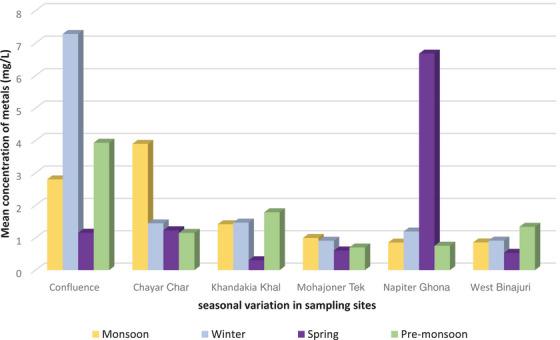
The obtained order of mean concentrations of heavy metals for four seasons was winter > spring > monsoon > pre-monsoon, and the assessed mean concentrations (mg/L) of heavy metals follow the trend: Fe (9.129) > Pb (0.033) > Zn (0.024) > Cr (0.017) > Cu (0.012) > Cd (0.002). The concentration of Fe was found above the permissible limit set by the World Health Organization (WHO) (Guidelines for Water Quality) and ECR (1997), and the concentrations for Pb were found above the USEPA (2006) limit in all four seasons. Contamination indices (heavy metal pollution Index [HPI] and metal index [MI]) indicate that during winter and monsoon, the river water metal condition is critical (HPI > 100) and the sites are moderately as well as slightly (1< MI <2) affected by the studied heavy metals. Contamination indices, such as contamination factors (C), degree of contamination (C) and the pollution load index (PLI), demonstrate the fact that Fe and Pb remarkably contaminated the studied sampling sites. The Pearson correlation matrix and the principal component analysis (PCA) revealed that the studied metals are connected by their sources, which can be geological or anthropogenic.
CONCLUSION
Urgent initiatives need to be taken, and effective strategies must be implemented to control the different sources responsible for the entry of heavy metals into the Halda River water.
背景
本研究旨在评估恒河唯一的天然印度大型鲤鱼繁殖地不同采样点的水中重金属浓度。
目的
我们分析了重金属(铁、铜、锌、铬、镉和铅)的污染水平和季节性变化。使用不同的污染指数评估了繁殖环境的适宜性。
方法
在四个不同季节从六个采样点采集水样,并使用火焰原子吸收分光光度计测定水样中的金属浓度。
结果
四个季节重金属的平均浓度顺序为冬季>春季>季风期>前季风期,评估的重金属平均浓度(mg/L)呈以下趋势:铁(9.129)>铅(0.033)>锌(0.024)>铬(0.017)>铜(0.012)>镉(0.002)。铁的浓度超过了世界卫生组织(世卫组织)(水质指南)和 ECR(1997 年)规定的允许限值,在四个季节中,铅的浓度均超过了美国环保署(USEPA)(2006 年)的限值。污染指数(重金属污染指数[HPI]和金属指数[MI])表明,在冬季和季风期,河水金属状况为临界(HPI>100),且各采样点受到所研究重金属的中度和轻度影响(1<MI<2)。污染指数,如污染因子(C)、污染程度(C)和污染负荷指数(PLI),表明铁和铅显著污染了所研究的采样点。皮尔逊相关矩阵和主成分分析(PCA)表明,所研究的金属是由其来源连接的,这些来源可能是地质的或人为的。
结论
需要采取紧急行动,并实施有效策略,以控制导致重金属进入恒河河水的不同来源。


 Zotero 插件