
联合 CO2 激光 fractional 与局部酮康唑治疗甲真菌病;一项随机对照试验。
Combined fractional CO2 laser with topical tioconazole versus Q-switched Nd-YAG laser in the treatment of onychomycosis; a randomized comparative trial.
机构信息
Dermatology Department, Kasr alainy Faculty of Medicine, Cairo University, Cairo, Egypt.
Lowell General Hospital, Lowell, MA, USA.
出版信息
Lasers Med Sci. 2024 Nov 12;39(1):274. doi: 10.1007/s10103-024-04214-9.
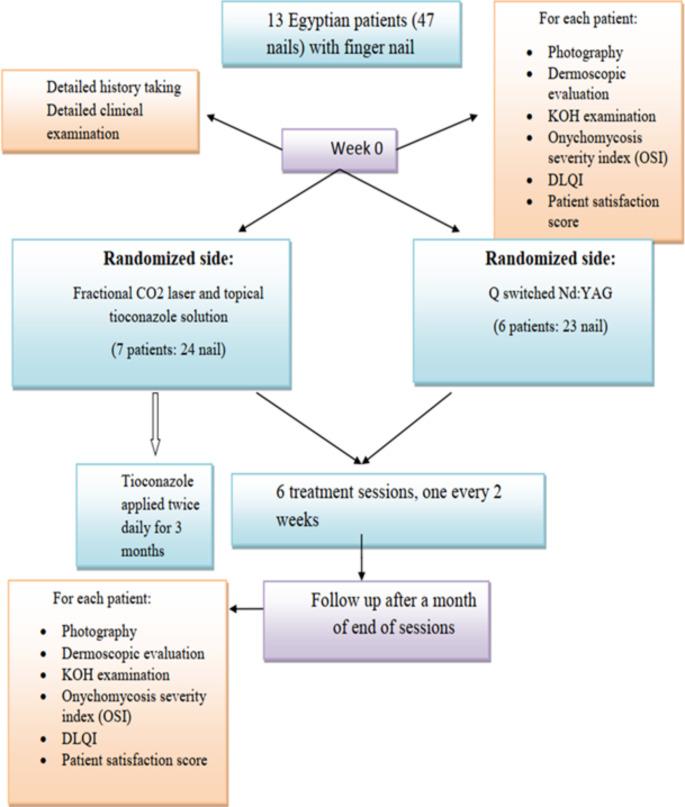
Treatment of onychomycosis includes topical and systemic agents. However, prolonged use of oral treatment could cause adverse effects and topical antifungal agents have limited penetration. To compare the clinical efficacy and the safety of fractional CO laser combined with topical tioconazole nail solution versus Q-switched 1064 Nd: YAG laser in the treatment of fingernail onychomycosis. This randomized comparative clinical trial was conducted on 13 patients (47 nails) with fingernail onychomycosis. Patients were randomized to receive either fractional CO2 laser combined with topical tioconazole or Q-Switched Nd: YAG 1064 nm laser every 2 weeks for 3 months followed by a 1-month follow up assessment. Onychomycosis severity index (OSI) score, Dermatology life Quality Index (DLQI) score, patient satisfaction score, dermoscopic evaluation and KOH examination were used for assessment of improvement. OSI showed improvement after treatment in both arms (from 16.17 to 10.92 in fractional CO2 arm (p = 0.026) and 23.13 to 22.43 (p = 0.92)). When comparing both groups OSI score significantly reduced in the fractional CO2 laser combined with tioconazole more than the Q-switched laser group (p = 0.002). The mean DLQI score significantly improved in both groups but no statistically significant difference between the two groups. Significant improvement in patient satisfaction score was noted in both groups. Mycological cure using KOH examination was detected in both groups (44.4% in the CO2 group and 56.5% in the Q-switched group) with no significant difference (P value < 0.05). Ruin pattern keratosis found to be the most dermoscopic pattern to be associated with poor OSI score improvement. Fractional CO2 laser combined with topical tioconazole is more efficient in treatment of onychomycosis than Q-Switched Nd: YAG 1064 nm laser group as regards clinical improvement but both have comparable effect on mycological cure. Their use as adjuvant treatment rather than alone is recommended to ensure mycological cure in onychomycosis.
治疗甲真菌病包括局部和全身药物治疗。然而,长期使用口服治疗可能会引起不良反应,而局部抗真菌药物的渗透有限。比较分数 CO2 激光联合局部酮康唑指甲溶液与 Q 开关 1064nmNd:YAG 激光治疗手指甲真菌病的临床疗效和安全性。这项随机对照临床试验共纳入 13 名(47 个指甲)手指甲真菌病患者。患者随机分为两组,分别接受分数 CO2 激光联合局部酮康唑或 Q 开关 1064nmNd:YAG 激光治疗,每 2 周治疗 1 次,共 3 个月,然后进行 1 个月的随访评估。采用甲真菌病严重程度指数(OSI)评分、皮肤病生活质量指数(DLQI)评分、患者满意度评分、皮肤镜评估和 KOH 检查评估改善情况。两组 OSI 评分均在治疗后改善(分数 CO2 臂从 16.17 降至 10.92(p=0.026),Q 开关激光臂从 23.13 降至 22.43(p=0.92))。比较两组时,分数 CO2 激光联合酮康唑治疗组 OSI 评分明显低于 Q 开关激光组(p=0.002)。两组患者的平均 DLQI 评分均显著改善,但两组间无统计学差异。两组患者的满意度评分均显著提高。两组患者的 KOH 检查均发现真菌学治愈(分数 CO2 组为 44.4%,Q 开关组为 56.5%),差异无统计学意义(P 值均<0.05)。角化性破坏模式被发现与 OSI 评分改善不良最相关。分数 CO2 激光联合局部酮康唑治疗甲真菌病的疗效优于 Q 开关 Nd:YAG 激光组,但在真菌学治愈率方面两者相当。建议联合使用这些治疗方法,而不是单独使用,以确保甲真菌病的真菌学治愈。



 Zotero 插件