
绝经前乳腺癌女性卵巢功能抑制的临床管理:美国临床肿瘤学会成员调查
Clinical Management of Ovarian Function Suppression in Premenopausal Women With Breast Cancer: A Survey of Members of ASCO.
作者信息
Kelly Catherine M, Bennett Kathleen E, Cahir Caitriona, Eisen Andrea, Pusztai Lajos
机构信息
Department of Medical Oncology, Mater Private Hospital, Dublin, Ireland.
School of Population Health, RCSI University of Medicine and Health Sciences, Dublin, Ireland.
出版信息
JCO Oncol Pract. 2025 May;21(5):654-662. doi: 10.1200/OP-24-00502. Epub 2024 Nov 12.
PURPOSE
Ovarian function suppression (OFS) with gonadotropin-releasing hormone agonists (GnRHas) is a standard of care for premenopausal patients with high-risk stage II/III hormone receptor-positive breast cancer (BC). Practical guidance on the optimal choice of GnRHa, timing, schedule, and monitoring is limited. Our aim was to determine how oncologists use OFS in routine care.
METHODS
We designed a questionnaire to determine the choice of GnRHa, schedule, duration, initiation, use of bone modifiers, and monitoring of estradiol (E2). The questionnaire was sent to oncologists treating BC, in practice for >1 year and participating in the ASCO Research Survey Pool (RSP). It was also forwarded by investigators to oncologists meeting these criteria. The survey was open between November 14, 2023, and January 5, 2024.
RESULTS
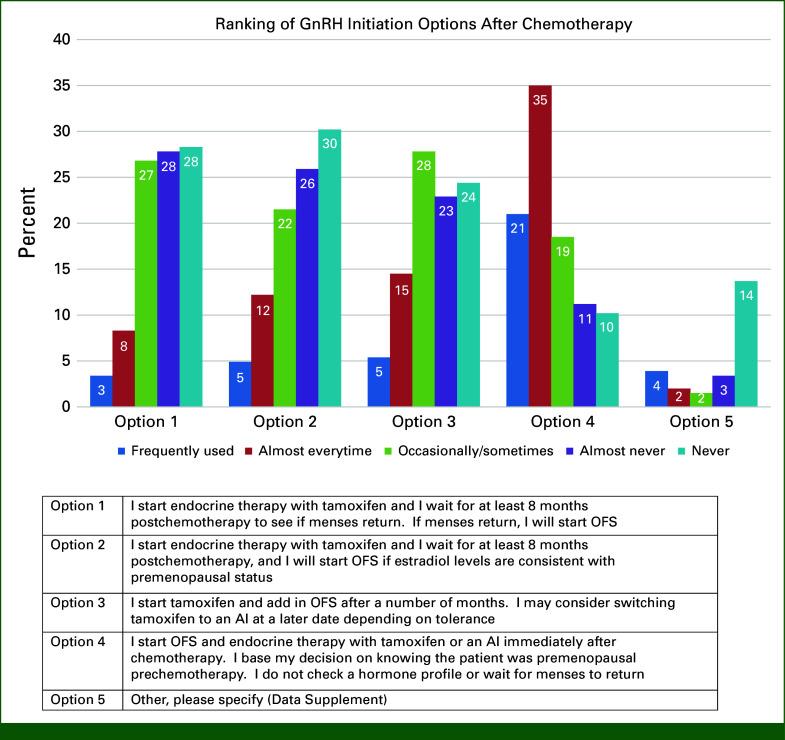
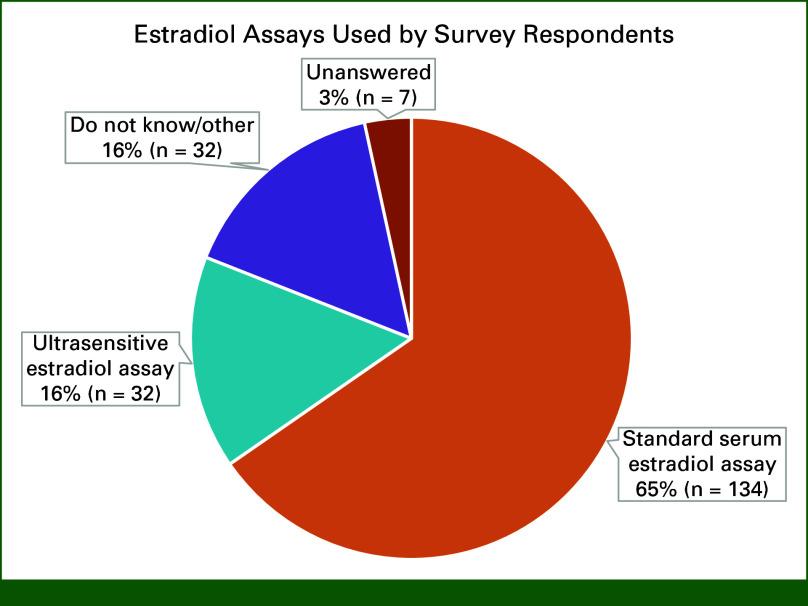
Of 996 oncologists participating in the ASCO RSP, 178 (18%) completed the survey. An additional 56 oncologists contacted by investigators responded. Respondents were from the United States (57%), Asia (15%), and Europe (14%). Goserelin (54%) and leuprolide (39%) were the most frequently used GnRHas and were administered once every month by 46%. Approaches to starting GnRHas were varied. Most continued them for the duration of aromatase inhibitor therapy (57%). Estradiol monitoring was performed regularly, sometimes, or never by 43%, 27%, and 27%, respectively. The E2 assays used were standard (65%), ultrasensitive (16%), and unknown (14%). Interpreting E2 assay results were considered difficult by 55%; however, 62% of oncologists changed treatment on the basis of them. A total of 92% of respondents would like ASCO guidance on the practical use of OFS.
CONCLUSION
Considerable practice variation exists for similar clinical scenarios in OFS administration. Respondents would welcome ASCO guidance on all aspects of OFS.
目的
对于绝经前高危II/III期激素受体阳性乳腺癌(BC)患者,使用促性腺激素释放激素激动剂(GnRHas)进行卵巢功能抑制(OFS)是一种标准治疗方法。关于GnRHa的最佳选择、时机、给药方案和监测的实用指南有限。我们的目的是确定肿瘤学家在常规治疗中如何使用OFS。
方法
我们设计了一份问卷,以确定GnRHa的选择、给药方案、持续时间、起始时间、骨改良剂的使用以及雌二醇(E2)的监测。该问卷发送给从事BC治疗、从业超过1年且参与美国临床肿瘤学会研究调查池(RSP)的肿瘤学家。研究人员也将问卷转发给符合这些标准的肿瘤学家。调查于2023年11月14日至2024年1月5日开放。
结果
在参与ASCO RSP的996名肿瘤学家中,178名(18%)完成了调查。研究人员联系的另外56名肿瘤学家进行了回复。受访者来自美国(57%)、亚洲(15%)和欧洲(14%)。戈舍瑞林(54%)和亮丙瑞林(39%)是最常用的GnRHas,46%的人每月给药一次。开始使用GnRHas的方法各不相同。大多数人在芳香化酶抑制剂治疗期间持续使用(57%)。分别有43%、27%和27%的人定期、有时或从不进行雌二醇监测。所使用的E2检测方法为标准方法(65%)、超敏方法(16%)和未知方法(14%)。55%的人认为解读E2检测结果困难;然而,62%的肿瘤学家会根据检测结果改变治疗方案。共有92%的受访者希望ASCO提供关于OFS实际应用的指南。
结论
在OFS给药的类似临床场景中存在相当大的实践差异。受访者欢迎ASCO就OFS的各个方面提供指南。



 Zotero 插件