
替沙格韦单抗-西加韦单抗预防透析患者新冠病毒突破性感染的前瞻性研究
Tixagevimab-cilgavimab for preventing breakthrough COVID-19 in dialysis patients: a prospective study.
作者信息
Boongird Sarinya, Srithongkul Thatsaphan, Sethakarun Sethanant, Bruminhent Jackrapong, Kiertiburanakul Sasisopin, Nongnuch Arkom, Kitiyakara Chagriya, Sritippayawan Suchai
机构信息
D ivision of Nephrology, Department of Medicine, Faculty of Medicine Ramathibodi Hospital, Mahidol University, Bangkok, Thailand.
Division of Nephrology, Department of Medicine, Faculty of Medicine Siriraj Hospital, Mahidol University, Bangkok, Thailand.
出版信息
Clin Kidney J. 2024 Oct 18;17(11):sfae309. doi: 10.1093/ckj/sfae309. eCollection 2024 Nov.
BACKGROUND
The effectiveness of tixagevimab-cilgavimab as pre-exposure prophylaxis (PrEP) against breakthrough coronavirus disease 2019 (COVID-19) in dialysis patients remains uncertain due to limited data.
METHODS
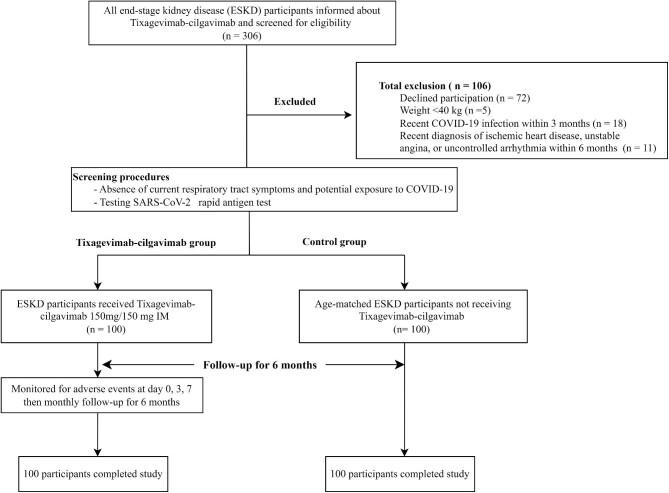
In this multicenter prospective study, we enrolled vaccinated dialysis patients and divided them into two groups: a tixagevimab-cilgavimab group (received a 150 mg/150 mg intramuscular dose of tixagevimab-cilgavimab) and a control group (age-matched patients not receiving tixagevimab-cilgavimab). The primary outcome was the breakthrough COVID-19 rate at 6 months, whereas secondary outcomes included COVID-19-related hospitalization, intensive care unit admission, endotracheal intubation and mortality. The safety of tixagevimab-cilgavimab was assessed.
RESULTS
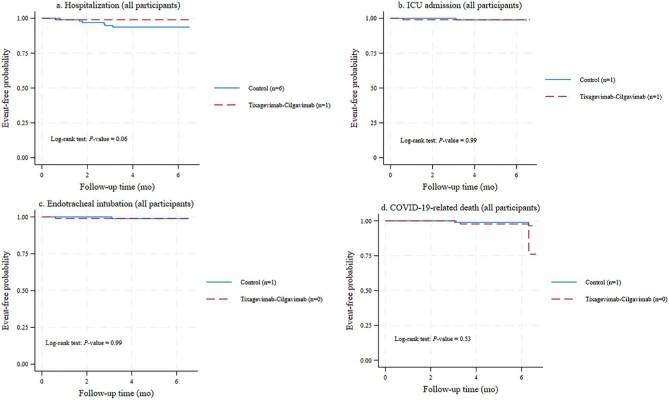
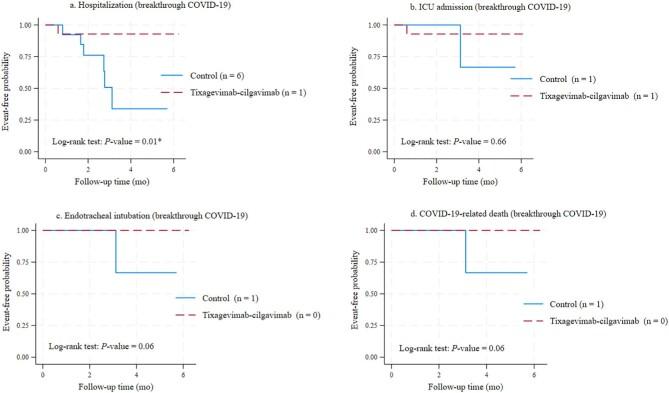
Two hundred participants were enrolled, with equal numbers in each group ( = 100 each). Baseline characteristics were comparable between groups, except for a higher number of COVID-19 vaccine doses in the tixagevimab-cilgavimab group [median (IQR) 4 (3-5) vs. 3 (3-4); = .01]. At 6 months, the breakthrough COVID-19 rates were comparable between the tixagevimab-cilgavimab (17%) and control (15%) groups ( = .66). However, the median (IQR) time to diagnosis of breakthrough infections tended to be longer in the tixagevimab-cilgavimab group [4.49 (2.81-4.98) vs 1.96 (1.65-2.91) months; = .08]. Tixagevimab-cilgavimab significantly reduced COVID-19-related hospitalization rates (5.9% vs 40.0%; = .02) among participants with breakthrough infections. All tixagevimab-cilgavimab-related adverse events were mild.
CONCLUSION
The use of tixagevimab-cilgavimab as PrEP in vaccinated dialysis patients during the Omicron surge did not prevent breakthrough infections but significantly reduced COVID-19-related hospitalizations. Further research should prioritize alternative strategies.
背景
由于数据有限,替沙格韦单抗-西加韦单抗作为透析患者暴露前预防(PrEP)预防2019冠状病毒病(COVID-19)突破性感染的有效性仍不确定。
方法
在这项多中心前瞻性研究中,我们招募了接种疫苗的透析患者,并将他们分为两组:替沙格韦单抗-西加韦单抗组(接受150mg/150mg替沙格韦单抗-西加韦单抗肌肉注射剂量)和对照组(未接受替沙格韦单抗-西加韦单抗的年龄匹配患者)。主要结局是6个月时的突破性COVID-19感染率,次要结局包括与COVID-19相关的住院、重症监护病房收治、气管插管和死亡率。评估了替沙格韦单抗-西加韦单抗的安全性。
结果
共招募了200名参与者,每组人数相等(每组n = 100)。两组之间的基线特征具有可比性,但替沙格韦单抗-西加韦单抗组的COVID-19疫苗接种剂量较多[中位数(IQR)4(3-5)vs. 3(3-4);P = 0.01]。在6个月时,替沙格韦单抗-西加韦单抗组(17%)和对照组(15%)的突破性COVID-19感染率具有可比性(P = 0.66)。然而,替沙格韦单抗-西加韦单抗组突破性感染的诊断中位(IQR)时间往往更长[4.49(2.81-4.98)个月vs 1.96(1.65-2.91)个月;P = 0.08]。替沙格韦单抗-西加韦单抗显著降低了突破性感染参与者中与COVID-19相关的住院率(5.9% vs 40.0%;P = 0.02)。所有与替沙格韦单抗-西加韦单抗相关的不良事件均为轻度。
结论
在奥密克戎毒株激增期间,在接种疫苗的透析患者中使用替沙格韦单抗-西加韦单抗作为PrEP并不能预防突破性感染,但显著降低了与COVID-19相关的住院率。进一步的研究应优先考虑替代策略。

 Zotero 插件