
针刺对房颤患者生活质量的影响:一项随机对照试验的研究方案。
Effect of acupuncture on quality of life in atrial fibrillation: study protocol for a randomised controlled trial.
机构信息
International Acupuncture and Moxibustion Innovation Institute, School of Acupuncture-Moxibustion and Tuina, Beijing University of Chinese Medicine, Beijing, China.
The First Teaching Hospital of Tianjin University of Traditional Chinese Medicine, Tianjin, China.
出版信息
BMJ Open. 2024 Nov 14;14(11):e087460. doi: 10.1136/bmjopen-2024-087460.
INTRODUCTION
Atrial fibrillation (AF) is the prevalent cardiac arrhythmia and can significantly impair the quality of life (QoL). Although catheter ablation (CA) is an established treatment for AF,post-procedural complications or perceived inadequate control of AF may diminish the QoL for some patients, potentially even to levels lower than pre-procedure. Preliminary findings from our previous pilot trial indicate that acupuncture may positively influence QoL in AF patients post-CA. This study aims to increase the sample size to evaluate the efficacy of acupuncture as an adjunctive treatment to conventional medical therapy in improving QoL of patients with AF after CA.
METHODS AND DESIGN
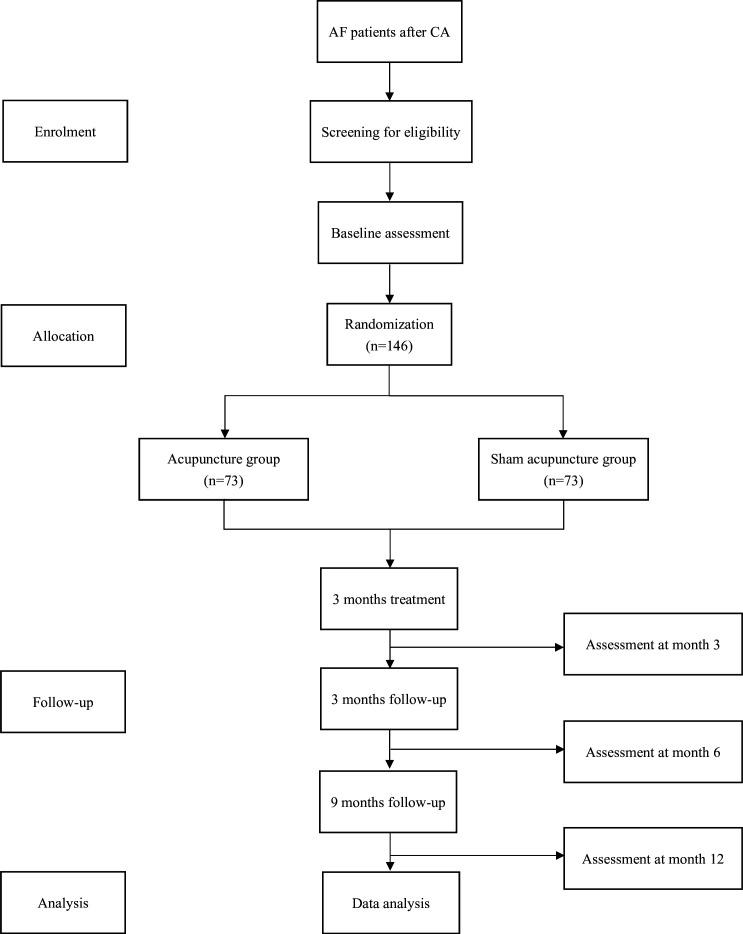
This multicentre randomised clinical trial will be conducted in China. A total of 146 eligible patients will be randomly assigned in a 1:1 ratio to either the acupuncture group or the sham acupuncture group. All patients will receive standard postablation care and undergo 18 sessions of acupuncture/sham acupuncture within 12 weeks following CA, followed by a 9-month follow-up period. The primary outcome is the change in the Atrial Fibrillation Effect on Quality-of-Life (AFEQT) summary score from baseline to months 6 after CA. Secondary outcomes include the changes in the AFEQT subscale scores at months 6, the AFEQT summary and subscale score at months 3 and 12, AF burden, AF recurrence, heart rate variability, number of cardioversions, repeat CA procedures, European Heart Rhythm Association score, number of arrhythmia-related hospitalisations, average heart rate, use of Six-Dimensional Health State Short Form to assess health status, costs incurred by disease treatment, Credibility/Expectancy Questionnaire and blinded assessments. Adverse events will also be meticulously recorded throughout the trial.
ETHICS AND DISSEMINATION
Ethics approval has been granted by the Ethics Committee of Beijing University of Traditional Chinese Medicine (approval no: 2020BZYLL0802) and seven other subcentres. The findings of the study results will be disseminated through presentations at scientific conferences or publications in peer-reviewed journals.
TRIAL REGISTRATION NUMBER
ChiCTR2100049323.
简介
心房颤动(AF)是一种常见的心律失常,可显著降低生活质量(QoL)。虽然导管消融(CA)是治疗 AF 的一种既定方法,但术后并发症或认为 AF 控制不理想可能会降低某些患者的 QoL,甚至可能降至低于术前水平。我们之前的一项初步研究结果表明,针刺可能会对 CA 后 AF 患者的 QoL 产生积极影响。本研究旨在增加样本量,以评估针刺作为辅助治疗在改善 CA 后 AF 患者生活质量方面的疗效。
方法和设计
这是一项在中国进行的多中心随机临床试验。将 146 名符合条件的患者以 1:1 的比例随机分配至针刺组或假针刺组。所有患者将接受标准消融后护理,并在 CA 后 12 周内接受 18 次针刺/假针刺治疗,随后进行 9 个月的随访。主要结局是从 CA 后 6 个月时的房颤对生活质量的影响(AFEQT)综合评分的变化。次要结局包括 6 个月时 AFEQT 亚量表评分的变化、3 个月和 12 个月时 AFEQT 综合和亚量表评分、房颤负荷、房颤复发、心率变异性、电复律次数、重复 CA 程序、欧洲心律协会评分、心律失常相关住院次数、平均心率、使用六维度健康状态简短量表评估健康状况、疾病治疗费用、可信度/期望问卷和盲法评估。整个试验过程中还将仔细记录不良事件。
伦理和传播
北京中医药大学伦理委员会(批准号:2020BZYLL0802)和其他七个分中心已批准该研究。研究结果将通过在科学会议上的演讲或在同行评议期刊上的发表进行传播。
试验注册号
ChiCTR2100049323。
 Zotero 插件