
美国国立卫生与临床优化研究所膝关节骨关节炎诊断临床标准:一项针对2型糖尿病患者的前瞻性诊断准确性研究
National Institute of Health and Care Excellence Clinical Criteria for the Diagnosis of Knee Osteoarthritis: A Prospective Diagnostic Accuracy Study in Individuals With Type 2 Diabetes.
作者信息
King Lauren K, Stanaitis Ian, Hung Vivian, Koppikar Sahil, Waugh Esther J, Lipscombe Lorraine, Hawker Gillian A
机构信息
University of Toronto and St. Michael's Hospital, Unity Health, Toronto, Canada.
Women's College Hospital, Toronto, Canada.
出版信息
Arthritis Care Res (Hoboken). 2025 May;77(5):623-630. doi: 10.1002/acr.25464. Epub 2024 Dec 29.
OBJECTIVE
The National Institute of Health and Care Excellence (NICE) criteria for osteoarthritis (OA) obviate the need for physical examination or imaging, and their use may improve timely diagnosis of OA. However, they have not been validated.
METHODS
Within a larger study of individuals with type 2 diabetes, participants with and without self-reported knee pain underwent assessment of the NICE criteria for knee OA by questionnaire (index test) and clinical evaluation for established or possible knee OA by a rheumatologist (reference standard). We calculated the sensitivity, specificity, likelihood ratio positive (LR+), and likelihood ratio negative (LR-) of the NICE criteria and modified NICE criteria without the stiffness criterion.
RESULTS
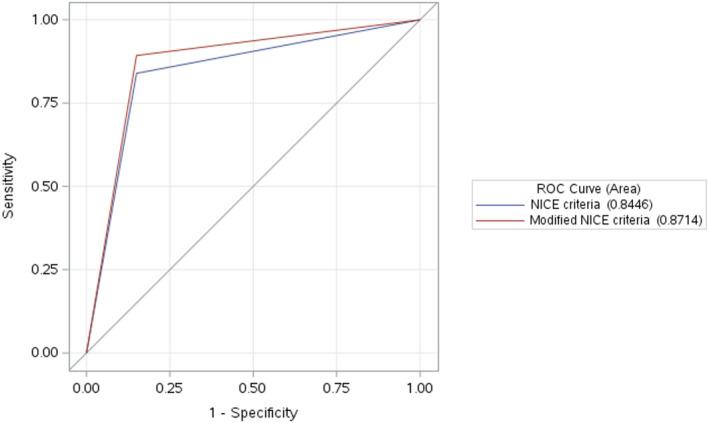
Our study included 96 participants: the mean ± SD age was 65.4 ± 8.3 years and 52% were women. Individuals who fulfilled the NICE criteria for knee OA (55.2%) included a spectrum of pain severity on an 11-point pain numeric rating scale with a median score of 5 (range 1-9). Rheumatologist assessment identified 56 participants (58.3%) with symptomatic knee OA. The sensitivity, specificity, LR+, and LR- of the NICE criteria for symptomatic knee OA were 0.84 (95% confidence interval [CI] 0.74-0.94), 0.85 (95% CI 0.74-0.96), 5.6, and 0.19, respectively. For the modified NICE criteria, these were 0.89 (95% CI 0.82-0.97), 0.85 (95% CI 0.74-0.96), 5.93, and 0.13.
CONCLUSION
The NICE criteria have high sensitivity and specificity for detecting symptomatic knee OA in a population with type 2 diabetes. We found that a modified version, omitting the stiffness criterion, performed similarly. These criteria should be validated in other settings and populations.
目的
英国国家卫生与临床优化研究所(NICE)的骨关节炎(OA)标准无需进行体格检查或影像学检查,使用这些标准可能会改善OA的及时诊断。然而,它们尚未得到验证。
方法
在一项针对2型糖尿病患者的更大规模研究中,有和没有自我报告膝关节疼痛的参与者通过问卷(索引测试)对膝关节OA的NICE标准进行评估,并由风湿病学家通过临床评估确定是否存在已确诊或可能的膝关节OA(参考标准)。我们计算了NICE标准以及不包括僵硬标准的改良NICE标准的敏感性、特异性、阳性似然比(LR+)和阴性似然比(LR-)。
结果
我们的研究纳入了96名参与者:平均年龄±标准差为65.4±8.3岁,52%为女性。符合膝关节OA的NICE标准的个体(55.2%)在11点疼痛数字评分量表上的疼痛严重程度范围广泛,中位数为5分(范围1-9)。风湿病学家评估确定56名参与者(58.3%)患有症状性膝关节OA。症状性膝关节OA的NICE标准的敏感性、特异性、LR+和LR-分别为0.84(95%置信区间[CI]0.74-0.94)、0.85(95%CI0.74-0.96)、5.6和0.19。对于改良的NICE标准,这些值分别为0.89(95%CI0.82-0.97)、0.85(95%CI0.74-0.96)、5.9 和0.13。
结论
NICE标准在检测2型糖尿病患者中的症状性膝关节OA方面具有较高的敏感性和特异性。我们发现省略僵硬标准后的改良版本表现相似。这些标准应在其他环境和人群中进行验证。

 Zotero 插件