
随机对照临床试验中缺失的结局数据:主要精神病学期刊发表的试验报告综述。
Missing outcome data in randomised clinical trials of psychological interventions: a review of published trial reports in major psychiatry journals.
机构信息
Copenhagen Trial Unit, Centre for Clinical Intervention Research, The Capital Region, Copenhagen University Hospital, Rigshospitalet, Copenhagen, Denmark.
Stolpegaard Psychotherapy Centre, Mental Health Services in the Capital Region of Denmark, Gentofte, Denmark.
出版信息
BMC Psychiatry. 2024 Nov 14;24(1):798. doi: 10.1186/s12888-024-06263-4.
BACKGROUND
Missing outcome data can pose a serious threat to the validity of randomised clinical trial results. We aimed to study the extent of missing outcome data in randomised clinical trials of psychological interventions.
METHODS
We performed a retrospective study of randomised clinical trial reports of psychological interventions published in World Psychiatry, JAMA Psychiatry, Lancet Psychiatry, American Journal of Psychiatry, British Journal of Psychiatry, or Psychotherapy and Psychosomatics from 2017 to 2022. We assessed the proportion of missing outcome data, whether missing data patterns differed between types of outcomes, participants, intervention lengths, and psychological intervention types, how missing outcome data were handled in the statistical analyses, and whether trialists discussed missing outcome data in the discussion section of the manuscript.
RESULTS
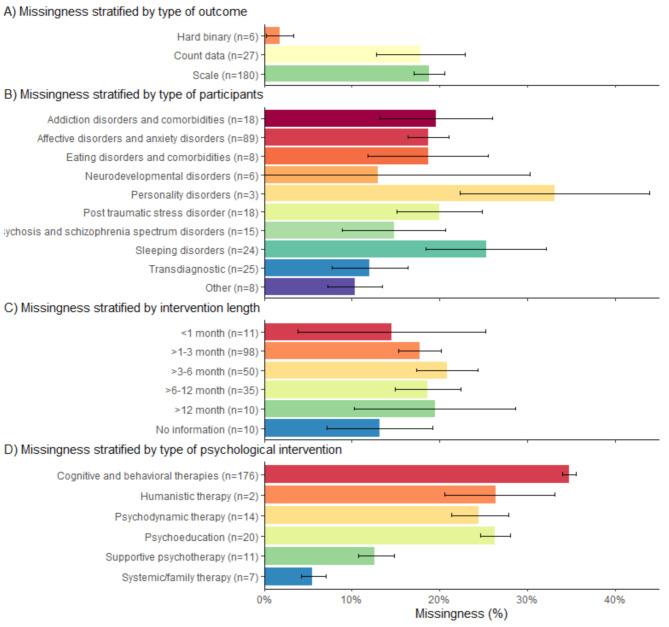
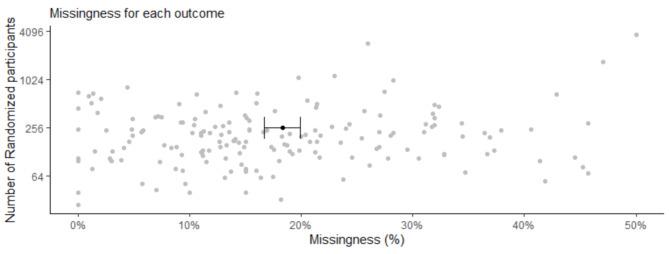
We identified 182 randomised clinical trials (233 primary outcomes), of which 206 outcomes (88.4%) were assessed at high risk of bias due to missing data. The overall mean percentage of missing outcome data was 18.3% (95% confidence interval (CI): 16.7-20%) for all outcomes. The percentages of missing data were 18.9% (95% CI: 17.1-20.6%; 180 outcomes) for symptom severity scales and 1.8% (95% CI: 2.3-3.3%; 6 outcomes) for 'hard' binary outcomes. Trials including participants with borderline personality disorder had the highest percentage of missing outcome data (33.1%; 95% CI: 22.3-43.9%) compared with other psychiatric disorders. Fisher's exact test showed that intervention lengths and psychological intervention types were associated with the proportion of missing outcome data (p < 0.001), but there were no clear patterns.
CONCLUSION
Missing outcome data is a considerable problem in randomised clinical trials of psychological interventions, and trialists should consider the corresponding methodological limitations in the design and analysis to reduce the risk of bias due to missing outcome data.
CLINICAL TRIAL REGISTRATION NUMBER
Not applicable.
背景
缺失的结局数据可能对随机临床试验结果的有效性构成严重威胁。我们旨在研究心理干预随机临床试验中缺失结局数据的程度。
方法
我们对 2017 年至 2022 年期间在《世界精神病学杂志》、《美国医学会精神病学杂志》、《柳叶刀精神病学杂志》、《美国精神病学杂志》、《英国精神病学杂志》或《心理治疗与身心医学》上发表的心理干预随机临床试验报告进行了回顾性研究。我们评估了缺失结局数据的比例、缺失数据模式是否因结局类型、参与者、干预时长和心理干预类型而不同、缺失结局数据在统计分析中是如何处理的,以及试验者是否在论文的讨论部分讨论了缺失结局数据。
结果
我们确定了 182 项随机临床试验(233 个主要结局),其中 206 个结局(88.4%)由于缺失数据而存在较高的偏倚风险。所有结局的缺失结局数据的总体平均百分比为 18.3%(95%置信区间:16.7-20%)。症状严重程度量表的缺失数据百分比为 18.9%(95%置信区间:17.1-20.6%;180 个结局),“硬”二分结局的缺失数据百分比为 1.8%(95%置信区间:2.3-3.3%;6 个结局)。与其他精神障碍相比,包括边缘型人格障碍患者的试验具有最高的缺失结局数据百分比(33.1%;95%置信区间:22.3-43.9%)。Fisher 确切检验显示,干预时长和心理干预类型与缺失结局数据的比例相关(p<0.001),但没有明显的模式。
结论
在心理干预的随机临床试验中,缺失结局数据是一个相当严重的问题,试验者在设计和分析时应考虑相应的方法学限制,以降低因缺失结局数据导致的偏倚风险。
临床试验注册号
不适用。
 Zotero 插件