
美国成年人饮食类黄酮摄入与骨密度和骨质疏松症的关系:来自 NHANES 2007-2008、2009-2010 和 2017-2018 年的数据。
The association between dietary flavonoid intake and bone mineral density and osteoporosis in US adults: data from NHANES 2007-2008, 2009-2010 and 2017-2018.
机构信息
Department of Orthopedics, Shengjing Hospital of China Medical University, Shenyang, China.
Department of Anesthesiology, Shengjing Hospital of China Medical University, Shenyang, China.
出版信息
BMC Public Health. 2024 Nov 14;24(1):3168. doi: 10.1186/s12889-024-20700-9.
BACKGROUND
Epidemiological studies investigating the association between flavonoid intake and bone mineral density (BMD) draw inconsistent conclusions. Our study aims to investigate the association between flavonoid intake and BMD and osteoporosis and the mediating role of composite dietary antioxidant index (CDAI) in their relationship using data from the National Health and Nutrition Examination Survey (NHANES).
METHODS
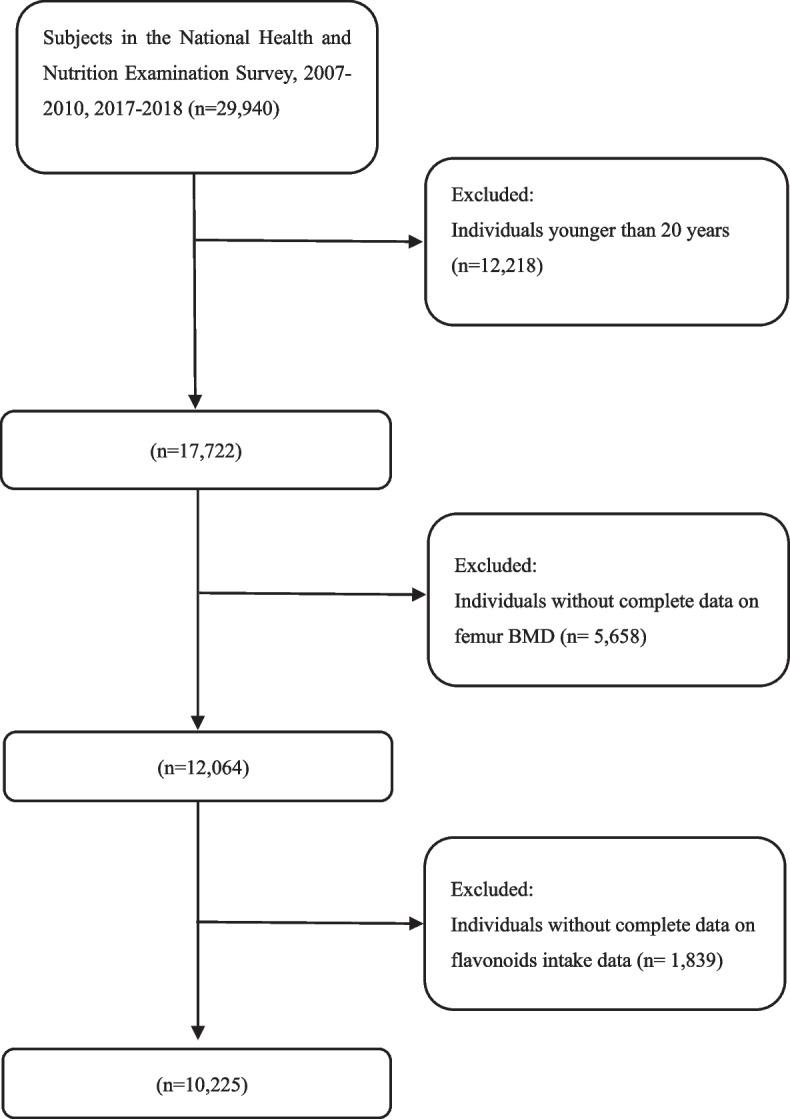
The study assessed the relationship between flavonoid intake and femur BMD and osteoporosis in 10,225 individuals from NHANES 2007-2010 and 2017-2018. Multivariable linear regression analyses were used to detect the association between flavonoid intake and femur BMD in adult Americans. Restricted cubic splines (RCS) were used to examine the nonlinear relationship between flavonoid intake and their subclasses and osteoporosis risk in individuals 20 years or older. We explored the mediating role of CDAI in the association between flavonoid intake and BMD.
RESULTS
In fully adjusted multivariable regression analyses, compared with people in the first quartile, people in the fourth quartile of total flavonoid intake have a higher BMD at total femur (0.013, 95% CI: 0.004, 0.022, P = 0.001), femur neck (0.010, 95% CI: 0.004, 0.017, P = 0.001), trochanter (0.010, 95% CI: 0.004, 0.017, P = 0.001), and intertrochanter (0.012, 95% CI: 0.003, 0.020, P = 0.006). The positive relationship between flavonoid intake and femur BMD was present in both sexes. Furthermore, we found that people in the fourth quartile of total flavonoid intake have a lower risk of osteoporosis compared with the first quartile (OR = 0.686, 95% CI: 0.528-0.890, P = 0.005). RCS found a linear inverse relationship between total flavonoid intake and osteoporosis in individuals ≥ 20 years (Overall P = 0.015, nonlinear P = 0.086). Moreover, CDAI partially mediates the association of total flavonoid intake with femur BMD.
CONCLUSIONS
Our findings suggest that higher flavonoid intake is associated with higher BMD and lower risk of osteoporosis in Americans. Furthermore, we found distinct associations between different flavonoid subclasses and osteoporosis risk. More studies with stronger evidence are needed to explore the causal association between flavonoid intake and bone health and their underlying mechanisms.
背景
流行病学研究调查了黄酮类化合物摄入与骨矿物质密度(BMD)之间的关系,但得出的结论并不一致。我们的研究旨在使用来自国家健康和营养检查调查(NHANES)的数据,调查黄酮类化合物摄入与 BMD 和骨质疏松症之间的关系,以及复合膳食抗氧化指数(CDAI)在它们关系中的中介作用。
方法
本研究评估了 2007-2010 年和 2017-2018 年 NHANES 中 10225 名成年人黄酮类化合物摄入与股骨 BMD 和骨质疏松症之间的关系。多变量线性回归分析用于检测成年美国人黄酮类化合物摄入与股骨 BMD 之间的关系。受限三次样条(RCS)用于检查黄酮类化合物摄入及其亚类与 20 岁或以上个体骨质疏松症风险之间的非线性关系。我们探讨了 CDAI 在黄酮类化合物摄入与 BMD 之间关联中的中介作用。
结果
在完全调整的多变量回归分析中,与第 1 四分位组相比,第 4 四分位组的总黄酮类化合物摄入更高的总股骨 BMD(0.013,95%CI:0.004,0.022,P=0.001),股骨颈(0.010,95%CI:0.004,0.017,P=0.001),转子(0.010,95%CI:0.004,0.017,P=0.001)和转子间(0.012,95%CI:0.003,0.020,P=0.006)。黄酮类化合物摄入与股骨 BMD 之间的正相关关系在两性中均存在。此外,我们发现与第 1 四分位组相比,第 4 四分位组的总黄酮类化合物摄入者骨质疏松症的风险较低(OR=0.686,95%CI:0.528-0.890,P=0.005)。RCS 发现总黄酮类化合物摄入与 20 岁及以上个体骨质疏松症之间存在线性反比关系(总体 P=0.015,非线性 P=0.086)。此外,CDAI 部分介导了总黄酮类化合物摄入与股骨 BMD 之间的关联。
结论
我们的研究结果表明,较高的黄酮类化合物摄入与美国人更高的 BMD 和较低的骨质疏松症风险相关。此外,我们发现不同黄酮类化合物亚类与骨质疏松症风险之间存在明显的关联。需要更多具有更强证据的研究来探索黄酮类化合物摄入与骨骼健康及其潜在机制之间的因果关系。

 Zotero 插件