
普通人群、心力衰竭患者和肢端肥大症患者的胰岛素样生长因子-1水平:荟萃分析的差异与预测——双重视角
IGF-1 levels in the general population, heart failure patients, and individuals with acromegaly: differences and projections from meta-analyses-a dual perspective.
作者信息
Hu Yan, Jiang Yinling, Duan Lixia, Yang Songwei, Tuniyazi Subinur, Zou Jianghua, Ma Rui, Muhemaitibieke Gulina, Amuti Xiayidanguli, Guo Yanying
机构信息
Department of Endocrinology, People's Hospital of Xinjiang Uygur Autonomous Region, Xinjiang Clinical Research Center for Diabetes, Urumqi, China.
出版信息
Front Cardiovasc Med. 2024 Oct 31;11:1379257. doi: 10.3389/fcvm.2024.1379257. eCollection 2024.
BACKGROUND
The complex relationship between insulin-like growth factor 1 (IGF-1) levels and heart failure (HF) is not fully understood, particularly across different populations and conditions. This meta-analysis aims to elucidate the dual perspectives of IGF-1 levels in the general population, HF patients, and individuals with treatment-naïve acromegaly, highlighting IGF-1 as a biomarker and potential therapeutic target in HF management.
METHODS
Studies were searched across multiple electronic databases up to January 2024 and independently identified by reviewers. The outcomes were analyzed using RevMan 5.4 and STATA 15.
RESULTS
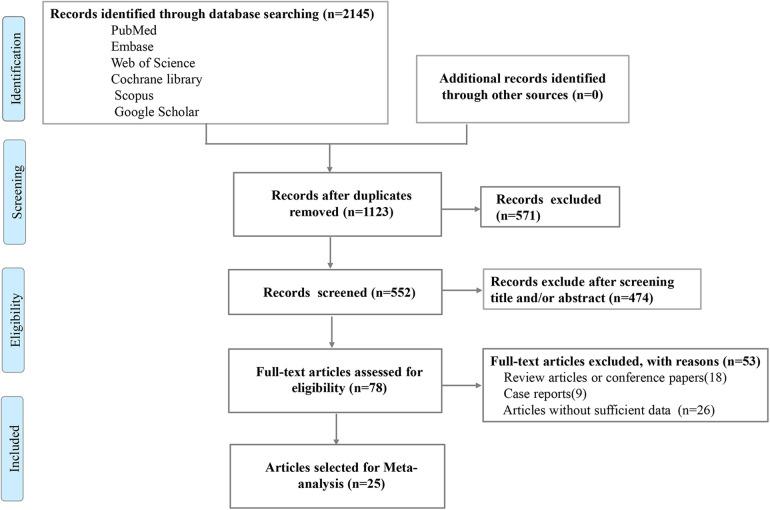
A total of 25 articles were ultimately included in the analysis. Six studies compared IGF-1 levels between HF patients and non-HF controls, revealing significantly lower IGF-1 levels in HF patients (mean difference -20.93; 95% CI -37.88 to -3.97; = 0.02). This reduction was consistent across various HF subtypes and severities. In addition, individuals with intermediate IGF-1 levels had a lower risk of developing HF [risk ratio (RR) 0.78; 95% CI 0.74-0.83; < 0.01] and HF-related mortality (RR 0.98; 95% CI 0.97, 0.99; < 0.01) compared to those with low IGF-1 levels, suggesting a protective role for maintaining adequate IGF-1 levels. Conversely, treatment-naïve acromegaly patients, characterized by excessively high IGF-1 levels, showed a significantly higher incidence of both diastolic HF [odds ratio (OR) 9.08; 95% CI 6.20-13.29; < 0.01] and systolic HF (OR 13.1; 95% CI 6.64-25.84; < 0.01), implicating supraphysiological IGF-1 levels in adverse cardiac outcomes.
CONCLUSIONS
Our meta-analysis highlights the complex interplay between IGF-1 levels and HF. We found that reduced IGF-1 levels are commonly observed in HF patients and are associated with an increased risk of HF and higher HF-related mortality. Conversely, excessively high levels, as observed in acromegaly, are linked to a higher incidence of HF. Based on these results, it is recommended that cardiac function be closely monitored in patients with reduced IGF-1 levels and in those with acromegaly. These findings suggest that IGF-1 could hold potential prognostic value for risk stratification in HF.
背景
胰岛素样生长因子1(IGF-1)水平与心力衰竭(HF)之间的复杂关系尚未完全明确,尤其是在不同人群和情况下。本荟萃分析旨在阐明IGF-1水平在普通人群、HF患者以及未经治疗的肢端肥大症患者中的双重作用,强调IGF-1作为HF管理中的生物标志物和潜在治疗靶点。
方法
检索了截至2024年1月的多个电子数据库中的研究,并由评审人员独立识别。使用RevMan 5.4和STATA 15对结果进行分析。
结果
最终共有25篇文章纳入分析。六项研究比较了HF患者和非HF对照者的IGF-1水平,发现HF患者的IGF-1水平显著降低(平均差异-20.93;95%可信区间-37.88至-3.97;P = 0.02)。这种降低在各种HF亚型和严重程度中均一致。此外,与IGF-1水平低的个体相比,IGF-1水平中等的个体发生HF的风险较低[风险比(RR)0.78;95%可信区间0.74 - 0.83;P < 0.01]以及HF相关死亡率较低(RR 0.98;95%可信区间0.97,0.99;P < 0.01),这表明维持适当的IGF-1水平具有保护作用。相反,未经治疗的肢端肥大症患者,其特征是IGF-1水平过高,舒张性HF[优势比(OR)9.08;95%可信区间6.20 - 13.29;P < 0.01]和收缩性HF(OR 13.1;95%可信区间6.64 - 25.84;P < 0.01)的发生率均显著更高,这意味着超生理水平的IGF-1与不良心脏结局有关。
结论
我们的荟萃分析突出了IGF-1水平与HF之间的复杂相互作用。我们发现HF患者中常见IGF-1水平降低,且与HF风险增加和更高的HF相关死亡率相关。相反,如肢端肥大症中观察到的过高水平与HF的更高发生率相关。基于这些结果,建议对IGF-1水平降低的患者和肢端肥大症患者密切监测心脏功能。这些发现表明IGF-1可能对HF的风险分层具有潜在的预后价值。


 Zotero 插件