
生理动力学在预测重度抑郁症严重程度中的作用。
Contribution of physiological dynamics in predicting major depressive disorder severity.
作者信息
Pagès Esther García, Kontaxis Spyridon, Siddi Sara, Miguel Mar Posadas-de, de la Cámara Concepción, Bernal Maria Luisa, Ribeiro Thais Castro, Laguna Pablo, Badiella Llorenç, Bailón Raquel, Haro Josep Maria, Aguiló Jordi
机构信息
Department de Microelectrònica i Sistemes electrònics, Universitat Autònoma de Barcelona, Cerdanyola del Vallès, Spain.
Centro de Investigación Biomédica en Red de Bioingeniería, Biomateriales y Nanomedicina, Madrid, Spain.
出版信息
Psychophysiology. 2025 Feb;62(2):e14729. doi: 10.1111/psyp.14729. Epub 2024 Nov 17.
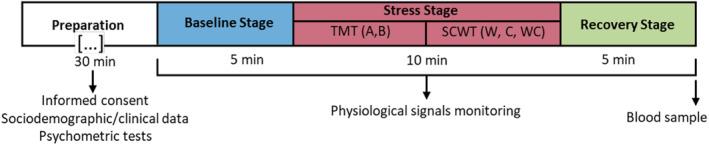
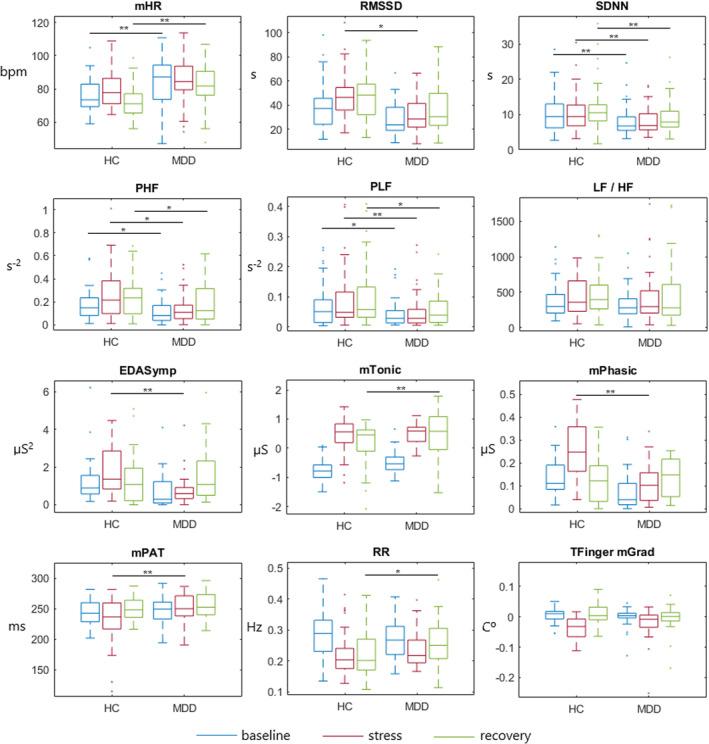
This study aimed to explore the physiological dynamics of cognitive stress in patients with Major Depressive Disorder (MDD) and design a multiparametric model for objectively measuring severity of depression. Physiological signal recordings from 40 MDD patients and 40 healthy controls were collected in a baseline stage, in a stress-inducing stage using two cognitive tests, and in the recovery period. Several features were extracted from electrocardiography, photoplethysmography, electrodermal activity, respiration, and temperature. Differences between values of these features under different conditions were used as indexes of autonomic reactivity and recovery. Finally, a linear model was designed to assess MDD severity, using the Beck Depression Inventory scores as the outcome variable. The performance of this model was assessed using the MDD condition as the response variable. General physiological hyporeactivity and poor recovery from stress predict depression severity across all physiological signals except for respiration. The model to predict depression severity included gender, body mass index, cognitive scores, and mean heart rate recovery, and achieved an accuracy of 78%, a sensitivity of 97% and a specificity of 59%. There is an observed correlation between the behavior of the autonomic nervous system, assessed through physiological signals analysis, and depression severity. Our findings demonstrated that decreased autonomic reactivity and recovery are linked with an increased level of depression. Quantifying the stress response together with a cognitive evaluation and personalization variables may facilitate a more precise diagnosis and monitoring of depression, enabling the tailoring of therapeutic interventions to individual patient needs.
本研究旨在探讨重度抑郁症(MDD)患者认知应激的生理动力学,并设计一个多参数模型来客观测量抑郁症的严重程度。在基线阶段、使用两项认知测试的应激诱导阶段以及恢复期,收集了40名MDD患者和40名健康对照者的生理信号记录。从心电图、光电容积脉搏波描记法、皮肤电活动、呼吸和体温中提取了几个特征。这些特征在不同条件下的值之间的差异被用作自主反应性和恢复的指标。最后,以贝克抑郁量表评分作为结果变量,设计了一个线性模型来评估MDD的严重程度。以MDD状况作为反应变量来评估该模型的性能。除呼吸外,一般生理反应性降低和应激恢复不良可预测所有生理信号中的抑郁严重程度。预测抑郁严重程度的模型包括性别、体重指数、认知分数和平均心率恢复情况,其准确率为78%,敏感性为97%,特异性为59%。通过生理信号分析评估的自主神经系统行为与抑郁严重程度之间存在相关性。我们的研究结果表明,自主反应性和恢复能力下降与抑郁水平升高有关。将应激反应与认知评估及个性化变量相结合进行量化,可能有助于更精确地诊断和监测抑郁症,从而能够根据个体患者的需求调整治疗干预措施。

 Zotero 插件