
根际微生物组的昼夜节律性——对根际功能的机制性见解及意义
Diurnal Rhythmicity in the Rhizosphere Microbiome-Mechanistic Insights and Significance for Rhizosphere Function.
作者信息
Bending Gary D, Newman Amy, Picot Emma, Mushinski Ryan M, Jones Davey L, Carré Isabelle A
机构信息
School of Life Sciences, University of Warwick, Coventry, UK.
School of Environmental and Natural Sciences, Bangor University, Bangor, UK.
出版信息
Plant Cell Environ. 2025 Mar;48(3):2040-2052. doi: 10.1111/pce.15283. Epub 2024 Nov 18.
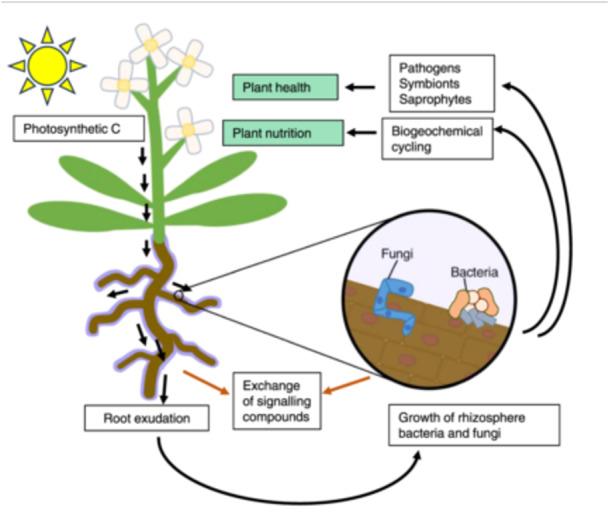
The rhizosphere is a key interface between plants, microbes and the soil which influences plant health and nutrition and modulates terrestrial biogeochemical cycling. Recent research has shown that the rhizosphere environment is far more dynamic than previously recognised, with evidence emerging for diurnal rhythmicity in rhizosphere chemistry and microbial community composition. This rhythmicity is in part linked to the host plant's circadian rhythm, although some heterotrophic rhizosphere bacteria and fungi may also possess intrinsic rhythmicity. We review the evidence for diurnal rhythmicity in rhizosphere microbial communities and its link to the plant circadian clock. Factors which may drive microbial rhythmicity are discussed, including diurnal change in root exudate flux and composition, rhizosphere physico-chemical properties and plant immunity. Microbial processes which could contribute to community rhythmicity are considered, including self-sustained microbial rhythms, bacterial movement into and out of the rhizosphere, and microbe-microbe interactions. We also consider evidence that changes in microbial composition mediated by the plant circadian clock may affect microbial function and its significance for plant health and broader soil biogeochemical cycling processes. We identify key knowledge gaps and approaches which could help to resolve the spatial and temporal variation and functional significance of rhizosphere microbial rhythmicity. This includes unravelling the factors which determine the oscillation of microbial activity, growth and death, and cross-talk with the host over diurnal time frames. We conclude that diurnal rhythmicity is an inherent characteristic of the rhizosphere and that temporal factors should be considered and reported in rhizosphere studies.
根际是植物、微生物与土壤之间的关键界面,它影响植物健康与营养,并调节陆地生物地球化学循环。最近的研究表明,根际环境比以前认识的更加动态,有证据显示根际化学和微生物群落组成存在昼夜节律性。这种节律性部分与宿主植物的昼夜节律有关,尽管一些异养根际细菌和真菌可能也具有内在节律性。我们综述了根际微生物群落昼夜节律性的证据及其与植物生物钟的联系。讨论了可能驱动微生物节律性的因素,包括根系分泌物通量和组成的昼夜变化、根际物理化学性质和植物免疫力。考虑了可能导致群落节律性的微生物过程,包括自我维持的微生物节律、细菌进出根际的移动以及微生物-微生物相互作用。我们还考虑了证据,即植物生物钟介导的微生物组成变化可能影响微生物功能及其对植物健康和更广泛土壤生物地球化学循环过程的意义。我们确定了关键的知识空白和方法,这些方法有助于解决根际微生物节律性的时空变化和功能意义。这包括揭示决定微生物活动、生长和死亡振荡的因素,以及在昼夜时间框架内与宿主的相互作用。我们得出结论,昼夜节律性是根际的固有特征,根际研究应考虑并报告时间因素。


 Zotero 插件