
益生菌补充对绝经后妇女骨骼健康的影响:系统评价和荟萃分析。
Effects of probiotic supplementation on bone health in postmenopausal women: a systematic review and meta-analysis.
机构信息
Department of Clinical Nutrition, Peking Union Medical College Hospital, China Academic Medical Science and Peking Union Medical College, Beijing, China.
出版信息
Front Endocrinol (Lausanne). 2024 Nov 1;15:1487998. doi: 10.3389/fendo.2024.1487998. eCollection 2024.
CONTEXT
The beneficial effects of probiotic supplementation on bone health in postmenopausal women require further validation.
OBJECTIVE
This study systematically reviewed and conducted a meta-analysis of randomized controlled trials (RCTs) to assess the relationship between probiotic supplementation and changes in bone mineral density (BMD) and bone turnover markers (BTMs) among postmenopausal women.
METHODS
A systematic search was conducted across four databases to retrieve data on lumbar spine BMD, hip BMD, collagen type 1 cross-linked C-telopeptide (CTX), receptor activator of nuclear factor-κB ligand (RANKL), osteocalcin (OC), osteoprotegerin (OPG), N-terminal propeptide of type 1 procollagen (P1NP), and bone-specific alkaline phosphatase (BALP) in postmenopausal women. Eligible RCTs were quantitatively analyzed using random-effects meta-analyses. Additional analyses, including subgroup, sensitivity, and meta-regression analyses, were performed.
RESULTS
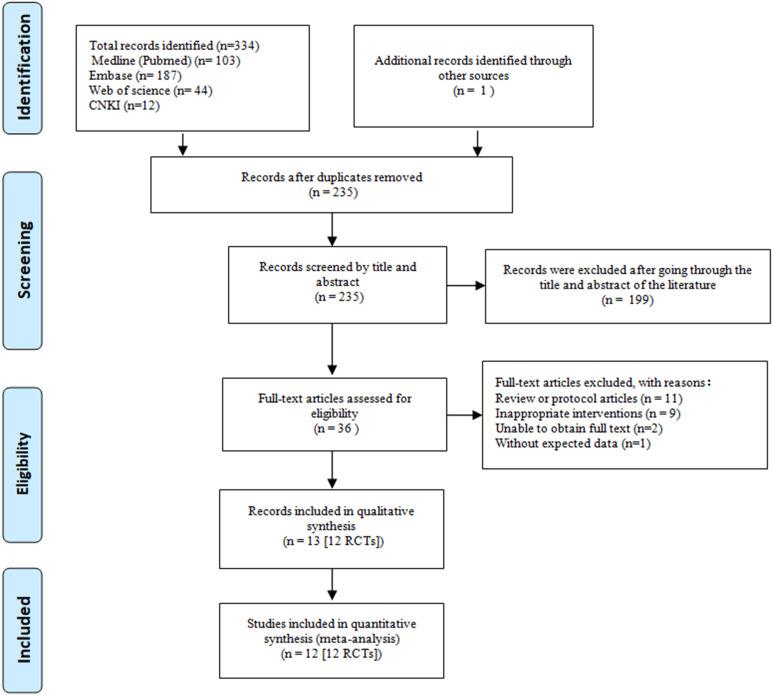
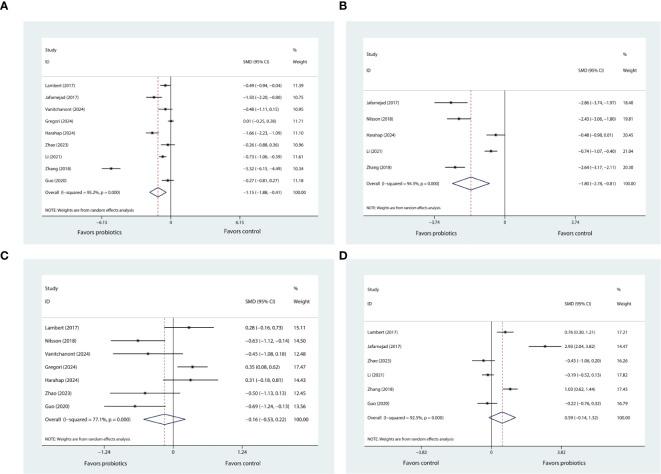
Twelve RCTs involving 1183 postmenopausal women were included. Compared with the control group, postmenopausal women who received probiotic supplementation showed significantly greater BMD in both the lumbar spine (standardized mean difference [SMD] = 0.60, 95% confidence interval [CI] 0.14 to 1.05) and the hip (SMD = 0.74, 95%CI 0.15 to 1.33). Additionally, probiotic supplementation was associated with reduced levels of CTX (SMD = -1.51, 95%CI -1.88 to -0.41) and BALP (SMD = -1.80, 95%CI -2.78 to -0.81). No significant differences were found between the probiotic and control groups in terms of other BTMs. Subgroup analyses revealed that the increase in BMD due to probiotic supplementation was more significant in postmenopausal women with osteopenia than in those with osteoporosis. The meta-analysis results for both lumbar spine and hip BMD remained robust after conducting sensitivity analyses and meta-regressions.
CONCLUSION
Supplementation with probiotics may increase BMD among postmenopausal women, with stronger evidence in women with osteopenia than osteoporosis. Further RCTs are suggested to confirm and refine these findings.
SYSTEMATIC REVIEW REGISTRATION
https://www.crd.york.ac.uk/PROSPERO/, identifier CRD42024576764.
背景
益生菌补充剂对绝经后妇女骨骼健康的有益影响需要进一步验证。
目的
本研究系统综述并进行了荟萃分析,以评估益生菌补充剂与绝经后妇女骨密度(BMD)和骨转换标志物(BTMs)变化之间的关系。
方法
系统检索了四个数据库中关于腰椎 BMD、髋部 BMD、Ⅰ型胶原交联 C 端肽(CTX)、核因子 κB 受体激活剂配体(RANKL)、骨钙素(OC)、骨保护素(OPG)、Ⅰ型前胶原 N 端肽(P1NP)和骨碱性磷酸酶(BALP)的绝经后妇女的益生菌补充数据。使用随机效应荟萃分析对合格的随机对照试验进行定量分析。进行了额外的分析,包括亚组、敏感性和荟萃回归分析。
结果
纳入了 12 项涉及 1183 名绝经后妇女的 RCT。与对照组相比,接受益生菌补充剂的绝经后妇女腰椎(标准化均数差 [SMD] = 0.60,95%置信区间 [CI] 0.14 至 1.05)和髋部(SMD = 0.74,95%CI 0.15 至 1.33)的 BMD 显著增加。此外,益生菌补充剂与 CTX(SMD = -1.51,95%CI -1.88 至 -0.41)和 BALP(SMD = -1.80,95%CI -2.78 至 -0.81)水平降低相关。益生菌和对照组之间在其他 BTM 方面没有发现显著差异。亚组分析表明,在骨质疏松症患者中,益生菌补充剂对 BMD 的增加更为显著,而在骨质疏松症患者中则不显著。在进行敏感性分析和荟萃回归后,腰椎和髋部 BMD 的荟萃分析结果仍然稳健。
结论
益生菌补充剂可能会增加绝经后妇女的 BMD,在骨质疏松症患者中比在骨质疏松症患者中更有证据。建议进一步进行 RCT 以证实和完善这些发现。
系统综述注册
https://www.crd.york.ac.uk/PROSPERO/,标识符 CRD42024576764。

 Zotero 插件