
未来之眼:释放水凝胶在人工晶状体中的潜在应用
Eye of the future: Unlocking the potential utilization of hydrogels in intraocular lenses.
作者信息
Wu Hao, Wang Jiale, Fan Wenhui, Zhong Qi, Xue Rongyue, Li Siyu, Song Zongming, Tao Ye
机构信息
Henan Eye Institute, Henan Eye Hospital, People's Hospital of Zhengzhou University Zhengzhou China.
Zhengzhou University School of Medicine Zhengzhou China.
出版信息
Bioeng Transl Med. 2024 Apr 23;9(5):e10664. doi: 10.1002/btm2.10664. eCollection 2024 Sep.
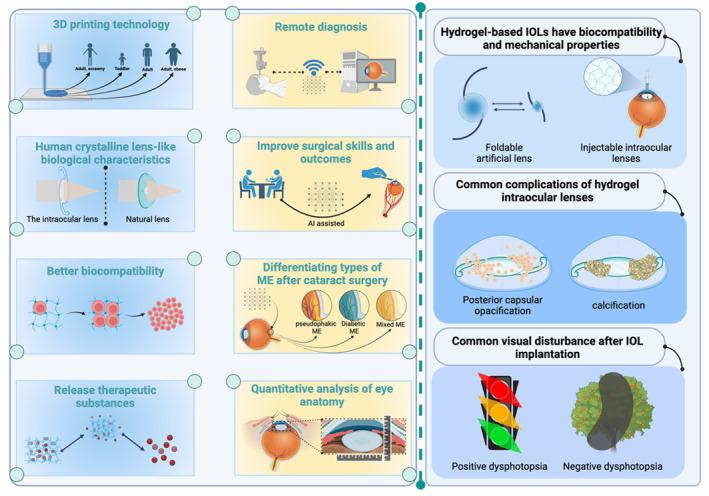
Hydrogels are distinguished by their exceptional ability to absorb and retain large volumes of water within their complex three-dimensional polymer networks, which is advantageous for the development of intraocular lenses (IOLs). Their innate hydrophilicity offers an optimal substrate for the fabrication of IOLs that simulate the natural lens' accommodation, thereby reducing irritation and facilitating healing after surgery. The swelling and water retention characteristics of hydrogels contribute to their notable biocompatibility and versatile mechanical properties. However, the clinical application of hydrogels faces challenges, including managing potential adverse postimplantation effects. Rigorous research is essential to ascertain the safety and effectiveness of hydrogels. This review systematically examines the prospects and constraints of hydrogels as innovative materials for IOLs. Our comprehensive analysis examines their inherent properties, various classification strategies, cross-linking processes, and sensitivity to external stimuli. Additionally, we thoroughly evaluate their interactions with ocular tissues, underscoring the potential for hydrogels to be refined into seamless and biologically integrated visual aids. We also discuss the anticipated technological progress and clinical uses of hydrogels in IOL manufacturing. With ongoing technological advancements, the promise of hydrogels is poised to evolve from concept to clinical reality, marking a significant leap forward in ophthalmology characterized by improved patient comfort, enhanced functionality, and reliable safety.
水凝胶的独特之处在于其在复杂的三维聚合物网络中吸收和保留大量水分的卓越能力,这对人工晶状体(IOL)的开发具有优势。它们固有的亲水性为制造模拟天然晶状体调节功能的人工晶状体提供了理想的基质,从而减少刺激并促进术后愈合。水凝胶的溶胀和保水特性有助于其显著的生物相容性和多样的机械性能。然而,水凝胶的临床应用面临挑战,包括处理潜在的植入后不良影响。严谨的研究对于确定水凝胶的安全性和有效性至关重要。本综述系统地研究了水凝胶作为人工晶状体创新材料的前景和限制。我们的综合分析考察了它们的固有特性、各种分类策略、交联过程以及对外部刺激的敏感性。此外,我们全面评估了它们与眼组织的相互作用,强调了水凝胶被改进为无缝且生物整合的视觉辅助器具的潜力。我们还讨论了水凝胶在人工晶状体制造中的预期技术进展和临床应用。随着技术的不断进步,水凝胶的前景有望从概念转变为临床现实,标志着眼科领域向前迈出重要一步,其特点是提高患者舒适度、增强功能并确保可靠的安全性。


 Zotero 插件