
乌拉圭人群猫咬伤的流行病学:受害者年龄和性别、一年中的季节以及 COVID-19 大流行的影响。
Epidemiology of cat bites to people in Uruguay: Effects of the age and sex of the victim, season of the year, and the COVID-19 pandemic.
机构信息
Departamento de Biociencias Veterinarias, Facultad de Veterinaria, Universidad de la República, Montevideo, Uruguay.
Núcleo de Bienestar Animal, Facultad de Veterinaria, Universidad de la República, Montevideo, Uruguay.
出版信息
Open Vet J. 2024 Sep;14(9):2392-2397. doi: 10.5455/OVJ.2024.v14.i9.27. Epub 2024 Sep 30.
BACKGROUND
Cat bites to people are an important public health problem. However, very little information exists on the epidemiology of people bitten by cats at the level of an entire country in Latin America. Additionally, the COVID-19 pandemic significantly influenced people's lives and their relationships with pets, which could potentially affect the frequency of people bitten by cats.
AIM
The aim of this study was to determine the prevalence of people bitten by cats in Uruguay (2010 to 2020) according to the sex and age of the victim, season of the year, and to compare the prevalence in the pandemic year (2020) with that of the pre-pandemic years (2010-2019).
METHODS
Cross-sectional study. Cat-bite notifications for the 2010-2020 period were analyzed using data from the Uruguayan Ministry of Public Health (Uruguay).
RESULTS
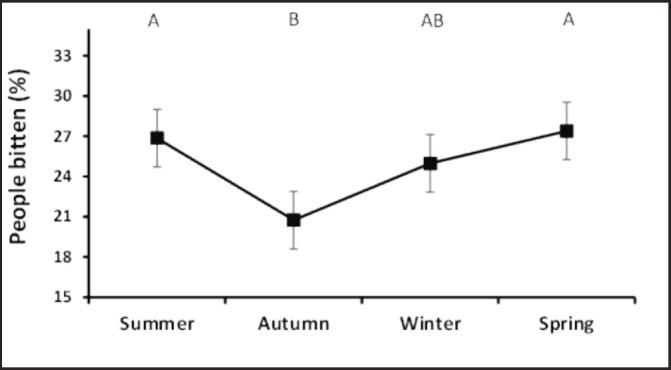
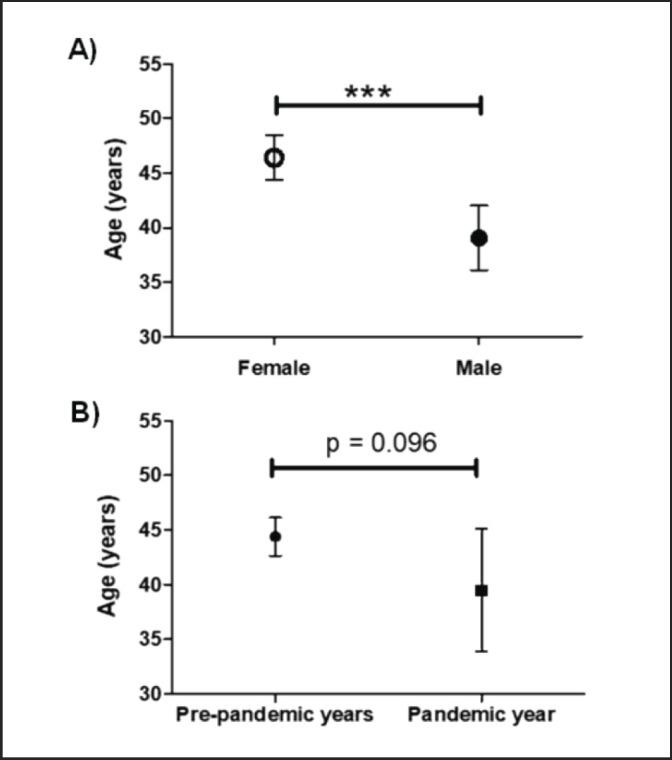
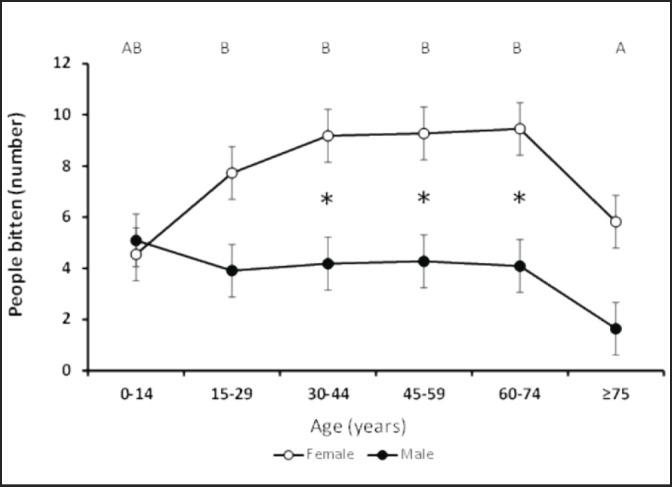
The annual cat-bite rate for the 2010-2020 period was 2.1 per 100,000 people. The frequency of cat bites varied with the victim´s sex ( < 0.0001), being greater in females ( = 506, 66.5%) than in males ( = 255, 33.5%). The age at being bitten by cats varied with the sex of the victim, with males being bitten at an earlier age than females ( < 0.0001). Among the age categories of 30-74 years, females were bitten more than males ( < 0.05). Overall, cat bites were much less frequent in the oldest age categories (over 75 years old, < 0.05). The percentage of cat bites tended to change with the season of the year ( = 0.08), with most bites occurring in spring and summer. The frequency of cat-bite injuries was similar between 2020 and the pre-COVID-19 pandemic years.
CONCLUSION
In Uruguay, cat bite incidents were affected by the victim's sex (more in females) and age, as well as by the season. During the initial year of the COVID-19 pandemic, the rate of cat bites was no different from those in earlier years.
背景
猫咬伤是一个重要的公共卫生问题。然而,在拉丁美洲的整个国家层面上,关于猫咬伤的流行病学信息非常有限。此外,COVID-19 大流行极大地影响了人们的生活及其与宠物的关系,这可能会影响猫咬伤的频率。
目的
本研究旨在根据受害者的性别和年龄、一年中的季节,确定乌拉圭(2010 年至 2020 年)猫咬伤的流行率,并比较大流行年份(2020 年)与大流行前年份(2010-2019 年)的流行率。
方法
横断面研究。使用乌拉圭公共卫生部(乌拉圭)的数据,对 2010-2020 年期间的猫咬伤报告进行了分析。
结果
2010-2020 年期间,猫咬伤的年发生率为每 100,000 人 2.1 例。猫咬伤的频率因受害者的性别而异(<0.0001),女性(=506,66.5%)多于男性(=255,33.5%)。猫咬伤的年龄因受害者的性别而异,男性比女性更早被咬伤(<0.0001)。在 30-74 岁的年龄组中,女性比男性更容易被咬伤(<0.05)。总体而言,最年长的年龄组(>75 岁,<0.05)猫咬伤的频率较低。猫咬伤的百分比随季节的变化而变化(=0.08),大多数咬伤发生在春季和夏季。2020 年与 COVID-19 大流行前几年的猫咬伤频率相似。
结论
在乌拉圭,猫咬伤事件受受害者的性别(女性居多)和年龄以及季节的影响。在 COVID-19 大流行的初始年份,猫咬伤的发生率与前几年没有差异。
 Zotero 插件