
基于临床实验室参数,使用机器学习算法构建结直肠癌诊断模型。
Construction of diagnostic models with machine-learning algorithms for colorectal cancer based on clinical laboratory parameters.
作者信息
Si Dengqing, Shu Yu, Jiang Hongbo, Lin Xueping, Yuan Qiurong, Deng Shaotuan, Luo Wei, Lin Yangze, Wang Ju, Zhan Chengxiong, Shaukat Aasma, Ambe Peter C, Niu Shiqiong, Luo Zhaofan
机构信息
Department of Clinical Medical Laboratory, The Seventh Affiliated Hospital of Sun Yat-sen University, Shenzhen, China.
Shenzhen Mindray Bio-Medical Electronics Co., Ltd., Shenzhen, China.
出版信息
J Gastrointest Oncol. 2024 Oct 31;15(5):2145-2156. doi: 10.21037/jgo-24-516. Epub 2024 Sep 12.
BACKGROUND
Colonoscopy remains the predominant diagnostic modality for colorectal cancer (CRC), as the diagnostic performance of tumor markers in alone, particularly in the early stages of the disease, is limited. This study sought to develop a diagnostic model for CRC that integrated various laboratory parameters.
METHODS
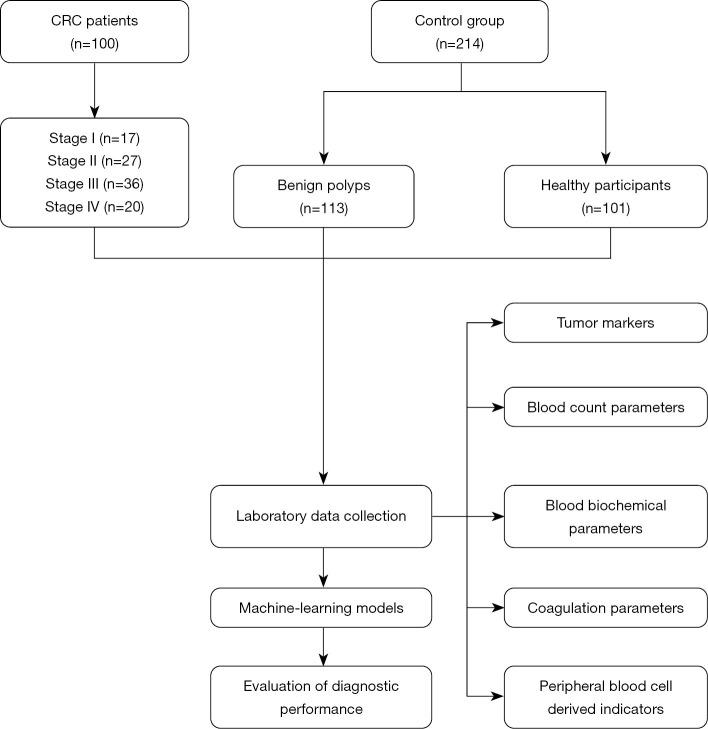
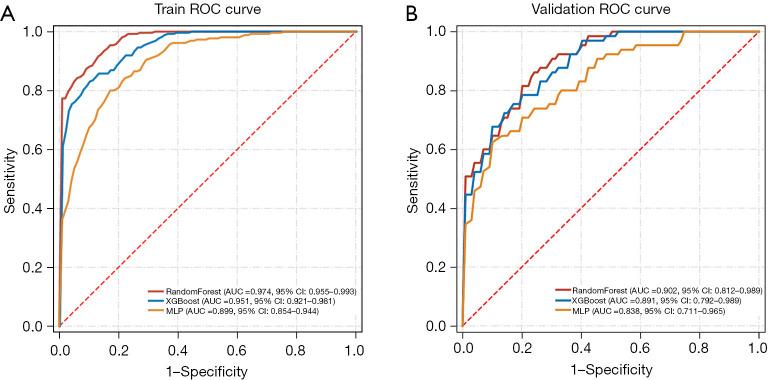
One hundred patients with CRC were assigned to an experimental group while 114 with benign colorectal diseases and 101 healthy individuals were assigned to a control group. The clinical and laboratory data, including the tumor markers such as carcinoembryonic antigen (CEA), glycan carbohydrate antigen 19-9 (CA19-9), carbohydrate antigen 242 (CA242), blood count parameters, blood biochemical parameters, and coagulation parameters, were collected for each participant. Three machine-learning models [multilayered perceptron (MLP), eXtreme Gradient Boosting (XGBoost), and random forest (RF)] were used to construct CRC diagnostic models. The performance of each model was evaluated based on its area under the curve (AUC), sensitivity, and specificity.
RESULTS
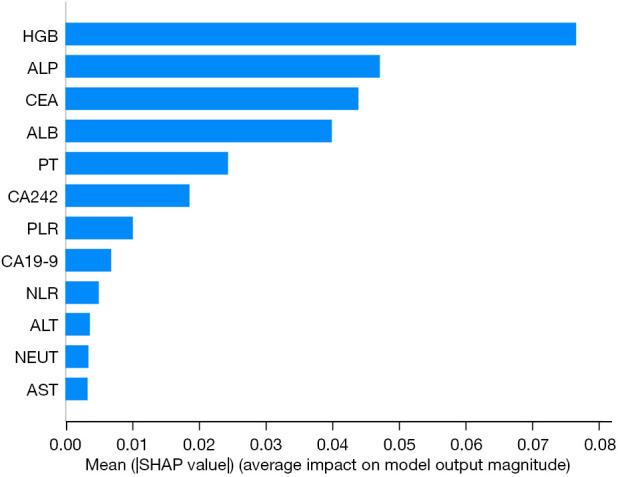
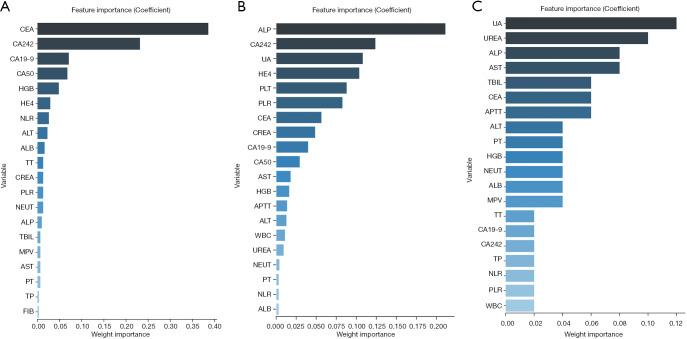
There are 12 parameters: including CEA, CA19-9, CA242, absolute neutrophil value (NEUT), hemoglobin, the neutrophil/lymphocyte ratio, the platelet/lymphocyte ratio, alanine aminotransferase, alkaline phosphatase, aspartate aminotransferase, albumin, and prothrombin time, were selected to build the diagnostic model. For the validation set, the RF machine-learning model achieved the highest performance in identifying CRC [AUC: 0.902 (95% confidence interval: 0.812-0.989), accuracy: 0.803, sensitivity: 0.908, specificity: 0.772, positive predictive value: 0.664, negative predictive value: 0.890, and F1 score: 0.763]. The AUC, sensitivity, specificity, and Youden's index for the combined diagnosis of tumor markers CEA, CA19-9, and CA242 were 0.761, 0.486, 0.983, and 0.469, respectively. The RF diagnostic model showed better diagnostic efficacy than the combined diagnosis model of tumor markers CEA, CA19-9 and CA242.
CONCLUSIONS
The use of machine learning combined with multiple laboratory parameters effectively improved the diagnostic efficiency of CRC and provided more accurate results for clinical diagnosis.
背景
结肠镜检查仍然是结直肠癌(CRC)的主要诊断方式,因为单独使用肿瘤标志物的诊断性能有限,尤其是在疾病的早期阶段。本研究旨在开发一种整合多种实验室参数的CRC诊断模型。
方法
将100例CRC患者分配到实验组,将114例良性结直肠疾病患者和101例健康个体分配到对照组。收集每位参与者的临床和实验室数据,包括癌胚抗原(CEA)、糖链碳水化合物抗原19-9(CA19-9)、碳水化合物抗原242(CA242)等肿瘤标志物、血细胞计数参数、血液生化参数和凝血参数。使用三种机器学习模型[多层感知器(MLP)、极端梯度提升(XGBoost)和随机森林(RF)]构建CRC诊断模型。根据曲线下面积(AUC)、敏感性和特异性评估每个模型的性能。
结果
选择12个参数构建诊断模型,包括CEA、CA19-9、CA242、中性粒细胞绝对值(NEUT)、血红蛋白、中性粒细胞/淋巴细胞比值、血小板/淋巴细胞比值、谷丙转氨酶、碱性磷酸酶、谷草转氨酶、白蛋白和凝血酶原时间。对于验证集,RF机器学习模型在识别CRC方面表现出最高的性能[AUC:0.902(95%置信区间:0.812-0.989),准确率:0.803,敏感性:0.908,特异性:0.772,阳性预测值:0.664,阴性预测值:0.890,F1分数:0.763]。肿瘤标志物CEA、CA19-9和CA242联合诊断的AUC、敏感性、特异性和尤登指数分别为0.761、0.486、0.983和0.469。RF诊断模型显示出比肿瘤标志物CEA、CA19-9和CA242联合诊断模型更好的诊断效能。
结论
机器学习结合多种实验室参数的使用有效地提高了CRC的诊断效率,并为临床诊断提供了更准确的结果。

 Zotero 插件