
与临床阿尔茨海默病谱系结构变化相关的一致性基因。
Consistent genes associated with structural changes in clinical Alzheimer's disease spectrum.
作者信息
Lu Yingqi, Zhang Xiaodong, Hu Liyu, Cheng Qinxiu, Zhang Zhewei, Zhang Haoran, Xie Zhuoran, Gao Yiheng, Cao Dezhi, Chen Shangjie, Xu Jinping
机构信息
Department of Rehabilitation Medicine, The People's Hospital of Baoan Shenzhen, Shenzhen, China.
Department of Rehabilitation Medicine, The Second Affiliated Hospital of Shenzhen University, Shenzhen, China.
出版信息
Front Neurosci. 2024 Nov 1;18:1376288. doi: 10.3389/fnins.2024.1376288. eCollection 2024.
BACKGROUND
Previous studies have demonstrated widespread brain neurodegeneration in Alzheimer's disease (AD). However, the neurobiological and pathogenic substrates underlying this structural atrophy across the AD spectrum remain largely understood.
METHODS
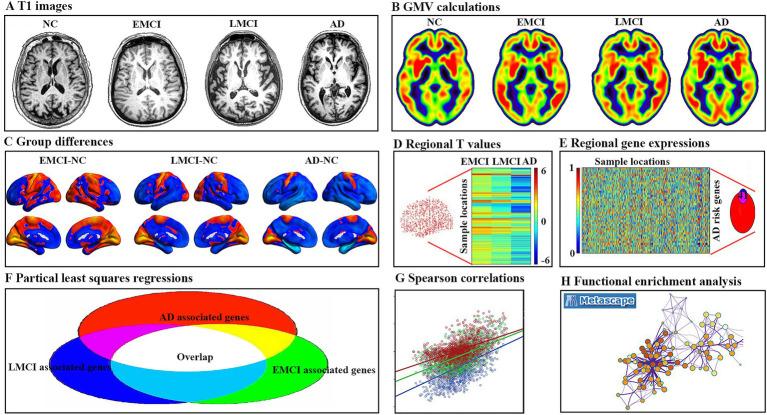
In this study, we obtained structural MRI data from ADNI datasets, including 83 participants with early-stage cognitive impairments (EMCI), 83 with late-stage mild cognitive impairments (LMCI), 83 with AD, and 83 with normal controls (NC). Our goal was to explore structural atrophy across the full clinical AD spectrum and investigate the genetic mechanism using gene expression data from the Allen Human Brain Atlas.
RESULTS
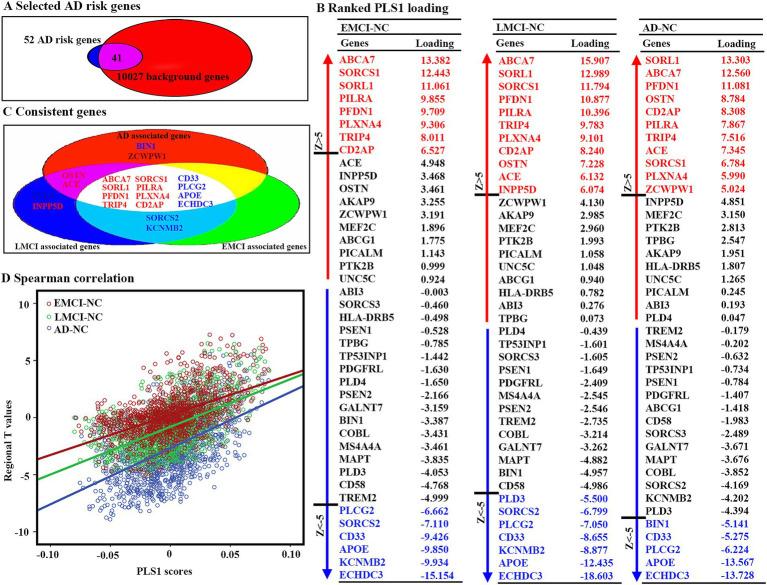
As a result, we identified significant volume atrophy in the left thalamus, left cerebellum, and bilateral middle frontal gyrus across the AD spectrum. These structural changes were positively associated with the expression levels of genes such as ABCA7, SORCS1, SORL1, PILRA, PFDN1, PLXNA4, TRIP4, and CD2AP, while they were negatively associated with the expression levels of genes such as CD33, PLCG2, APOE, and ECHDC3 across the clinical AD spectrum. Further gene enrichment analyses revealed that the positively associated genes were mainly involved in the positive regulation of cellular protein localization and the negative regulation of cellular component organization, whereas the negatively associated genes were mainly involved in the positive regulation of iron transport.
CONCLUSION
Overall, these results provide a deeper understanding of the biological mechanisms underlying structural changes in prodromal and clinical AD.
背景
先前的研究已证明阿尔茨海默病(AD)存在广泛的脑神经元变性。然而,在整个AD谱系中,这种结构萎缩背后的神经生物学和致病底物仍 largely understood。
方法
在本研究中,我们从ADNI数据集中获取了结构MRI数据,包括83名早期认知障碍(EMCI)参与者、83名晚期轻度认知障碍(LMCI)参与者、83名AD患者和83名正常对照(NC)。我们的目标是探索整个临床AD谱系中的结构萎缩,并使用来自艾伦人类大脑图谱的基因表达数据研究遗传机制。
结果
结果,我们在整个AD谱系中发现左丘脑、左小脑和双侧额中回存在显著体积萎缩。这些结构变化与ABCA7、SORCS1、SORL1、PILRA、PFDN1、PLXNA4、TRIP4和CD2AP等基因的表达水平呈正相关,而在整个临床AD谱系中,它们与CD33、PLCG2、APOE和ECHDC3等基因的表达水平呈负相关。进一步的基因富集分析表明,正相关基因主要参与细胞蛋白质定位的正调控和细胞组分组织的负调控,而负相关基因主要参与铁转运的正调控。
结论
总体而言,这些结果为前驱期和临床AD结构变化的生物学机制提供了更深入的理解。



 Zotero 插件