
利用开源大型语言模型在医院员工调查中进行数据扩充:混合方法研究。
Leveraging Open-Source Large Language Models for Data Augmentation in Hospital Staff Surveys: Mixed Methods Study.
机构信息
Watt Family Innovation Center, Clemson University, Clemson, SC, United States.
Department of Industrial Engineering, Clemson University, Clemson, SC, United States.
出版信息
JMIR Med Educ. 2024 Nov 19;10:e51433. doi: 10.2196/51433.
BACKGROUND
Generative large language models (LLMs) have the potential to revolutionize medical education by generating tailored learning materials, enhancing teaching efficiency, and improving learner engagement. However, the application of LLMs in health care settings, particularly for augmenting small datasets in text classification tasks, remains underexplored, particularly for cost- and privacy-conscious applications that do not permit the use of third-party services such as OpenAI's ChatGPT.
OBJECTIVE
This study aims to explore the use of open-source LLMs, such as Large Language Model Meta AI (LLaMA) and Alpaca models, for data augmentation in a specific text classification task related to hospital staff surveys.
METHODS
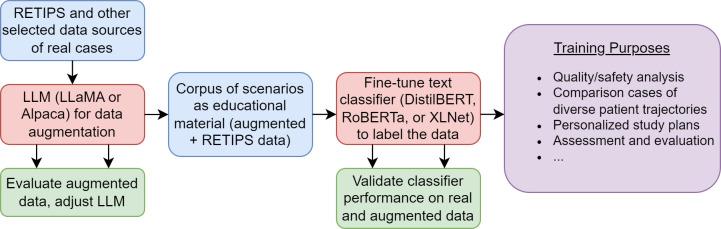
The surveys were designed to elicit narratives of everyday adaptation by frontline radiology staff during the initial phase of the COVID-19 pandemic. A 2-step process of data augmentation and text classification was conducted. The study generated synthetic data similar to the survey reports using 4 generative LLMs for data augmentation. A different set of 3 classifier LLMs was then used to classify the augmented text for thematic categories. The study evaluated performance on the classification task.
RESULTS
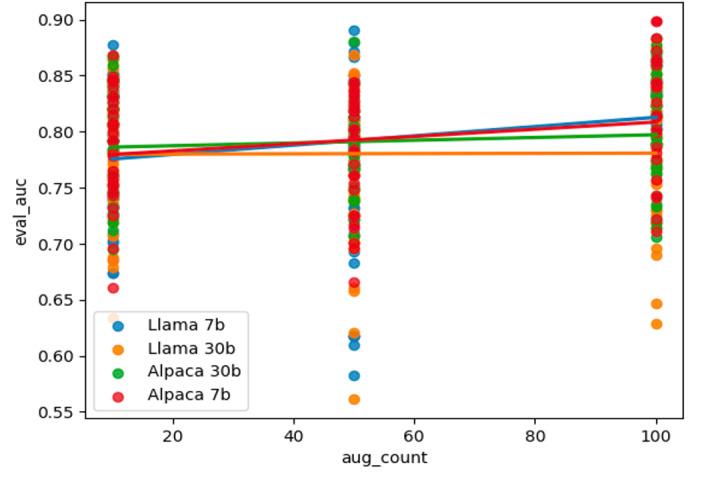
The overall best-performing combination of LLMs, temperature, classifier, and number of synthetic data cases is via augmentation with LLaMA 7B at temperature 0.7 with 100 augments, using Robustly Optimized BERT Pretraining Approach (RoBERTa) for the classification task, achieving an average area under the receiver operating characteristic (AUC) curve of 0.87 (SD 0.02; ie, 1 SD). The results demonstrate that open-source LLMs can enhance text classifiers' performance for small datasets in health care contexts, providing promising pathways for improving medical education processes and patient care practices.
CONCLUSIONS
The study demonstrates the value of data augmentation with open-source LLMs, highlights the importance of privacy and ethical considerations when using LLMs, and suggests future directions for research in this field.
背景
生成式大型语言模型(LLMs)具有通过生成定制学习材料、提高教学效率和提高学习者参与度来彻底改变医学教育的潜力。然而,LLMs 在医疗保健环境中的应用,特别是在增强文本分类任务中小数据集方面的应用,仍然没有得到充分探索,特别是对于那些不允许使用第三方服务(如 OpenAI 的 ChatGPT)的注重成本和隐私的应用程序。
目的
本研究旨在探索使用开源 LLM,如 Large Language Model Meta AI(LLaMA)和 Alpaca 模型,在与医院工作人员调查相关的特定文本分类任务中进行数据扩充。
方法
调查旨在了解一线放射科工作人员在 COVID-19 大流行初期的日常适应情况。采用两步数据扩充和文本分类过程。该研究使用 4 种生成式 LLM 生成类似于调查报告的合成数据进行数据扩充。然后,使用一组不同的 3 种分类器 LLM 对扩充后的文本进行主题分类。该研究评估了分类任务的性能。
结果
总体而言,表现最佳的 LLM 组合、温度、分类器和合成数据案例数是通过在温度为 0.7 时使用 LLaMA 7B 进行扩充,并使用 Robustly Optimized BERT Pretraining Approach(RoBERTa)进行分类任务,实现了平均接收器操作特征(ROC)曲线下面积(AUC)为 0.87(标准差 0.02;即 1 个标准差)。结果表明,开源 LLM 可以增强医疗保健环境中小数据集的文本分类器性能,为改善医学教育流程和患者护理实践提供了有前途的途径。
结论
该研究展示了使用开源 LLM 进行数据扩充的价值,强调了在使用 LLM 时隐私和伦理考虑的重要性,并提出了该领域未来研究的方向。
 Zotero 插件