
月桂烯治疗柔嫩艾美耳球虫和刚地弓形虫感染的疗效评估。
Evaluation of the efficicacy of myrcene in the treatment of Eimeria tenella and Toxoplasma gondii infection.
作者信息
Chen Nianyuan, Cai Qingxiu, Wang Shujing, Song Qingyang, Xie Ying, Shi Huijuan, Li Hongmei, Zhao Xiaomin, Zhao Ningning, Zhang Xiao
机构信息
Department of Preventive Veterinary Medicine, College of Veterinary Medicine, Shandong Agricultural University, Tai'an, China.
The National Animal Health Products for Engineering Technology Research Center, Qingdao, China.
出版信息
J Vet Med Sci. 2025 Jan 1;87(1):32-42. doi: 10.1292/jvms.24-0397. Epub 2024 Nov 20.
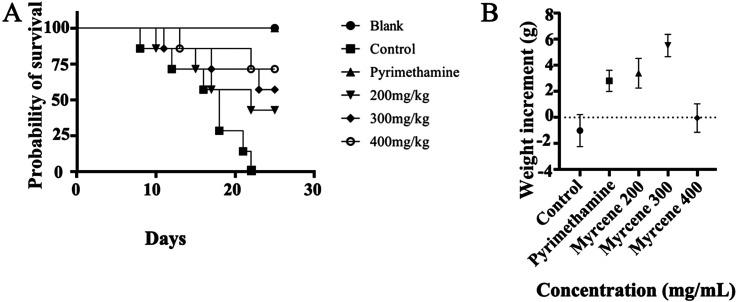
Protozoan parasites such as Eimeria tenella and Toxoplasma gondii pose significant health challenges in livestock and humans. The limited treatment options and rising drug resistance underscore the urgent need for new therapies. This study investigates myrcene, a monoterpene hydrocarbon classified for its antiprotozoal potential against E. tenella and T. gondii infections. Initially, we examined its effect on the sporulation process of E. tenella oocysts in vitro and its anti-E. tenella activity in vivo. Myrcene significantly reduced the sporulation rate of E. tenella oocysts at 3 and 4 mg/kg. In vivo experiments demonstrated that treatment with 4 mg/kg myrcene significantly reduced E. tenella load and oocyst output, as well as cecal lesion and weight loss caused by E. tenella infection, showing moderate anti-E. tenella activity, with an Anticoccidial Index (ACI) of 161.4. Furthermore, we investigated the anti-T. gondii activity of myrcene both in vitro and in vivo. In vitro studies showed that treatment with myrcene effectively inhibited the invasion rate and intracellular proliferation ability of T. gondii tachyzoite in DF-1 cells in a dose-dependent manner. In vivo administration prolonged the survival time in T. gondii-infected mice, suggesting notable protective effects. Additionally, it mitigated T. gondii-induced hepatosplenic toxicity by reducing parasite load in the liver and spleen, and ameliorating liver function as evidenced by decreased serum transaminase levels. In conclusion, the findings demonstrate promising anti-E. tenella and anti-T. gondii activity exhibited by myrcene warranting further exploration into its mechanisms and potential therapeutic applications.
艾美耳球虫和刚地弓形虫等原生动物寄生虫对家畜和人类的健康构成了重大挑战。治疗选择有限且耐药性不断上升,凸显了对新疗法的迫切需求。本研究调查了月桂烯,一种单萜烃,因其对艾美耳球虫和刚地弓形虫感染具有抗寄生虫潜力而被分类研究。最初,我们在体外研究了其对艾美耳球虫卵囊孢子化过程的影响以及其体内抗艾美耳球虫活性。月桂烯在3和4mg/kg时显著降低了艾美耳球虫卵囊的孢子化率。体内实验表明,用4mg/kg月桂烯治疗可显著降低艾美耳球虫载量和卵囊产量,以及由艾美耳球虫感染引起的盲肠病变和体重减轻,显示出中度抗艾美耳球虫活性,抗球虫指数(ACI)为161.4。此外,我们还研究了月桂烯在体外和体内的抗刚地弓形虫活性。体外研究表明,月桂烯处理以剂量依赖的方式有效抑制了刚地弓形虫速殖子在DF-1细胞中的侵袭率和细胞内增殖能力。体内给药延长了刚地弓形虫感染小鼠的存活时间,表明具有显著的保护作用。此外,它通过降低肝脏和脾脏中的寄生虫载量减轻了刚地弓形虫诱导的肝脾毒性,并通过降低血清转氨酶水平改善了肝功能。总之,研究结果表明月桂烯具有有前景的抗艾美耳球虫和抗刚地弓形虫活性,值得进一步探索其作用机制和潜在的治疗应用。


 Zotero 插件