
成纤维细胞生长因子21(FGF21)在大脑中发挥作用,驱动行为动机和大脑奖赏信号中特定常量营养素的变化。
FGF21 acts in the brain to drive macronutrient-specific changes in behavioral motivation and brain reward signaling.
作者信息
Khan Md Shahjalal H, Kim Sora Q, Ross Robert C, Corpodean Florina, Spann Redin A, Albarado Diana A, Fernandez-Kim Sun O, Clarke Blaise, Berthoud Hans-Rudolf, Münzberg Heike, McDougal David H, He Yanlin, Yu Sangho, Albaugh Vance L, Soto Paul L, Morrison Christopher D
机构信息
Pennington Biomedical Research Center, Baton Rouge, LA, 70808, USA.
Pennington Biomedical Research Center, Baton Rouge, LA, 70808, USA; Department of Surgery, Louisiana State University Health Sciences Center, New Orleans, LA, 70112, USA.
出版信息
Mol Metab. 2025 Jan;91:102068. doi: 10.1016/j.molmet.2024.102068. Epub 2024 Nov 19.
OBJECTIVE
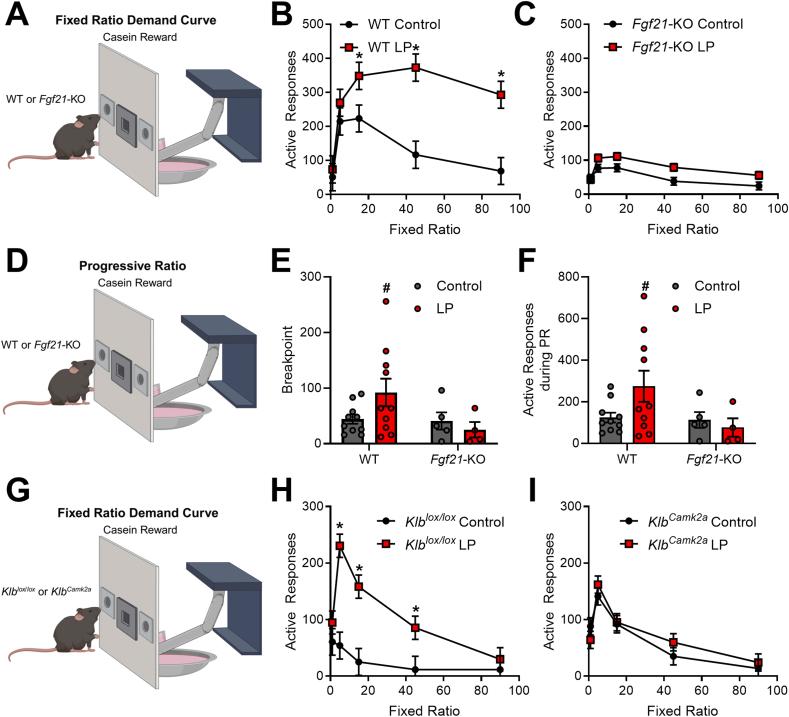
Dietary protein restriction induces adaptive changes in food preference, increasing protein consumption over carbohydrates or fat. We investigated whether motivation and reward signaling underpin these preferences.
METHODS AND RESULTS
In an operant task, protein-restricted male mice responded more for liquid protein rewards, but not carbohydrate, fat, or sweet rewards compared to non-restricted mice. When the number of responses required to access protein reward varied, protein-restricted mice exhibited higher operant responses at moderate to high response requirements. The protein restriction-induced increase in operant responding for protein was absent in Fgf21-KO mice and mice with neuron-specific deletion of the FGF21 co-receptor beta-Klotho (Klb). Fiber photometry recording of VTA dopamine neurons revealed that oral delivery of maltodextrin triggered a larger dopamine neuron activation than casein in control diet-fed mice, while casein triggered a larger activation in low-protein diet-fed mice. This restriction-induced shift in nutrient-specific VTA dopamine signaling was lost in Fgf21-KO mice.
CONCLUSION
These data suggest that the increased FGF21 during protein restriction acts in the brain to induce a protein-specific appetite by specifically enhancing the reward value of protein-containing foods and the motivation to consume them.
目的
饮食中蛋白质限制会引发食物偏好的适应性变化,增加蛋白质的摄入量,使其超过碳水化合物或脂肪。我们研究了动机和奖赏信号是否是这些偏好的基础。
方法与结果
在一项操作性任务中,与未受限制的小鼠相比,蛋白质限制的雄性小鼠对液体蛋白质奖赏的反应更多,但对碳水化合物、脂肪或甜味奖赏的反应则不然。当获取蛋白质奖赏所需的反应次数变化时,蛋白质限制的小鼠在中等至高反应要求下表现出更高的操作性反应。在成纤维细胞生长因子21基因敲除(Fgf21-KO)小鼠和神经元特异性缺失FGF21共受体β-klotho(Klb)的小鼠中,蛋白质限制诱导的对蛋白质操作性反应的增加不存在。对腹侧被盖区(VTA)多巴胺能神经元的光纤光度记录显示,在对照饮食喂养的小鼠中,口服麦芽糊精比酪蛋白引发更大的多巴胺能神经元激活,而在低蛋白饮食喂养的小鼠中,酪蛋白引发更大的激活。在Fgf21-KO小鼠中,这种限制诱导的营养物质特异性VTA多巴胺信号的转变消失了。
结论
这些数据表明,蛋白质限制期间FGF21的增加在大脑中起作用,通过特异性增强含蛋白质食物的奖赏价值和食用它们的动机来诱导蛋白质特异性食欲。




 Zotero 插件