
肿瘤微环境中 CD8 和 Ki67 细胞的空间分布独立预测 ER+/HER2- 和三阴性乳腺癌患者的乳腺癌特异性生存。
Spatial distributions of CD8 and Ki67 cells in the tumor microenvironment independently predict breast cancer-specific survival in patients with ER+HER2- and triple-negative breast carcinoma.
机构信息
Department of Pathology and Forensic Medicine, Institute of Biomedical Sciences, Faculty of Medicine, Vilnius University, Vilnius, Lithuania.
National Centre of Pathology, affiliate of Vilnius University Hospital Santaros Klinikos, Vilnius, Lithuania.
出版信息
PLoS One. 2024 Nov 22;19(11):e0314364. doi: 10.1371/journal.pone.0314364. eCollection 2024.
INTRODUCTION
Breast cancer (BC) presents diverse malignancies with varying biological and clinical behaviors, driven by an interplay between cancer cells and tumor microenvironment. Deciphering these interactions is crucial for personalized diagnostics and treatment. This study explores the prognostic impact of tumor proliferation and immune response patterns, assessed by computational pathology indicators, on breast cancer-specific survival (BCSS) models in estrogen receptor-positive HER2-negative (ER+HER2-) and triple-negative BC (TNBC) patients.
MATERIALS AND METHODS
Whole-slide images of tumor surgical excision samples from 252 ER+HER2- patients and 63 TNBC patients stained for estrogen and progesterone receptors, Ki67, HER2, and CD8 were analyzed. Digital image analysis (DIA) was performed for tumor tissue segmentation and quantification of immunohistochemistry (IHC) markers; the DIA outputs were subsampled by hexagonal grids to assess the spatial distributions of Ki67-positive tumor cells and CD8-positive (CD8+) cell infiltrates, expressed as Ki67-entropy and CD8-immunogradient indicators, respectively. Prognostic models for BCSS were generated using multivariable Cox regression analysis, integrating clinicopathological and computational IHC indicators.
RESULTS
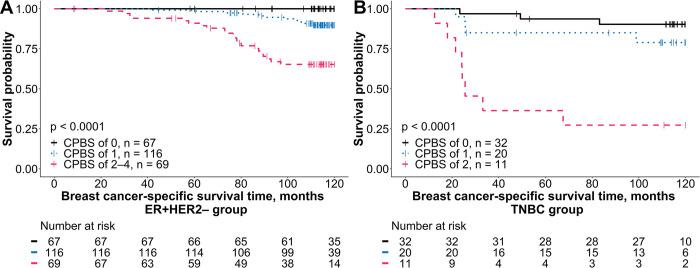
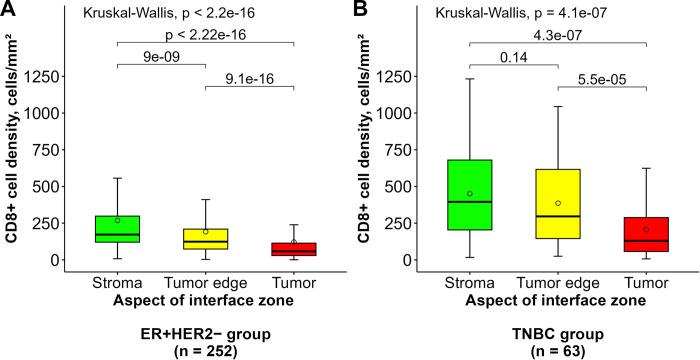
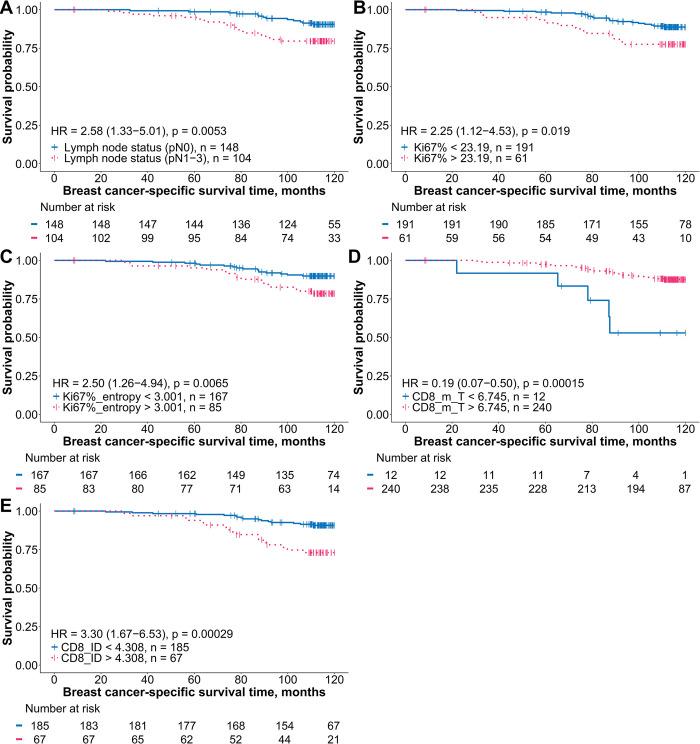
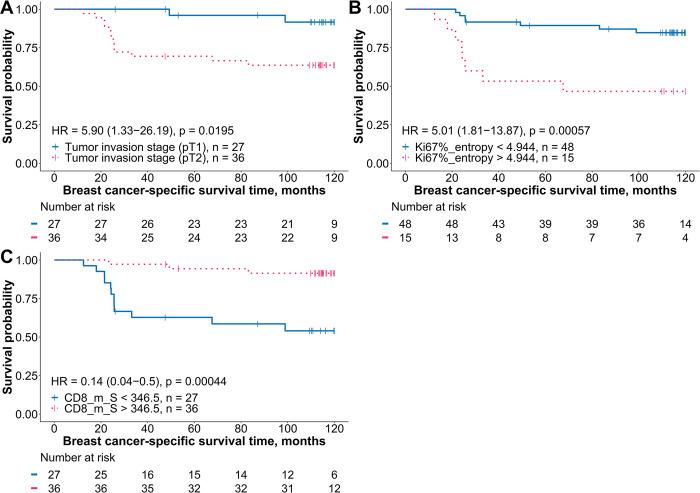
In the ER+HER2- BC, multivariable Cox regression revealed that high CD8+ density within the tumor interface zone (IZ) (HR: 0.26, p = 0.0056), low immunodrop indicator of CD8+ density (HR: 2.93, p = 0.0051), and low Ki67-entropy (HR: 5.95, p = 0.0.0061) were independent predictors of better BCSS, while lymph node involvement predicted worse BCSS (HR: 3.30, p = 0.0013). In TNBC, increased CD8+ density in the IZ stroma (HR: 0.19, p = 0.0119) and Ki67-entropy (HR: 3.31, p = 0.0250) were independent predictors of worse BCSS. Combining these independent indicators enhanced prognostic stratification in both BC subtypes.
CONCLUSIONS
Computational biomarkers, representing spatial properties of the tumor proliferation and immune cell infiltrates, provided independent prognostic information beyond conventional IHC markers in BC. Integrating Ki67-entropy and CD8-immunogradient indicators into prognostic models can improve patient stratification with regard to BCSS.
简介
乳腺癌(BC)表现出多种恶性肿瘤,具有不同的生物学和临床行为,这是癌细胞与肿瘤微环境相互作用的结果。解析这些相互作用对于个性化诊断和治疗至关重要。本研究通过计算病理学指标,探讨了肿瘤增殖和免疫反应模式对雌激素受体阳性 HER2 阴性(ER+HER2-)和三阴性乳腺癌(TNBC)患者乳腺癌特异性生存(BCSS)模型的预后影响。
材料与方法
对 252 例 ER+HER2-患者和 63 例 TNBC 患者的肿瘤手术切除样本进行全切片图像分析,这些样本均经过雌激素和孕激素受体、Ki67、HER2 和 CD8 染色。对肿瘤组织进行数字图像分析(DIA)以进行分割和定量免疫组织化学(IHC)标志物;通过六边形网格对 DIA 输出进行抽样,以评估 Ki67 阳性肿瘤细胞和 CD8+细胞浸润的空间分布,分别表示为 Ki67 熵和 CD8 免疫梯度指标。使用多变量 Cox 回归分析,结合临床病理和计算 IHC 指标,生成 BCSS 预后模型。
结果
在 ER+HER2- BC 中,多变量 Cox 回归显示肿瘤界面区(IZ)内高 CD8+密度(HR:0.26,p = 0.0056)、低 CD8+密度免疫下降指标(HR:2.93,p = 0.0051)和低 Ki67 熵(HR:5.95,p = 0.0061)是 BCSS 较好的独立预测因子,而淋巴结受累则预测 BCSS 较差(HR:3.30,p = 0.0013)。在 TNBC 中,IZ 间质中 CD8+密度增加(HR:0.19,p = 0.0119)和 Ki67 熵(HR:3.31,p = 0.0250)是 BCSS 较差的独立预测因子。结合这些独立指标可增强两种 BC 亚型的预后分层。
结论
计算生物标志物代表肿瘤增殖和免疫细胞浸润的空间特性,为 BC 提供了独立于常规 IHC 标志物的预后信息。将 Ki67 熵和 CD8 免疫梯度指标纳入预后模型可以改善患者的 BCSS 分层。


 Zotero 插件