
健康素养对社区居民健康促进生活方式的影响:家庭健康和身体活动的链式中介作用。
The impact of health literacy on health-promoting lifestyle among community residents: the chain-mediating role of family health and physical activity.
作者信息
Ma Yunxia, Huang Li, Tian Haodong, Liu Haowei, Yu Hanglin, Li Hansen, Guo Liya
机构信息
College of Physical Education and Health, Yili Normal University, Xinjiang, China.
College of Physical Education, Southwest University, Chongqing, China.
出版信息
Front Psychiatry. 2024 Nov 8;15:1487274. doi: 10.3389/fpsyt.2024.1487274. eCollection 2024.
BACKGROUND
Adopting health-promoting lifestyle (HPL) is crucial for improving overall well-being and reducing the risk of chronic diseases. The relationship between health literacy (HL) and HPL among Chinese community residents is complex, with potential mediating factors yet to be fully understood. Family health and physical activity (PA) may play significant roles in this relationship. This study aims to construct a chain mediation model to explore whether family health and PA mediate the effects of HL on HPL in Chinese community residents.
METHODS
Using the convenient sampling method, 1,072 Chinese community residents were selected for a cross-sectional study. All participants completed a self-report questionnaire that collected demographic information, as well as data from the Health Literacy Scale Short-Form (HLS-SF12), Family Health Scale Short-Form (FHS-SF), Physical Activity Rating Scale (PARS-3), and Health Promoting Lifestyle Profile-II Revise (HPLP-II R). Data were analyzed using SPSS 26.0, with mediation analysis performed using the SPSS PROCESS macro.
RESULTS
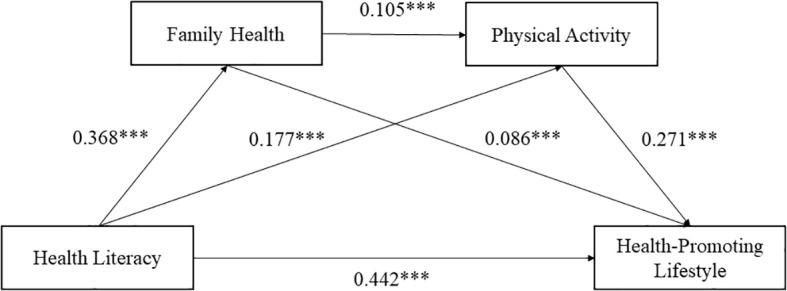
There were significant pairwise correlations between HL, family health, PA, and HPL ( < 0.01). HL was directly linked to HPL (effect = 0.442; SE = 0.025; 95% CI: 0.392, 0.491). Additionally, three indirect pathways were identified: family health independently mediated 6.02% of the effect (effect = 0.032; SE = 0.010; 95% CI: 0.013, 0.051), PA also independently mediated 9.02% of the effect (effect = 0.048; SE = 0.010; 95% CI: 0.030, 0.068), and a combined chain mediation through both family health and PA accounted for 1.88% of the effect (effect = 0.010; SE = 0.003; 95% CI: 0.005, 0.017).
CONCLUSION
HL not only has a direct impact on promoting HPL but also influences it indirectly through the mediating roles of family health and PA. These insights elucidate the mechanisms by which HL affects HPL, providing valuable theoretical guidance for the development and implementation of effective strategies to encourage healthy lifestyle practices.
背景
采用促进健康的生活方式(HPL)对于改善整体健康状况和降低慢性病风险至关重要。中国社区居民的健康素养(HL)与HPL之间的关系较为复杂,潜在的中介因素尚未完全明确。家庭健康和身体活动(PA)可能在这种关系中发挥重要作用。本研究旨在构建一个链式中介模型,以探讨家庭健康和PA是否介导了HL对中国社区居民HPL的影响。
方法
采用便利抽样法,选取1072名中国社区居民进行横断面研究。所有参与者均完成了一份自填式问卷,该问卷收集了人口统计学信息,以及来自健康素养量表简表(HLS-SF12)、家庭健康量表简表(FHS-SF)、身体活动评分量表(PARS-3)和促进健康生活方式概况-II修订版(HPLP-II R)的数据。使用SPSS 26.0对数据进行分析,采用SPSS PROCESS宏进行中介分析。
结果
HL、家庭健康、PA和HPL之间存在显著的两两相关性(<0.01)。HL与HPL直接相关(效应=0.442;标准误=0.025;95%置信区间:0.392,0.491)。此外,还确定了三条间接路径:家庭健康独立介导了6.02%的效应(效应=0.032;标准误=0.010;95%置信区间:0.013,0.051),PA也独立介导了9.02%的效应(效应=0.048;标准误=0.010;95%置信区间:0.030,0.068),通过家庭健康和PA的联合链式中介占效应的1.88%(效应=0.010;标准误=0.003;95%置信区间:照0.005,0.017)。
结论
HL不仅对促进HPL有直接影响,还通过家庭健康和PA的中介作用间接影响HPL。这些见解阐明了HL影响HPL的机制,为制定和实施鼓励健康生活方式的有效策略提供了有价值的理论指导。
 Zotero 插件