
体育锻炼休息对模拟课堂环境中执行功能的影响:揭开通向大脑的一扇窗
Effects of Physical Exercise Breaks on Executive Function in a Simulated Classroom Setting: Uncovering a Window into the Brain.
作者信息
Yu Qian, Zhang Zhihao, Ludyga Sebastian, Erickson Kirk I, Cheval Boris, Hou Meijun, Pindus Dominika M, Hillman Charles H, Kramer Arthur F, Falck Ryan S, Liu-Ambrose Teresa, Kuang Jin, Mullen Sean P, Kamijo Keita, Ishihara Toru, Raichlen David A, Heath Matthew, Moreau David, Werneck André O, Herold Fabian, Zou Liye
机构信息
Body-Brain-Mind Laboratory, School of Psychology, Shenzhen University, Shenzhen, 518060, China.
Faculty of Education, University of Macau, Macau, 999078, China.
出版信息
Adv Sci (Weinh). 2025 Jan;12(3):e2406631. doi: 10.1002/advs.202406631. Epub 2024 Nov 25.
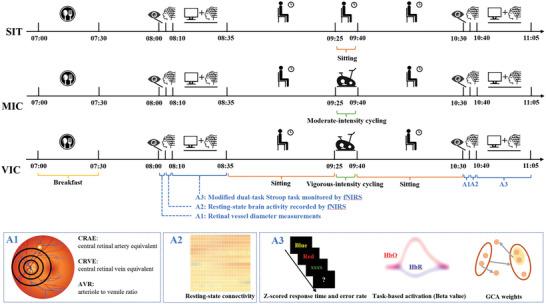
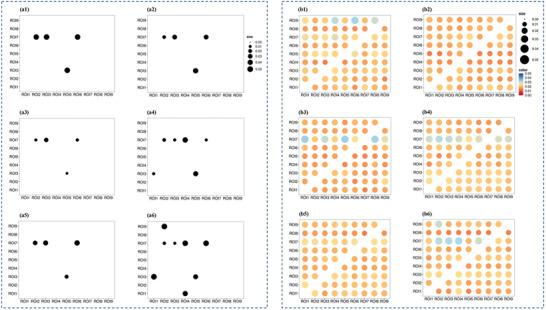
Acknowledging the detrimental effects of prolonged sitting, this study examined the effects of an acute exercise break during prolonged sitting on executive function, cortical hemodynamics, and microvascular status. In this randomized crossover study, 71 college students completed three conditions: (i) uninterrupted sitting (SIT); (ii) SIT with a 15 min moderate-intensity cycling break (MIC); and (iii) SIT with a 15 min vigorous-intensity cycling break (VIC). Behavioral outcomes, retinal vessel diameters (central retinal artery equivalents [CRAE], retinal vein equivalents [CRVE], arteriovenous ratio [AVR]), cortical activation, and effective connectivity were evaluated. Linear mixed models identified significant positive effects of exercise conditions on behavioral reaction time (RT), error rate, and inverse efficiency score (β = -2.62, -0.19, -3.04: ps < 0.05). MIC and VIC conditions produced pre-to-post-intervention increases in CRAE and CRVE (β = 4.46, 6.34), frontal activation, and resting-state and task-state causal density (β = 0.37, 0.06) (ps < 0.05) compared to SIT; VIC was more beneficial for executive function and neurobiological parameters. The effect of AVR on average RT was mediated through task-based causal density (indirect effect: -0.82). Acutely interrupting prolonged sitting improves executive function, microvascular status, and cortical activation and connectivity, with causal density mediating the microvascular-executive function link.
认识到长时间坐着的有害影响,本研究考察了长时间坐着期间进行一次急性运动休息对执行功能、皮质血流动力学和微血管状态的影响。在这项随机交叉研究中,71名大学生完成了三种情况:(i)不间断坐着(SIT);(ii)坐着并进行15分钟中等强度的自行车运动休息(MIC);以及(iii)坐着并进行15分钟高强度的自行车运动休息(VIC)。评估了行为结果、视网膜血管直径(视网膜中央动脉等效值[CRAE]、视网膜静脉等效值[CRVE]、动静脉比[AVR])、皮质激活和有效连接性。线性混合模型确定运动情况对行为反应时间(RT)、错误率和反向效率得分有显著的正向影响(β = -2.62,-0.19,-3.04:p<0.05)。与SIT相比,MIC和VIC情况在干预前后使CRAE和CRVE增加(β = 4.46,6.34),额叶激活以及静息状态和任务状态的因果密度增加(β = 0.37,0.06)(p<0.05);VIC对执行功能和神经生物学参数更有益。AVR对平均RT的影响通过基于任务的因果密度介导(间接效应:-0.82)。急性中断长时间坐着可改善执行功能、微血管状态以及皮质激活和连接性,因果密度介导了微血管与执行功能之间的联系。




 Zotero 插件