
先进的肝纤维化,但不是 MASLD,与加速的生物衰老有关:一项基于人群的研究。
Advanced liver fibrosis, but not MASLD, is associated with accelerated biological aging: a population-based study.
机构信息
Department of Gastroenterology, Anhui Provincial Key Laboratory of Digestive Disease, the First Affiliated Hospital of Anhui Medical University, Hefei, 230032, China.
Department of Gastroenterology, the First Affiliated Hospital of Wannan Medical College, Wuhu, 241000, China.
出版信息
BMC Public Health. 2024 Nov 27;24(1):3293. doi: 10.1186/s12889-024-20808-y.
BACKGROUND
The process of biological aging in patients diagnosed with chronic liver disease remains unclear.
AIM
The current study aims to investigate if there is an accelerated biological aging process in participants with advanced fibrosis (AF) and metabolic dysfunction-associated steatotic liver disease (MASLD).
METHODS
Data from the 2017-2018 NHANES cycle were analyzed. AF was determined based on the values of liver stiffness measurement (LSM) and MASLD was defined according to new consensus nomenclature. Klemera-Doubal method biological age (KDM bioage) and Phenotypic age (Phenoage) were adopted to quantify biological age. Phenoage advancement (Phenoage_advance) and KDM advancement (KDM_advance) were generated as the difference between the calculated biological age and chronological age, and a positive residual was regarded as an indicator of accelerated biological aging.
RESULTS
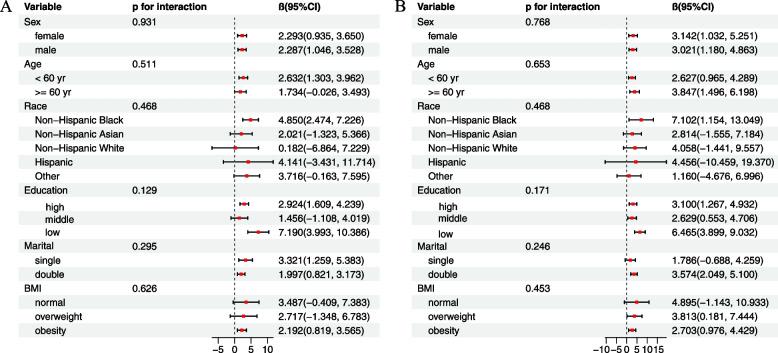
A total of 3974 participants was enrolled. The weight mean KDM_advance and phenoage_advance in AF group was 4.22 years (95%CI: 2.96-5.49 years) and 2.61 years (95%CI: 1.80-3.41 years), while in MASLD group was 0.37 years (95%CI: -0.28-1.03 years) and 0.04 years (95%CI: -0.64-0.72 years), respectively. Multivariate linear regression analysis showed that participants with AF had older KDM_advance and phenoage_advance compared with those without AF (1.50 years (95%CI: 0.23-2.77 years), P = 0.02; 1.00 years (95%CI: 0.18-1.82 years), P = 0.02; respectively), in models adjusting demographic characteristics, socioeconomic status, lifestyle factors, and comorbidities. No significant association was found between MASLD and KDM_advance and phenoage_advance.
CONCLUSIONS
AF, not MASLD, was independently associated with accelerated biological aging in adults from a US representative sample.
背景
慢性肝病患者的生物学衰老过程尚不清楚。
目的
本研究旨在探讨在晚期纤维化(AF)和代谢相关脂肪性肝病(MASLD)患者中是否存在加速的生物学衰老过程。
方法
分析了 2017-2018 年 NHANES 周期的数据。根据肝硬度测量值(LSM)确定 AF,根据新的共识命名法定义 MASLD。采用 Klemera-Doubal 方法生物年龄(KDM bioage)和表型年龄(Phenoage)来量化生物年龄。生成表型年龄提前(Phenoage_advance)和 KDM 提前(KDM_advance)作为计算的生物年龄与实际年龄之间的差值,正残差被认为是加速生物衰老的指标。
结果
共纳入 3974 名参与者。AF 组的体重平均 KDM_advance 和 phenoage_advance 分别为 4.22 岁(95%CI:2.96-5.49 岁)和 2.61 岁(95%CI:1.80-3.41 岁),而 MASLD 组分别为 0.37 岁(95%CI:-0.28-1.03 岁)和 0.04 岁(95%CI:-0.64-0.72 岁)。多变量线性回归分析显示,与无 AF 患者相比,AF 患者的 KDM_advance 和 phenoage_advance 更老,分别为 1.50 岁(95%CI:0.23-2.77 岁),P=0.02;1.00 岁(95%CI:0.18-1.82 岁),P=0.02;在调整人口统计学特征、社会经济地位、生活方式因素和合并症的模型中。MASLD 与 KDM_advance 和 phenoage_advance 之间无显著相关性。
结论
在来自美国代表性样本的成年人中,AF 而非 MASLD 与加速的生物学衰老独立相关。
 Zotero 插件