
从阿尔茨海默病的基础到创新:分子发现和革命性疗法。
From Fundamentals to Innovation in Alzheimer's Disease: Molecular Findings and Revolutionary Therapies.
机构信息
Doctoral School, "Carol Davila" University of Medicine and Pharmacy Bucharest, 020021 Bucharest, Romania.
Department of Infectious Diseases, "Carol Davila" University of Medicine and Pharmacy Bucharest, 020021 Bucharest, Romania.
出版信息
Int J Mol Sci. 2024 Nov 16;25(22):12311. doi: 10.3390/ijms252212311.
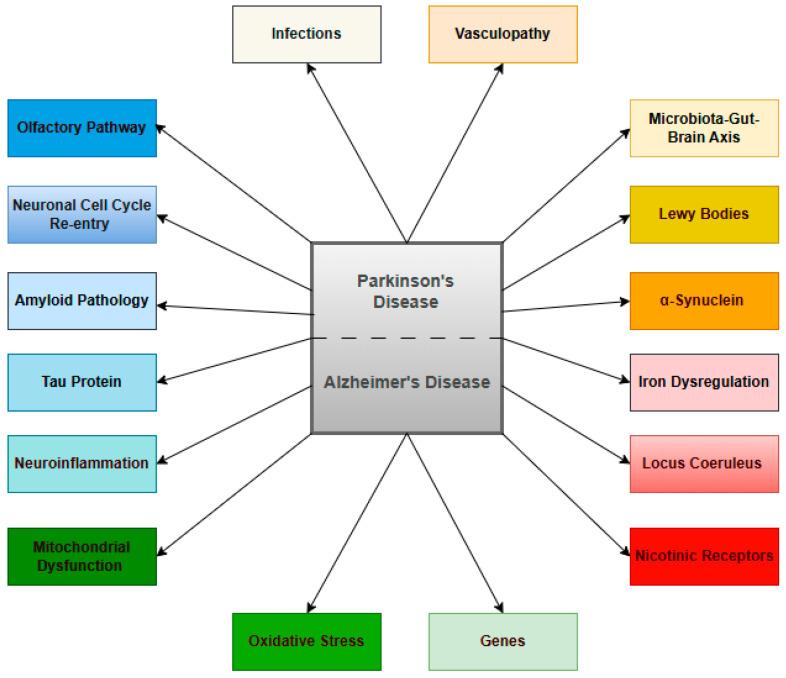
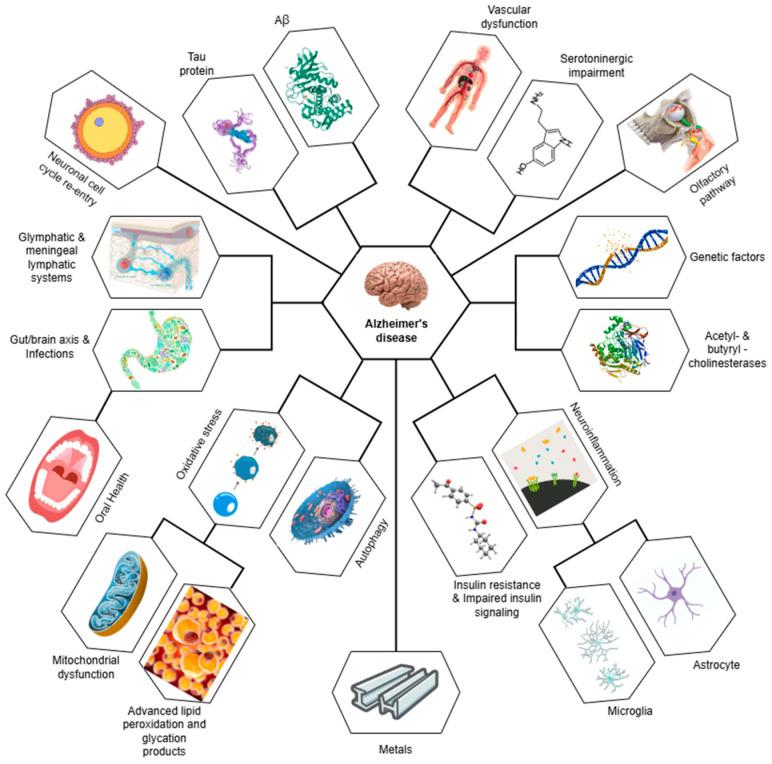
Alzheimer's disease (AD) is a global health concern and the leading cause of dementia in the elderly. The prevalence of this neurodegenerative condition is projected to increase concomitantly with increased life expectancy, resulting in a significant economic burden. With very few FDA-approved disease-modifying drugs available for AD, there is an urgent need to develop new compounds capable of impeding the progression of the disease. Given the unclear etiopathogenesis of AD, this review emphasizes the underlying mechanisms of this condition. It explores not only well-studied aspects, such as the accumulation of Aβ plaques and neurofibrillary tangles, but also novel areas, including glymphatic and lymphatic pathways, microbiota and the gut-brain axis, serotoninergic and autophagy alterations, vascular dysfunction, the metal hypothesis, the olfactory pathway, and oral health. Furthermore, the potential molecular targets arising from all these mechanisms have been reviewed, along with novel promising approaches such as nanoparticle-based therapy, neural stem cell transplantation, vaccines, and CRISPR-Cas9-mediated genome editing techniques. Taking into account the overlap of these various mechanisms, individual and combination therapies emerge as the future direction in the AD strategy.
阿尔茨海默病(AD)是一个全球性的健康问题,也是老年人痴呆症的主要原因。预计这种神经退行性疾病的患病率将随着预期寿命的延长而相应增加,从而带来巨大的经济负担。由于 AD 仅有极少数获得 FDA 批准的疾病修饰药物,因此迫切需要开发能够阻止疾病进展的新化合物。鉴于 AD 的发病机制尚不清楚,本综述强调了该疾病的潜在机制。它不仅探讨了研究较为充分的方面,如 Aβ 斑块和神经原纤维缠结的积累,还探讨了新的领域,包括糖质和淋巴管途径、微生物群和肠脑轴、血清素能和自噬改变、血管功能障碍、金属假说、嗅觉途径和口腔健康。此外,还综述了所有这些机制中出现的潜在分子靶点,以及新型有前途的方法,如基于纳米颗粒的治疗、神经干细胞移植、疫苗和 CRISPR-Cas9 介导的基因组编辑技术。考虑到这些不同机制的重叠,个体和联合治疗成为 AD 治疗策略的未来方向。
 Zotero 插件