
变革眼部护理:探索微针药物递送的潜力。
Revolutionizing Eye Care: Exploring the Potential of Microneedle Drug Delivery.
作者信息
Rojekar Satish, Parit Swapnali, Gholap Amol D, Manchare Ajit, Nangare Sopan N, Hatvate Navnath, Sugandhi Vrashabh V, Paudel Keshav Raj, Ingle Rahul G
机构信息
Department of Pharmacological Sciences, Icahn School of Medicine at Mount Sinai, New York, NY 10029, USA.
Institute of Chemical Technology, Marathwada Campus, Jalna 431203, India.
出版信息
Pharmaceutics. 2024 Oct 30;16(11):1398. doi: 10.3390/pharmaceutics16111398.
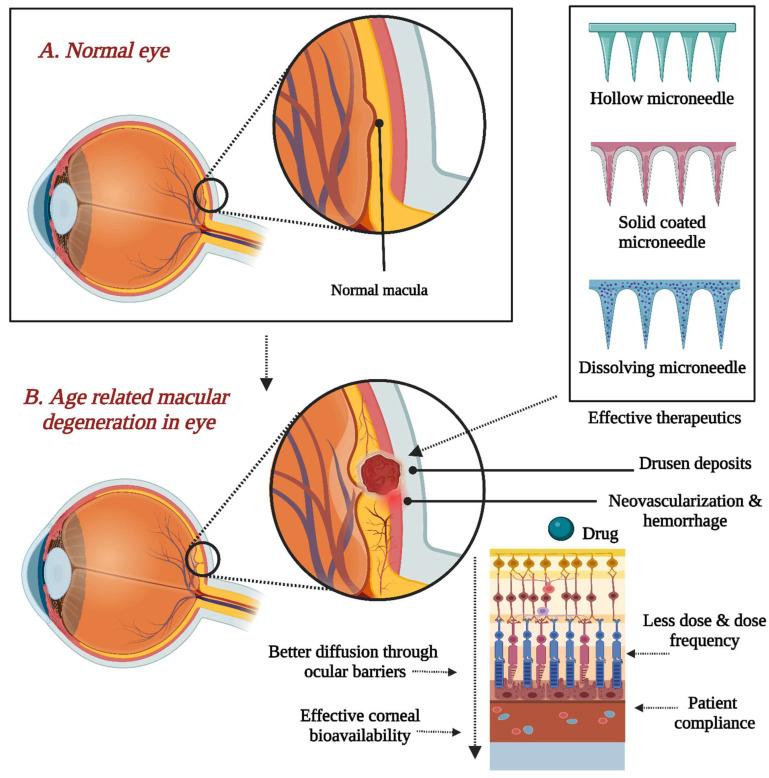
Microneedle technology revolutionizes ocular drug delivery by addressing challenges in treating ocular diseases. This review explores its potential impact, recent advancements, and clinical uses. This minimally invasive technique offers precise control of drug delivery to the eye, with various microneedle types showing the potential to penetrate barriers in the cornea and sclera, ensuring effective drug delivery. Recent advancements have improved safety and efficacy, offering sustained and controlled drug delivery for conditions like age-related macular degeneration and glaucoma. While promising, challenges such as regulatory barriers and long-term biocompatibility persist. Overcoming these through interdisciplinary research is crucial. Ultimately, microneedle drug delivery presents a revolutionary method with the potential to significantly enhance ocular disease treatment, marking a new era in eye care.
微针技术通过解决眼部疾病治疗中的挑战,彻底改变了眼部药物递送方式。本综述探讨了其潜在影响、最新进展及临床应用。这种微创技术能够精确控制药物递送至眼部,不同类型的微针显示出穿透角膜和巩膜屏障的潜力,确保药物有效递送。最近的进展提高了安全性和有效性,为年龄相关性黄斑变性和青光眼等病症提供了持续且可控的药物递送。尽管前景广阔,但监管障碍和长期生物相容性等挑战依然存在。通过跨学科研究克服这些挑战至关重要。最终,微针药物递送提供了一种革命性的方法,有可能显著增强眼部疾病的治疗效果,标志着眼科护理的新时代。




 Zotero 插件