
非传统物种乳制品的分子特征和加工技术。
Molecular Characteristics and Processing Technologies of Dairy Products from Non-Traditional Species.
机构信息
Doctoral Program in Agrifood and Environment Sciences, Universidad de La Frontera, Temuco 4780000, Chile.
Meat Quality Innovation and Technology Centre (CTI-Carne), Universidad de La Frontera, Temuco 4780000, Chile.
出版信息
Molecules. 2024 Nov 18;29(22):5427. doi: 10.3390/molecules29225427.
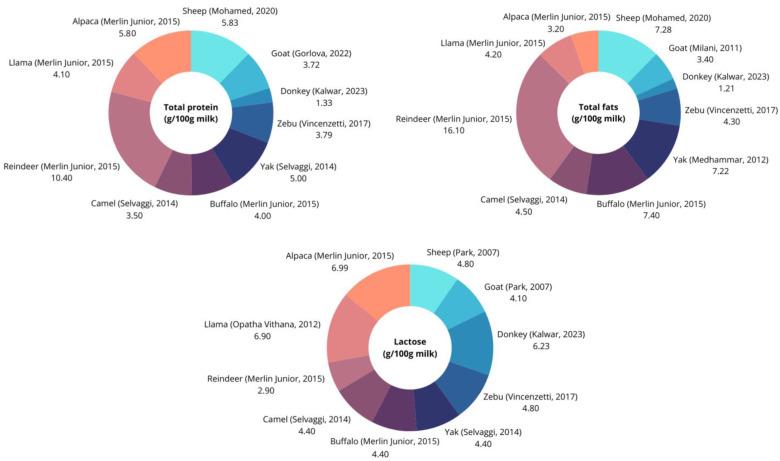
Non-bovine dairy animals, commonly referred to as non-traditional dairy species, include goats, sheep, yaks, buffalo, donkeys, alpacas, llamas, and other less commonly farmed species. These animals have been integral to livestock systems since ancient times, providing milk and other essential products. Despite their historical significance, dairy production from many of these species remains predominantly confined to rural areas in developing countries, where scientific advancements and technical improvements are often limited. As a consequence of this, the scientific literature and technological developments in the processing and characterization of dairy products from these species have lagged behind those for cow's milk. This review aims to compile and analyze existing research on dairy products derived from non-traditional animals, focusing on their molecular characteristics, including proteins (alpha, beta, kappa, and total casein), fats (cholesterol and total fat), lactose, albumin, ash, total solids, and somatic cell count, among others, for each of these species. Additionally, we discuss emerging technologies employed in their processing, encompassing both non-thermal methods (such as high-pressure processing, pulsed electric fields, ultrasound processing, UV-C irradiation, gamma radiation, microfiltration, and cold plasma processing) and thermal methods (such as ohmic heating). This review also explores the specific potential applications and challenges of implementing these technologies. By synthesizing recent findings, we aim to stimulate further research into innovative technologies and strategies that can enhance the quality and yield of non-bovine dairy products. Understanding the unique properties of milk from these species may lead to new opportunities for product development, improved processing methods, and increased commercialization in both developing and developed markets.
非牛科动物,通常被称为非传统奶畜,包括山羊、绵羊、牦牛、水牛、驴、羊驼、骆马和其他较少养殖的物种。这些动物自古以来就是畜牧业系统的重要组成部分,提供了牛奶和其他重要产品。尽管它们具有历史意义,但许多这些物种的奶制品生产仍然主要局限于发展中国家的农村地区,那里的科学进步和技术改进往往受到限制。因此,这些物种奶制品的加工和特性方面的科学文献和技术发展落后于牛奶。本综述旨在汇编和分析非传统动物奶制品的现有研究,重点关注它们的分子特性,包括蛋白质(α、β、κ 和总酪蛋白)、脂肪(胆固醇和总脂肪)、乳糖、白蛋白、灰分、总固形物和体细胞计数等,对每个物种都进行了分析。此外,我们还讨论了它们加工中采用的新兴技术,包括非热方法(如高压处理、脉冲电场、超声处理、UV-C 辐射、伽马辐射、微滤和冷等离子体处理)和热方法(如欧姆加热)。本综述还探讨了实施这些技术的特定潜在应用和挑战。通过综合最新发现,我们旨在促进对创新技术和策略的进一步研究,以提高非牛科动物奶制品的质量和产量。了解这些物种牛奶的独特性质可能会为产品开发、改进加工方法和在发展中和发达市场增加商业化带来新的机会。

 Zotero 插件