
新型电场缩窄电穿孔微芯片提高了猫胚胎的转染效率和存活率。
Novel electroporation microchip with field constriction enhances transfection efficiency and survival rates of feline embryos.
机构信息
Department of Obstetrics, Gynaecology, and Reproduction, Faculty of Veterinary Science, Chulalongkorn University, Bangkok, 10330, Thailand.
Center of Excellence for Veterinary Clinical Stem Cells and Bioengineering, Chulalongkorn University, Bangkok, 10330, Thailand.
出版信息
Sci Rep. 2024 Nov 27;14(1):29508. doi: 10.1038/s41598-024-80494-z.
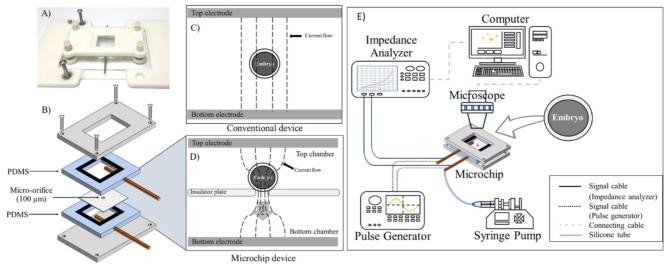
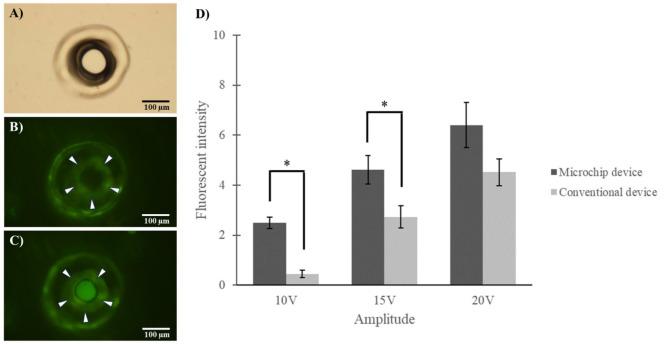
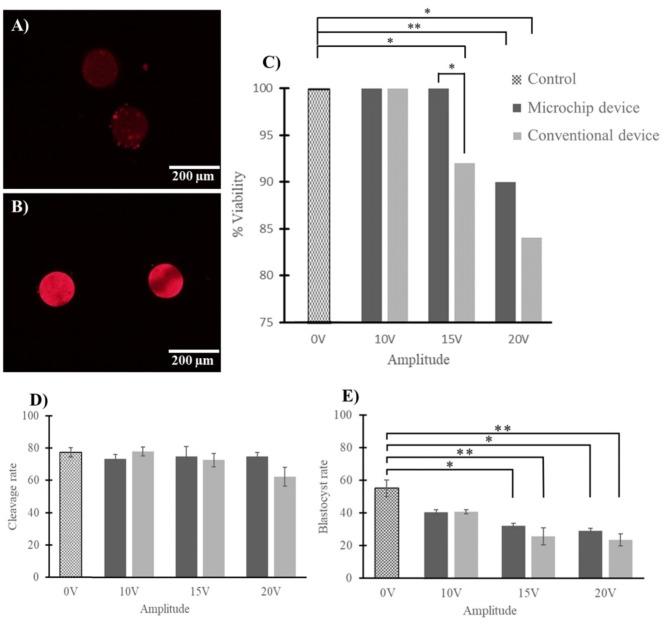
This study introduces a low-voltage electroporation microchip designed for transfection in cat embryos, featuring real-time impedance monitoring. The microchip uses a field constriction strategy, which localises the electric field to the membrane region in contact with the micro-orifice, enhancing electroporation efficiency while minimising damage. Embryos were positioned on the orifice, and a series of voltage pulses (10, 15, and 20 V) were applied. Electroporation efficacy was assessed using fluorescent dyes, followed by real-time impedance measurements to monitor the membrane resealing time. It provided valuable insights into membrane recovery times, essential for optimizing gene editing conditions to ensure efficient delivery and maintain cell integrity. The results demonstrated that the microchip with 15 V achieved a 69.5% higher electroporation rate and 100% of survival compared to conventional devices (p < 0.05). Additionally, the microchip successfully facilitated the transfer of green fluorescent protein genes into embryos, achieving a 78.5% success rate significantly greater compared to 53.6% with the conventional device (p < 0.05). This innovative microchip provides transformative transfection technology for safer and more efficient genomic modifications in embryos. It holds promising applications across species and therapeutic interventions, paving the way for future studies in advanced genomic research.
本研究介绍了一种用于猫胚胎转染的低压电穿孔微芯片,具有实时阻抗监测功能。该微芯片采用电场缩窄策略,将电场局限在与微孔接触的膜区域,提高电穿孔效率的同时最小化损伤。将胚胎放置在微孔上,施加一系列电压脉冲(10、15 和 20V)。使用荧光染料评估电穿孔效果,然后进行实时阻抗测量以监测膜封闭时间。这为优化基因编辑条件提供了有价值的见解,以确保高效传递和维持细胞完整性。结果表明,与传统设备相比,使用 15V 的微芯片的电穿孔率提高了 69.5%,存活率达到 100%(p<0.05)。此外,微芯片成功地将绿色荧光蛋白基因转移到胚胎中,成功率为 78.5%,明显高于传统设备的 53.6%(p<0.05)。这项创新的微芯片为胚胎中的更安全、更高效的基因组修饰提供了变革性的转染技术。它在跨物种和治疗干预方面具有广阔的应用前景,为未来的高级基因组研究铺平了道路。

 Zotero 插件