
一项针对高抑郁症状女性的温姆·霍夫方法干预的随机对照临床试验。
A randomized controlled clinical trial of a Wim Hof Method intervention in women with high depressive symptoms.
作者信息
Blades Robin, Mendes Wendy Berry, Don Brian P, Mayer Stefanie E, Dileo Rebecca, O'Bryan Julia, Fromer Elena, Guan Joanna Y, Cheng Sylvia S, Mason Ashley E, Prather Aric A, Epel Elissa S
机构信息
University of California, Los Angeles, Department of Psychology, USA.
Yale University, Department of Psychology, USA.
出版信息
Compr Psychoneuroendocrinol. 2024 Oct 24;20:100272. doi: 10.1016/j.cpnec.2024.100272. eCollection 2024 Nov.
OBJECTIVE
Stress is a driver of depression, and people with depression often struggle to cope with stress and anxiety. This study directly compares the mental health effects of a Wim Hof Method intervention to an active control condition (slow breathing) in women with high stress and high depressive symptoms.
METHODS
We randomized 84 healthy midlife women with high stress and high depressive symptoms to either: 1) the hormetic stress condition based on the Wim Hof Method (WHM) involving a breathing technique designed to induce intermittent hypoxia and cold showers (n = 41) or 2) an active comparison condition involving slow-paced breathing and warm showers (n = 43). We provided participants with daily audio instructions (15 min) for three weeks during the COVID-19 pandemic (2020-2021). Our primary outcomes were depressive symptoms, anxiety symptoms, and perceived stress collected at pre-intervention, post-intervention, and 3 months later. We also assessed daily stress rumination and affect with daily diary during the intervention, and participants completed a laboratory stressor, the Trier Social Stress Test, before and after the intervention, and provided samples for salivary cortisol reactivity.
RESULTS
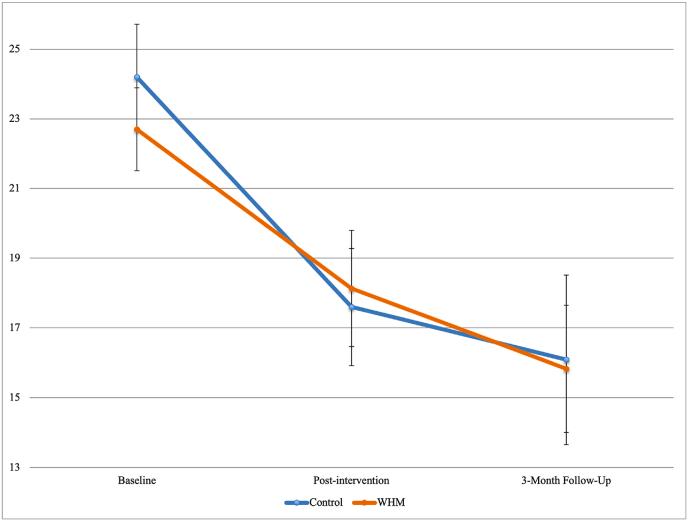
Participants in the active control condition perceived the intervention to be more credible and expected greater mental wellbeing benefits compared to those in the Wim Hof Method condition. Differential attrition was observed with six participants (7 %) dropping out -- all from WHM condition. Among the participants who completed the intervention, both groups improved on mental health outcomes immediately after the intervention with a 24 % reduction in depressive symptoms, a 27 % reduction in anxiety symptoms, and 20 % reduction in perceived stress. Improvements were maintained at the 3-month follow-up with 46 % of the sample reporting mild or no depressive symptoms. Participants in the WHM condition had significant reductions in rumination after daily stressful events compared to those in the active control group. Both conditions had reduced daily negative affect across the intervention and lower peak cortisol reactivity to the lab stressor post-intervention.
CONCLUSIONS
Counter to the preregistered predictions, and despite participants' differing expectations, the interventions led to equivalent reductions in depressive symptoms, anxiety symptoms, and perceived stress, which were sustained at three months. They also produced comparable reductions in cortisol reactivity and daily negative affect. However, the WHM condition was associated with greater reduction in reported rumination after daily stressful events than the active control, a finding that needs replication with larger and more diverse samples.
目的
压力是抑郁症的一个驱动因素,抑郁症患者常常难以应对压力和焦虑。本研究直接比较了维姆·霍夫方法干预与积极对照条件(慢呼吸)对高压力和高抑郁症状女性心理健康的影响。
方法
我们将84名有高压力和高抑郁症状的健康中年女性随机分为两组:1)基于维姆·霍夫方法(WHM)的应激适应条件,包括一种旨在诱发间歇性缺氧的呼吸技巧和冷水淋浴(n = 41);2)积极对照条件,包括慢节奏呼吸和温水淋浴(n = 43)。在2020 - 2021年新冠疫情期间,我们为参与者提供了为期三周的每日音频指导(15分钟)。我们的主要结局指标是在干预前、干预后和3个月后收集的抑郁症状、焦虑症状和感知压力。我们还在干预期间通过每日日记评估每日压力沉思和情绪,参与者在干预前后完成了一项实验室应激源测试——特里尔社会应激测试,并提供唾液皮质醇反应样本。
结果
与维姆·霍夫方法组的参与者相比,积极对照条件组的参与者认为干预更可信,并期望获得更大的心理健康益处。观察到有差异的损耗,6名参与者(7%)退出——均来自维姆·霍夫方法组。在完成干预的参与者中,两组在干预后心理健康结局立即得到改善,抑郁症状减少24%,焦虑症状减少27%,感知压力减少20%。在3个月的随访中,改善得以维持,46%的样本报告有轻度或无抑郁症状。与积极对照组相比,维姆·霍夫方法组的参与者在每日应激事件后的沉思有显著减少。在整个干预过程中,两组的每日负面情绪都有所减少,干预后对实验室应激源的皮质醇反应峰值也降低。
结论
与预先注册的预测相反,尽管参与者有不同的期望,但两种干预措施在抑郁症状、焦虑症状和感知压力方面导致了同等程度的降低,且在三个月时得以维持。它们在皮质醇反应性和每日负面情绪方面也产生了类似的降低。然而,与积极对照组相比,维姆·霍夫方法组在每日应激事件后报告的沉思减少幅度更大,这一发现需要在更大且更多样化的样本中进行重复验证。


 Zotero 插件