
甲壳动物模式识别受体:环境胁迫下的免疫作用。
Pattern recognition receptors in Crustacea: immunological roles under environmental stress.
机构信息
Department of Biology, University of Waterloo, Waterloo, ON, Canada.
出版信息
Front Immunol. 2024 Nov 14;15:1474512. doi: 10.3389/fimmu.2024.1474512. eCollection 2024.
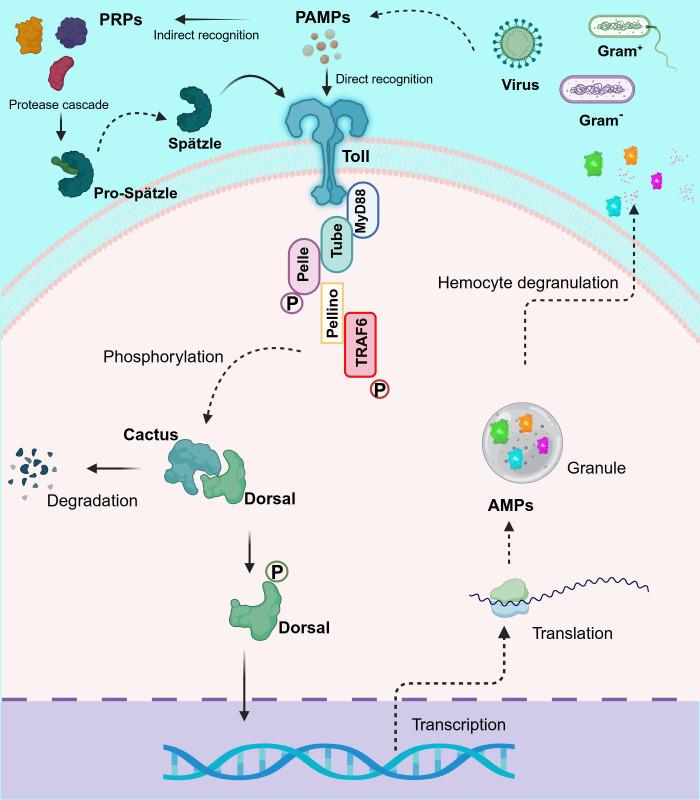
Innate immunity is the first line of defense against infections and the only known available strategy for invertebrates. Crustaceans, being mostly aquatic invertebrates, are constantly exposed to potential pathogens in the surrounding water. Their immune system abolishes most microbes that enter and are recognized as a threat. However, the stress produced by high population densities and abiotic changes, in aquaculture, disrupts the host-pathogen balance, leading to severe economic losses in this industry. Consequently, crustacean immunology has become a prime area of research where significant progress has been made. This review provides our current understanding of the key pattern recognition receptors in crustaceans, with special focus on Decapoda, and their roles in triggering an immune response. We discuss recent developments in the field of signal transduction pathways such as Toll-like receptors (TLRs) and the immune deficiency (IMD) pathway, and examine the role of antimicrobial peptides (AMPs) in pathogen defense. Additionally, we analyze how environmental stressors-such as temperature fluctuations, ammonia levels, and pollution-impact immune responses and increase susceptibility to diseases. Finally, we highlight future research directions, emphasizing the need to explore the interactions between environmental stressors and immune signaling pathways and to develop strategies to enhance immune responses in crustaceans within aquaculture settings. Altogether, these advancements deepen our understanding of pathogen recognition in invertebrates and the specific defense mechanisms employed by crustaceans, particularly in response to infections triggered by pathogens under abiotic stressors.
先天免疫是抵御感染的第一道防线,也是目前已知的无脊椎动物的唯一可用策略。甲壳类动物大多是水生无脊椎动物,它们经常暴露在周围水中的潜在病原体中。它们的免疫系统会消灭大多数进入并被识别为威胁的微生物。然而,水产养殖中高密度种群和非生物变化所产生的压力会破坏宿主-病原体平衡,导致该行业遭受严重的经济损失。因此,甲壳动物免疫学已成为一个主要的研究领域,在该领域取得了重大进展。本综述提供了我们目前对甲壳类动物关键模式识别受体的理解,特别关注十足目,并讨论了它们在触发免疫反应中的作用。我们讨论了信号转导途径(如 Toll 样受体 (TLR) 和免疫缺陷 (IMD) 途径)领域的最新进展,并研究了抗菌肽 (AMP) 在病原体防御中的作用。此外,我们分析了环境胁迫因素(如温度波动、氨水平和污染)如何影响免疫反应并增加对疾病的易感性。最后,我们强调了未来的研究方向,强调需要探索环境胁迫因素与免疫信号通路之间的相互作用,并开发在水产养殖环境中增强甲壳类动物免疫反应的策略。总之,这些进展加深了我们对无脊椎动物病原体识别以及甲壳类动物特定防御机制的理解,特别是对非生物胁迫下病原体引发的感染的防御机制。


 Zotero 插件