
用于革兰氏阴性菌分离株碳青霉烯酶亚型分型的先进基质辅助激光解吸电离飞行时间质谱的临床评估
Clinical evaluation of advanced MALDI-TOF MS for carbapenemase subtyping in Gram-negative isolates.
作者信息
Cheon Dong Huey, Jang Heejung, Choi Yoon Kyung, Oh Won Seok, Hwang Seohyun, Park Ju-Ri, Kim Hyojin, Park Yoonha, Lee Saeyoung, Yang Won Suk, Kim Min Jin, Lee Sun Hwa, Baek Je-Hyun
机构信息
R&D Center for Clinical Mass Spectrometry, Seegene Medical Foundation, Seoul, Republic of Korea.
Department of Laboratory Medicine, Seegene Medical Foundation, Seoul, Republic of Korea.
出版信息
J Clin Microbiol. 2025 Jan 31;63(1):e0147524. doi: 10.1128/jcm.01475-24. Epub 2024 Nov 29.
UNLABELLED
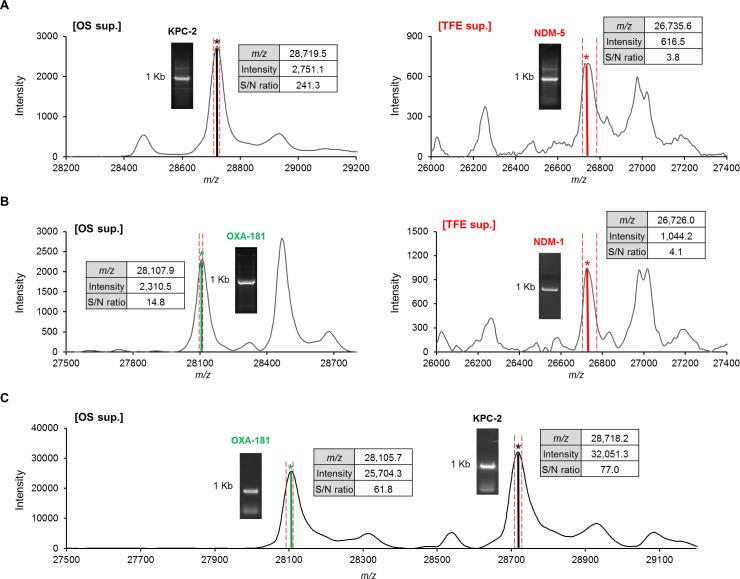
The spread of carbapenemase-producing Enterobacterales (CPE) is emerging as a significant clinical concern in tertiary hospitals and, in particular, long-term care facilities with deficiencies in infection control. This study aims to evaluate an advanced matrix-assisted laser desorption/ionization (A-MALDI) mass spectrometry method for the identification of carbapenemases and further discrimination of their subtypes in clinical isolates. The A-MALDI method was employed to detect CPE target proteins. Enhancements were made to improve detectability and mass accuracy through the optimization of MALDI-TOF settings and internal mass calibration. A total of 581 clinical isolates were analyzed, including 469 CPE isolates (388 carbapenemases [KPC], 51 NDM, 40 OXA, and 2 GES) and 112 carbapenemase-negative isolates. Clinical evaluation of the A-MALDI demonstrated 100% accuracy and precision in identifying all the collected CPE isolates. Additionally, A-MALDI successfully discriminated individual carbapenemase subtypes (KPC-2 or KPC-3/KPC-4, OXA-48 or OXA-181 or OXA-232, GES-5 or GES-24) and also differentiated co-producing carbapenemase strains (KPC and NDM, KPC and OXA, KPC and GES, and NDM and OXA), attributed to its high mass accuracy and simultaneous detection capability. A-MALDI is considered a valuable diagnostic tool for accurately identifying CPE and carbapenemase's subtypes in clinical isolates. It may also aid in selecting appropriate antibiotics for each carbapenemase subtype. Ultimately, we expect that the A-MALDI method will contribute to preventing the spread of antibiotic resistance and improving human public health.
IMPORTANCE
A-MALDI clearly demonstrated excellent ability to identify CPEs such as KPC, NDM, OXA, and GES when carbapenemase is present in the strain (100% accuracy and precision). The method also successfully discriminated carbapenemase subtypes and simultaneous detection of co-producing multiple carbapenemases in a single strain. This is the first report for simultaneous and multiple detection of intact carbapenemases of KPC, NDM, OXA, and GES using matrix-assisted laser desorption/ionization mass spectrometry in a clinical isolate.
未标注
产碳青霉烯酶肠杆菌科细菌(CPE)的传播正成为三级医院尤其是感染控制存在缺陷的长期护理机构中的一个重大临床问题。本研究旨在评估一种先进的基质辅助激光解吸/电离(A-MALDI)质谱方法,用于鉴定碳青霉烯酶并进一步区分临床分离株中其亚型。采用A-MALDI方法检测CPE靶蛋白。通过优化MALDI-TOF设置和内部质量校准进行改进,以提高检测能力和质量准确性。共分析了581株临床分离株,包括469株CPE分离株(388株碳青霉烯酶[KPC]、51株NDM、40株OXA和2株GES)和112株碳青霉烯酶阴性分离株。A-MALDI的临床评估显示,在鉴定所有收集的CPE分离株时,准确率和精密度均为100%。此外,A-MALDI成功区分了各个碳青霉烯酶亚型(KPC-2或KPC-3/KPC-4、OXA-48或OXA-181或OXA-232、GES-5或GES-24),还区分了共产生碳青霉烯酶的菌株(KPC和NDM、KPC和OXA、KPC和GES以及NDM和OXA),这归因于其高质量准确性和同时检测能力。A-MALDI被认为是一种有价值的诊断工具,可准确鉴定临床分离株中的CPE和碳青霉烯酶亚型。它还可能有助于为每种碳青霉烯酶亚型选择合适的抗生素。最终,我们期望A-MALDI方法将有助于预防抗生素耐药性的传播并改善人类公共卫生。
重要性
当菌株中存在碳青霉烯酶时,A-MALDI在鉴定KPC、NDM、OXA和GES等CPE方面表现出卓越能力(准确率和精密度均为100%)。该方法还成功区分了碳青霉烯酶亚型,并能在单个菌株中同时检测多种共产生的碳青霉烯酶。这是首次在临床分离株中使用基质辅助激光解吸/电离质谱同时多重检测KPC、NDM、OXA和GES完整碳青霉烯酶的报告。


 Zotero 插件