
感知到的新冠病毒疾病风险与感知到的乳腺癌风险变化之间的关系:前瞻性观察性研究
Relationship Between Perceived COVID-19 Risk and Change in Perceived Breast Cancer Risk: Prospective Observational Study.
作者信息
Baxter-King Ryan, Naeim Arash, Huang Tina Q, Sepucha Karen, Stanton Annette, Rudkin Aaron, Ryu Rita, Sabacan Leah, Vavreck Lynn, Esserman Laura, Stover Fiscalini Allison, Wenger Neil S
机构信息
Department of Political Science, UCLA, Los Angeles, CA, United States.
Center for SMART Health, Clinical and Translational Science Institute, David Geffen School of Medicine at UCLA, Los Angeles, CA, United States.
出版信息
JMIR Cancer. 2024 Dec 2;10:e47856. doi: 10.2196/47856.
BACKGROUND
Whether COVID-19 is associated with a change in risk perception about other health conditions is unknown. Because COVID-19 occurred during a breast cancer study, we evaluated the effect of COVID-19 risk perception on women's breast cancer risk perception.
OBJECTIVE
This study aims to evaluate the relationship between perceived risk of COVID-19 and change in perceived breast cancer risk. We hypothesized that women who perceived greater COVID-19 risk would evidence increased perceived breast cancer risk and this risk would relate to increased anxiety and missed cancer screening.
METHODS
Women aged 40-74 years with no breast cancer history were enrolled in a US breast cancer prevention trial in outpatient settings. They had provided breast cancer risk perception and general anxiety before COVID-19. We performed a prospective observational study of the relationship between the perceived risk of COVID-19 and the change in perceived breast cancer risk compared to before the pandemic. Each woman was surveyed up to 4 times about COVID-19 and breast cancer risk perception, general anxiety, and missed medical care early in COVID-19 (May to December 2020).
RESULTS
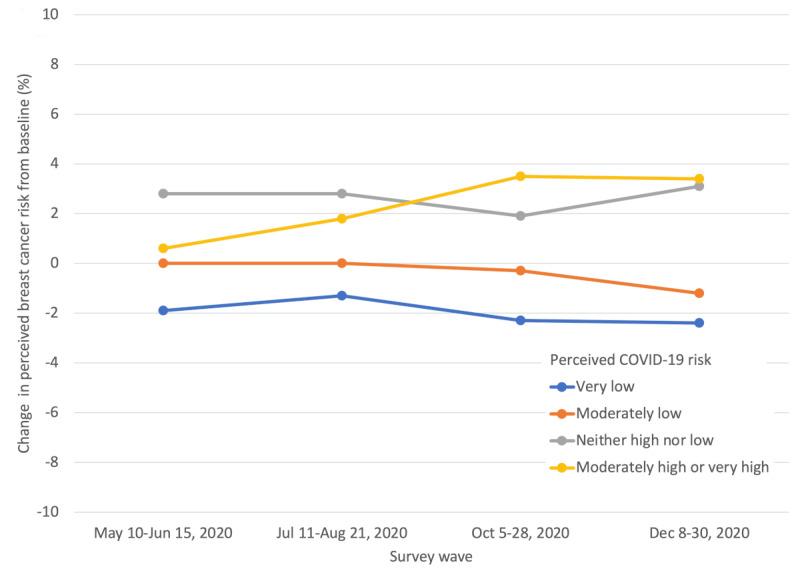
Among 13,002 women who completed a survey, compared to before COVID-19, anxiety was higher during COVID-19 (mean T score 53.5 vs 49.7 before COVID-19; difference 3.8, 95% CI 3.6-4.0; P<.001) and directly related to perceived COVID-19 risk. In survey wave 1, anxiety increased by 2.3 T score points for women with very low perceived COVID-19 risk and 5.2 points for those with moderately or very high perceived COVID-19 risk. Despite no overall difference in breast cancer risk perception (mean 32.5% vs 32.5% before COVID-19; difference 0.24, 95% CI -0.47 to 0.52; P=.93), there was a direct relationship between change in perceived breast cancer risk with COVID-19 risk perception, ranging in survey wave 4 from a 2.4% decrease in breast cancer risk perception for those with very low COVID-19 risk perception to a 3.4% increase for women with moderately to very high COVID-19 risk perception. This was not explained by the change in anxiety or missed cancer screening. After adjustment for age, race, education, and survey wave, compared to women with very low perceived COVID-19 risk, perceived breast cancer risk increased by 1.54% (95% CI 0.75%-2.33%; P<.001), 4.28% (95% CI 3.30%-5.25%; P<.001), and 3.67% (95% CI 1.94%-5.40%; P<.001) for women with moderately low, neither high nor low, and moderately or very high perceived COVID-19 risk, respectively.
CONCLUSIONS
Low perceived COVID-19 risk was associated with reduced perceived breast cancer risk, and higher levels of perceived COVID-19 risk were associated with increased perceived breast cancer risk. This natural experiment suggests that a threat such as COVID-19 may have implications beyond the pandemic. Preventive health behaviors related to perceived risk may need attention as COVID-19 becomes endemic.
背景
新冠病毒病(COVID-19)是否与对其他健康状况的风险认知变化相关尚不清楚。由于COVID-19在一项乳腺癌研究期间发生,我们评估了COVID-19风险认知对女性乳腺癌风险认知的影响。
目的
本研究旨在评估COVID-19的感知风险与感知乳腺癌风险变化之间的关系。我们假设,认为COVID-19风险更高的女性会表现出更高的感知乳腺癌风险,并且这种风险会与焦虑增加和错过癌症筛查相关。
方法
年龄在40 - 74岁且无乳腺癌病史的女性参加了美国一项在门诊进行的乳腺癌预防试验。她们在COVID-19之前已提供了乳腺癌风险认知和一般焦虑情况。我们对COVID-19的感知风险与大流行前相比感知乳腺癌风险的变化之间的关系进行了前瞻性观察研究。在COVID-19早期(2020年5月至12月),对每位女性就COVID-19和乳腺癌风险认知、一般焦虑以及错过的医疗护理进行了多达4次的调查。
结果
在13002名完成调查的女性中,与COVID-19之前相比,COVID-19期间焦虑水平更高(平均T评分53.5对COVID-19之前的49.7;差异3.8,95%CI 3.6 - 4.0;P <.001),并且与COVID-19的感知风险直接相关。在第1轮调查中,COVID-19感知风险非常低的女性焦虑增加2.3个T评分点,而COVID-19感知风险中等或非常高的女性焦虑增加5.2个点。尽管乳腺癌风险认知没有总体差异(平均32.5%对COVID-19之前的32.5%;差异0.24,95%CI -0.47至0.52;P = 0.93),但感知乳腺癌风险变化与COVID-19风险认知之间存在直接关系,在第4轮调查中,COVID-19感知风险非常低的女性乳腺癌风险认知降低2.4%,而COVID-19感知风险中等至非常高的女性乳腺癌风险认知增加3.4%。这无法用焦虑或错过癌症筛查的变化来解释。在调整年龄、种族、教育程度和调查轮次后,与COVID-19感知风险非常低的女性相比,COVID-19感知风险中等偏低、既不高也不低、中等或非常高的女性,其感知乳腺癌风险分别增加了1.54%(95%CI 0.75% - 2.33%;P <.001)、4.28%(95%CI 3.30% - 5.25%;P <.001)和3.67%(95%CI 1.94% - 5.40%;P <.001)。
结论
低COVID-19感知风险与降低的感知乳腺癌风险相关,而较高水平的COVID-19感知风险与增加的感知乳腺癌风险相关。这项自然实验表明,像COVID-19这样的威胁可能产生超出大流行本身的影响。随着COVID-19成为地方病,与感知风险相关的预防性健康行为可能需要关注。

 Zotero 插件