
身体圆润度指数和身体形状指数与阻塞性睡眠呼吸暂停的关联:来自2015 - 2018年美国国家健康与营养检查调查(NHANES)数据的见解
Association of Body Roundness Index and A Body Shape Index with Obstructive Sleep Apnea: insights from NHANES 2015-2018 data.
作者信息
Pan Xue, Liu Fang, Fan Jiayi, Guo Qihan, Guo Mengfei, Chen Yuxin, Sun Jingyao, Cao Xuezhao
机构信息
Department of Anesthesiology, The First Hospital of China Medical University, Shenyang, China.
Department of Neurology, The First Hospital of China Medical University, Shenyang, China.
出版信息
Front Nutr. 2024 Nov 18;11:1492673. doi: 10.3389/fnut.2024.1492673. eCollection 2024.
OBJECTIVE
This study examines the relationship between several anthropometric indices-Body Roundness Index (BRI), A Body Shape Index (ABSI), Waist-to-Weight Index (WWI), Waist Circumference (WC), and Body Mass Index (BMI)-and the prevalence of Obstructive Sleep Apnea (OSA) using data from the National Health and Nutrition Examination Survey (NHANES) spanning 2015 to 2018.
METHODS
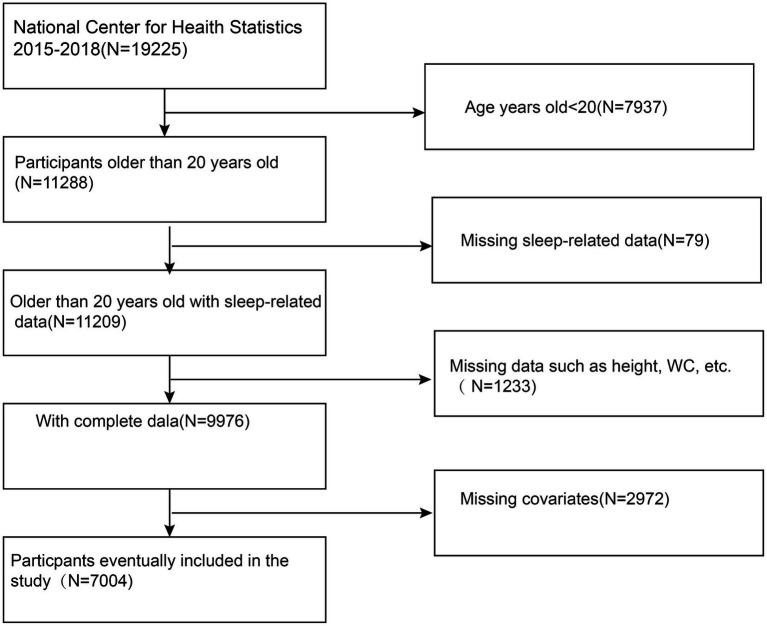
A retrospective cross-sectional analysis of 7,004 adult participants was conducted using NHANES 2015-2018 data. Multivariable-adjusted logistic regression models were employed to assess the association between BRI, ABSI, and OSA. Non-linear relationships were explored via smooth curve fitting and threshold effect analysis using a two-part linear regression model. Subgroup analyses identified sensitive populations, and the discriminatory power of the indices in screening OSA was assessed using Receiver Operating Characteristic (ROC) curves.
RESULTS
The analysis revealed a significant positive association between BRI and OSA, with a threshold effect observed at a BRI of 4.3. Below this threshold, OSA risk increased with higher BRI; however, no significant association was found above this threshold. Similarly, ABSI demonstrated a threshold effect at 8.2, with OSA risk positively associated to the left and negatively associated to the right. Subgroup analyses indicated stronger associations in younger and non-diabetic populations. ROC analysis identified BRI as a promising predictive tool for OSA, with an AUC of 0.64 (95% CI: 0.62-0.65).
CONCLUSION
BRI demonstrates significant potential as a predictive index for OSA incidence, warranting further large-scale prospective studies to validate these findings.
目的
本研究利用2015年至2018年美国国家健康与营养检查调查(NHANES)的数据,探讨几个身体测量指标——身体圆润度指数(BRI)、身体形状指数(ABSI)、腰重指数(WWI)、腰围(WC)和体重指数(BMI)——与阻塞性睡眠呼吸暂停(OSA)患病率之间的关系。
方法
使用NHANES 2015 - 2018年的数据对7004名成年参与者进行回顾性横断面分析。采用多变量调整逻辑回归模型评估BRI、ABSI与OSA之间的关联。通过平滑曲线拟合和使用两部分线性回归模型的阈值效应分析来探索非线性关系。亚组分析确定了敏感人群,并使用受试者工作特征(ROC)曲线评估这些指标在筛查OSA中的鉴别能力。
结果
分析显示BRI与OSA之间存在显著正相关,在BRI为4.3时观察到阈值效应。低于此阈值,OSA风险随BRI升高而增加;然而,高于此阈值未发现显著关联。同样,ABSI在8.2时表现出阈值效应,OSA风险在左侧呈正相关,在右侧呈负相关。亚组分析表明在年轻和非糖尿病人群中关联更强。ROC分析确定BRI是一种有前景的OSA预测工具,曲线下面积(AUC)为0.64(95%置信区间:0.62 - 0.65)。
结论
BRI作为OSA发病率的预测指标具有显著潜力,值得进一步开展大规模前瞻性研究以验证这些发现。


 Zotero 插件