
MelM菌株会干扰无法产卵的雌性果蝇的卵子保留。
strain MelM disrupts egg retention by females prevented from ovipositing.
作者信息
Ross Perran A, Yeatman Ella, Berran Mel S, Gu Xinyue, Hoffmann Ary A, van Heerwaarden Belinda
机构信息
Pest and Environmental Adaptation Research Group, School of BioSciences, Bio21 Molecular Science and Biotechnology Institute, The University of Melbourne, Parkville, Australia.
出版信息
Appl Environ Microbiol. 2025 Jan 31;91(1):e0149124. doi: 10.1128/aem.01491-24. Epub 2024 Dec 4.
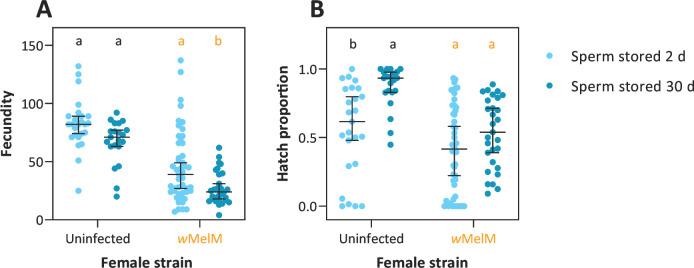
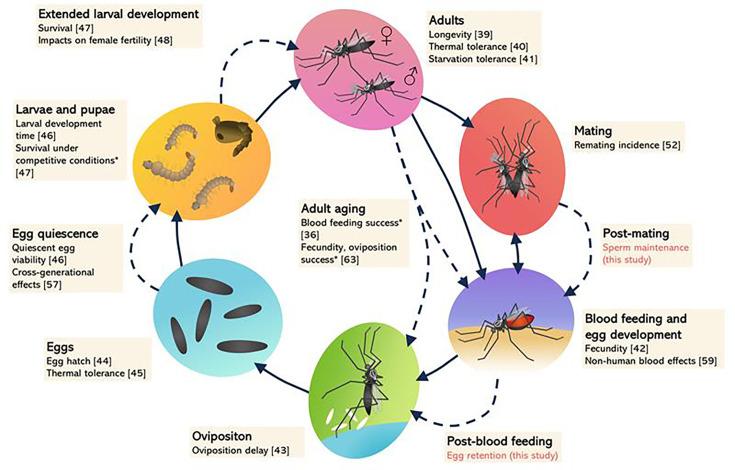
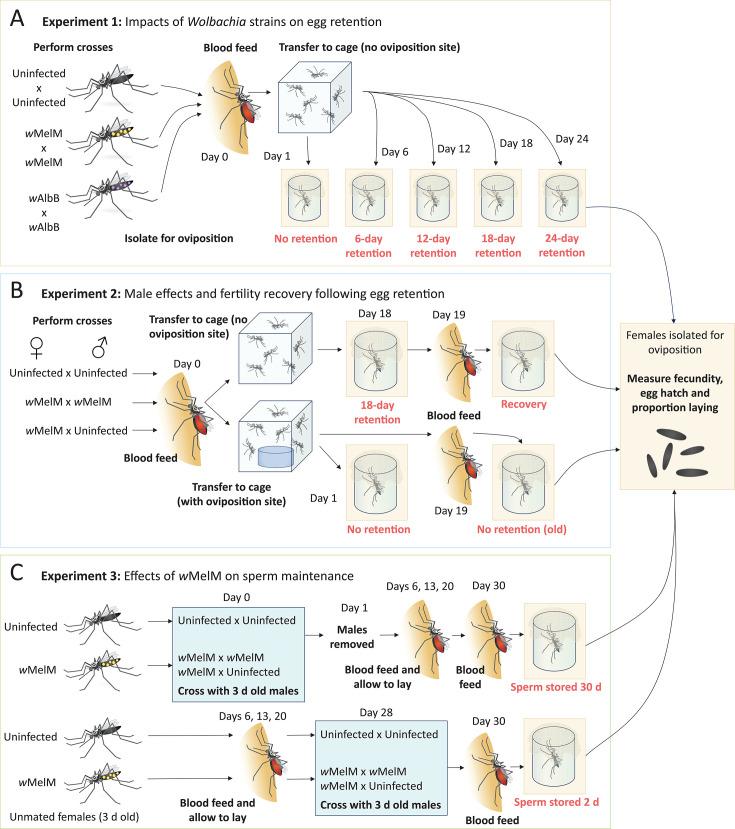
mosquitoes are well adapted to dry climates and can retain their eggs for extended periods in the absence of suitable habitat. strains transferred from other insects to mosquitoes can be released to combat dengue transmission by blocking virus replication and spreading through populations, but host fitness costs imposed by , particularly under some environments, can impede spread. We, therefore, assessed the impact of two strains being released for dengue control (AlbB and MelM) on fecundity and egg viability following extended egg retention (up to 24 days) under laboratory conditions. Egg viability following retention decreased to a greater extent in females carrying MelM compared to uninfected or AlbB females. Fertility fully recovered in uninfected females following a second blood meal after laying retained eggs, while MelM females experienced only partial recovery. Effects of MelM on egg retention were similar regardless of whether females were crossed to uninfected or MelM males, suggesting that fitness costs were triggered by presence in females. The fecundity and hatch proportions of eggs of MelM females declined with age, regardless of whether females used stored sperm or were recently inseminated. Costs of some strains during egg retention may affect the invasion and persistence of in release sites where larval habitats are scarce and/or intermittent.IMPORTANCE mosquito releases are expanding around the world with substantial impacts on dengue transmission. Releases have succeeded in many locations, but the establishment of has been challenging in some environments, and the factors contributing to this outcome remain unresolved. Here, we explore the effects of on a novel trait, egg retention, which is likely to be important for the persistence of mosquito populations in locations with intermittent rainfall. We find substantial impacts of the strain MelM on the quality of retained eggs but not the AlbB strain. This cost is driven by the infection status of the female and can partially recover following a second blood meal. The results of our study may help to explain the difficulty in establishing strains at some field release sites and emphasize the need to characterize phenotypes across a variety of traits and strains.
蚊子非常适应干燥气候,在缺乏适宜栖息地的情况下,其卵可以长时间保存。从其他昆虫转移到蚊子体内的菌株可以通过阻断病毒复制并在种群中传播来释放,以对抗登革热传播,但特别是在某些环境下,由其带来的宿主适应性成本可能会阻碍传播。因此,我们评估了在实验室条件下,为控制登革热而释放的两种菌株(AlbB和MelM)在延长卵保存时间(长达24天)后对繁殖力和卵活力的影响。与未感染或携带AlbB的雌性相比,携带MelM的雌性在保存后卵活力下降的程度更大。产卵后保留的卵在第二次吸血后,未感染雌性的生育力完全恢复,而携带MelM的雌性仅部分恢复。无论雌性与未感染的雄性还是MelM雄性杂交,MelM对卵保存的影响都是相似的,这表明适应性成本是由雌性体内的菌株存在引发的。携带MelM的雌性的繁殖力和卵孵化比例随年龄下降,无论雌性是使用储存的精子还是最近受精。在卵保存期间,某些菌株的成本可能会影响在幼虫栖息地稀缺和/或间歇性出现的释放地点中菌株的入侵和持久性。重要性 蚊子释放正在全球范围内扩大,对登革热传播产生重大影响。释放已经在许多地方取得成功,但在某些环境中,菌株的定殖一直具有挑战性,导致这一结果的因素仍未得到解决。在这里,我们探讨了菌株对一种新特性——卵保存的影响,这可能对间歇性降雨地区蚊子种群的持续存在很重要。我们发现MelM菌株对保存卵的质量有重大影响,但对AlbB菌株没有影响。这种成本是由雌性的菌株感染状态驱动的,并且在第二次吸血后可以部分恢复。我们的研究结果可能有助于解释在一些野外释放地点建立菌株的困难,并强调需要在各种特性和菌株中表征菌株表型。


 Zotero 插件