
新生蛋白质中N-乙酰-L-赖氨酸的共翻译沉积对哺乳动物细胞中的乙酰化蛋白质组有贡献。
Co-Translational Deposition of N-Acetyl-L-Lysine in Nascent Proteins Contributes to the Acetylome in Mammalian Cells.
作者信息
Guo Dingyuan, Li Nan, Zhang Xiaoyan, Zhou Runxin, He Jie, Ding Xiao-Ping, Yu Weixing, Tong Fuqiang, Yin Sibi, Wang Yu, Xu Xin, Wang Long, Fan Mingzhu, Feng Shan, Liu Ke, Tang Ke, Ouyang Zhuqing, Guo Yusong R, Wang Yugang
机构信息
Department of Biochemistry and Molecular Biology, School of Basic Medicine, Tongji Medical College and State Key Laboratory for Diagnosis and Treatment of Severe Zoonotic Infectious Diseases, Huazhong University of Science and Technology, Wuhan, Hubei, 430030, China.
Department of Pathogen Biology, School of Basic Medicine, Tongji Medical College, Huazhong University of Science and Technology, Wuhan, Hubei, 430030, China.
出版信息
Adv Sci (Weinh). 2025 Jan;12(4):e2403309. doi: 10.1002/advs.202403309. Epub 2024 Dec 4.
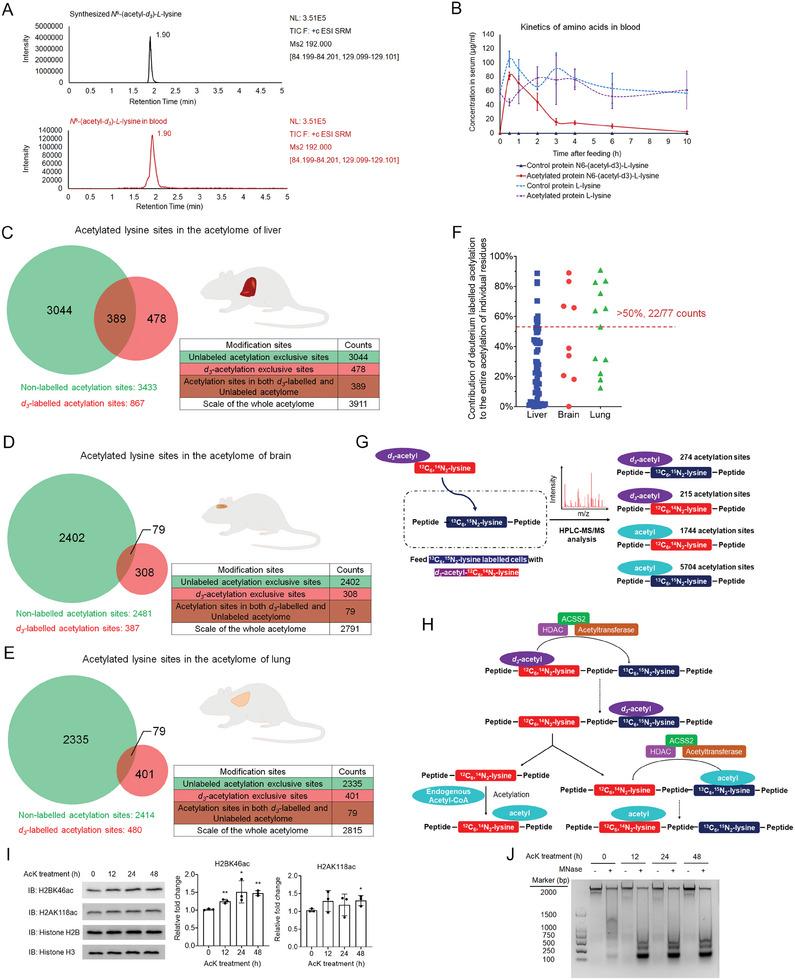
N-acetyl-L-lysine residue is abundant in dietary protein but little is known about its potential influences on the diet-consumers. Herein, it is reported that Lysyl-tRNA synthetase (KARS) mediates co-translational deposition of diet-derived N-acetyl-L-lysine (AcK) in nascent proteins to contribute to the acetylome in cells. Acetylated dietary protein is a direct source of AcK that can widely and substantially regulate the acetylome in multiple organs of mice. By analyzing the mechanisms underlying AcK contributing to the acetylome in mammalian cells, it is found that KARS can utilize AcK as an alternative substrate to produce N-acetyl-l-lysyl-tRNA. The crystal structure of KARS in complex with AcK at 2.26 Å resolution shows that AcK shares the same substrate-binding pocket as L-lysine, allowed by a sidechain flip of Tyr499. The generated N-acetyl-L-lysyl-tRNA introduces AcK into growing nascent polypeptide and results in protein acetylation, including the regions buried inside folded proteins that are post-translational modification (PTM)-inaccessible and functionally important. This undocumented protein modification mechanism is inherently different from PTM and termed as co-translational modification (coTM). It is expected to extend the repertoire of acetylome and improve the understanding of protein modification mechanisms in cells.
N-乙酰-L-赖氨酸残基在膳食蛋白质中含量丰富,但人们对其对饮食消费者的潜在影响知之甚少。在此报告,赖氨酰-tRNA合成酶(KARS)介导饮食来源的N-乙酰-L-赖氨酸(AcK)在新生蛋白质中的共翻译沉积,从而对细胞中的乙酰化蛋白质组产生影响。乙酰化的膳食蛋白质是AcK的直接来源,可广泛且显著地调节小鼠多个器官中的乙酰化蛋白质组。通过分析AcK在哺乳动物细胞中影响乙酰化蛋白质组的机制,发现KARS可将AcK用作替代底物来生成N-乙酰-L-赖氨酰-tRNA。KARS与AcK复合物的晶体结构在2.26 Å分辨率下显示,AcK与L-赖氨酸共享相同的底物结合口袋,这是由Tyr499的侧链翻转所允许的。生成的N-乙酰-L-赖氨酰-tRNA将AcK引入正在生长的新生多肽中,导致蛋白质乙酰化,包括折叠蛋白内部那些无法进行翻译后修饰(PTM)但功能重要的区域。这种未被记录的蛋白质修饰机制与PTM本质上不同,被称为共翻译修饰(coTM)。预计这将扩展乙酰化蛋白质组的范围,并增进对细胞中蛋白质修饰机制的理解。



 Zotero 插件