
长期胆囊切除术后患者的代谢功能障碍相关脂肪性肝病:一项横断面研究
Metabolic Dysfunction Associated Fatty Liver Disease in Long-Term Cholecystectomy Patients: A Cross-Sectional Study.
作者信息
Sezer Semih, Demirci Selim, Kara Murat
机构信息
Departments of Gastroenterology Medicine, Dr. Abdurrahman Yurtaslan Oncology Training and Research Hospital, Ankara, Türkiye.
Department of Physical and Rehabilitation Medicine, Hacettepe University Medical School, Ankara, Türkiye.
出版信息
Turk J Gastroenterol. 2024 Nov 25;36(3):162-168. doi: 10.5152/tjg.2024.24337.
BACKGROUND/AIMS: Cholecystectomy, while generally safe with low perioperative morbidity and mortality, has been linked to an increase in metabolic disorders. Metabolic dysfunction-associated fatty liver disease (MAFLD) is a globally prevalent condition that leads to both hepatic and systemic complications. This study aimed to investigate the association between cholecystectomy and MAFLD.
MATERIALS AND METHODS
This cross-sectional study was designed to evaluate the relationship between cholecystectomy and MAFLD. Metabolic dysfunction-associated fatty liver disease was defined by the presence of hepatic steatosis in combination with any of the following conditions: diabetes mellitus (fasting plasma glucose ≥126 mg/dL), overweight (body mass index (BMI) ≥25 kg/m2), or metabolic dysregulation.
RESULTS
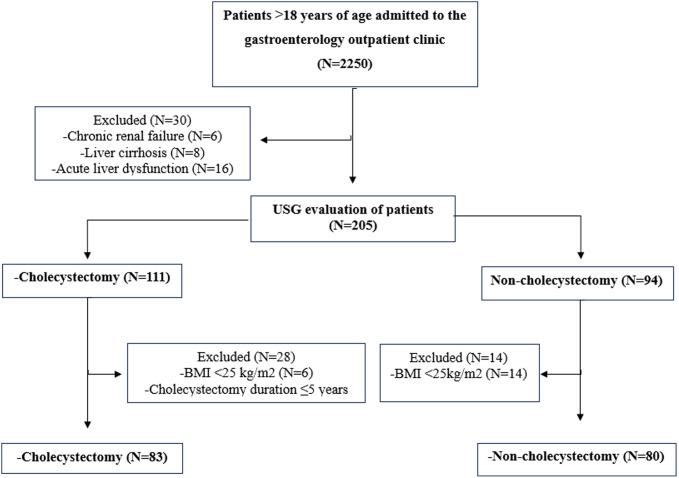
A total of 163 participants with BMI ≥25 kg/m2, including consecutive cholecystectomized (N = 83) and non-cholecystectomized (N = 80) subjects, were included. The prevalence of MAFLD was found in 64 out of 83 (77.1%) cholecystectomized patients and in 30 out of 80 (37.5%) non-cholecystectomized subjects (P < .001). When age, gender, BMI, exercise habits, hypertension, diabetes mellitus, and cholecystectomy status were included in regression analyses, we found that only BMI [odds ratio (OR) = 1.155 (95% CI: 1.040-1.283)] and cholecystectomy [OR = 4.540 (95% CI: 2.200-9.370)] were independently associated with MAFLD (both P < .01). ROC analysis identified 10 years as the cut-off, with MAFLD risk being 2.7-7.3 times higher in patients with cholecystectomy for ≤10 and >10 years.
CONCLUSION
In our study, MAFLD was found to be 4.5 times more likely in cholecystectomized patients compared to those without cholecystectomy, with a significant increase in frequency observed after 10 years. These results suggest that cholecystectomized patients should be monitored for MAFLD.
背景/目的:胆囊切除术虽然总体安全,围手术期发病率和死亡率较低,但与代谢紊乱的增加有关。代谢功能障碍相关脂肪性肝病(MAFLD)是一种全球普遍存在的疾病,会导致肝脏和全身并发症。本研究旨在调查胆囊切除术与MAFLD之间的关联。
材料与方法
本横断面研究旨在评估胆囊切除术与MAFLD之间的关系。代谢功能障碍相关脂肪性肝病的定义为存在肝脂肪变性并伴有以下任何一种情况:糖尿病(空腹血糖≥126mg/dL)、超重(体重指数(BMI)≥25kg/m²)或代谢失调。
结果
共有163名BMI≥25kg/m²的参与者,包括连续接受胆囊切除术的患者(N = 83)和未接受胆囊切除术的患者(N = 80)。在83名接受胆囊切除术的患者中,有64名(77.1%)被发现患有MAFLD,而在80名未接受胆囊切除术的患者中,有30名(37.5%)患有MAFLD(P <.001)。当将年龄、性别、BMI、运动习惯、高血压、糖尿病和胆囊切除术状态纳入回归分析时,我们发现只有BMI[比值比(OR)= 1.155(95%置信区间:1.040 - 1.283)]和胆囊切除术[OR = 4.540(95%置信区间:2.200 - 9.370)]与MAFLD独立相关(两者P <.01)。ROC分析确定10年为临界值,胆囊切除术≤10年和>10年的患者患MAFLD的风险分别高出2.7 - 7.3倍。
结论
在我们的研究中,发现接受胆囊切除术的患者患MAFLD的可能性是未接受胆囊切除术患者的4.5倍,10年后发病率显著增加。这些结果表明,应对接受胆囊切除术的患者进行MAFLD监测。
 Zotero 插件