
在一项针对头颈癌患者的前瞻性初步研究中,夜间皮质醇水平对无进展生存期具有预后价值。
Evening cortisol levels are prognostic for progression-free survival in a prospective pilot study of head and neck cancer patients.
作者信息
Cash Elizabeth, Beck Isak, Harbison Brooks, Albert Christy, Sephton Sandra E
机构信息
Department of Otolaryngology-Head and Neck Surgery and Communicative Disorders, University of Louisville School of Medicine, Louisville, KY, United States.
University of Louisville Healthcare-Brown Cancer Center, Louisville, KY, United States.
出版信息
Front Oncol. 2024 Nov 20;14:1436996. doi: 10.3389/fonc.2024.1436996. eCollection 2024.
INTRODUCTION
Cortisol rhythm disruptions predict early mortality in renal, colorectal, lung, and metastatic breast cancer. In head and neck cancer (HNC), various cortisol indices are known to correlate with adverse psychological and biological (e.g., inflammatory) outcomes, but links to mortality have yet to be demonstrated. We hypothesize that the prognostic value of diurnal cortisol aberrations will hold in HNC. Prior work leads us to predict that flattened or elevated diurnal cortisol profiles will be associated with elevations of serum inflammatory and tumor-promoting cytokines in this population, and that these immune markers would themselves predict poor progression-free survival.
METHOD
We prospectively recruited a pilot sample of HNC patients (N=40) at a multidisciplinary HNC clinic. Most patients presented with late-stage oral/oropharyngeal cancer, were older than 50, male, and subsequently received combined-modality (surgery and/or radiotherapy with or without chemotherapy) treatment with curative intent. Saliva was collected twice daily for six days to assess diurnal slope, mean, waking, and evening cortisol levels. Serum was assayed for an exploratory panel of inflammatory and tumor-promoting cytokines. Two years post study-entry, disease progression and survivorship status were abstracted from medical records. Bivariate correlations, linear regressions, and Cox Proportional Hazards models tested hypotheses.
RESULTS
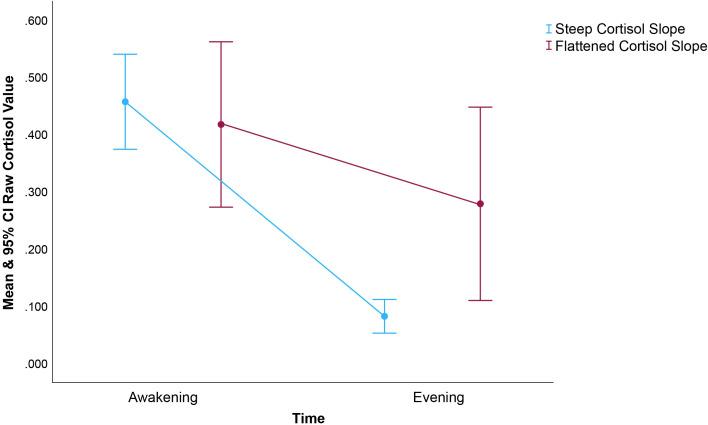
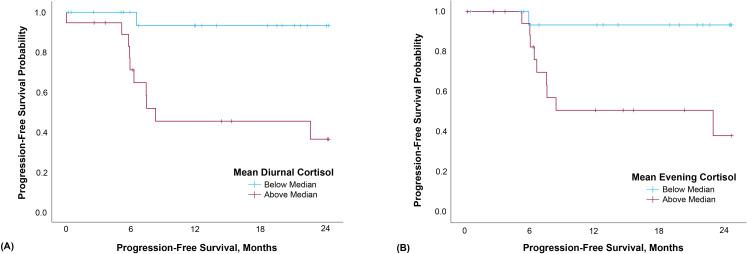
Elevations of evening cortisol and diurnal mean levels were each associated with shorter progression-free survival (evening: Hazard Ratio [HR]=1.848, 95% Confidence Interval [CI]=1.057-3.230, p=.031; diurnal mean: HR=2.662, 95% CI=1.115-6.355, p=.027). Bivariate correlations revealed that higher levels of the serum inflammatory marker interferon (IFN)-γ were linked with elevated evening (r=.405, p=.014) and mean (r=.459, p=.004) cortisol. Higher expression of IFN-γ also predicted poorer progression-free survival (HR=4.671, 95% CI=1.409-15.484, p=.012).
DISCUSSION
Elevated evening and diurnal mean cortisol were both prognostic; suggesting cortisol secretion is both dysregulated and elevated among patients who subsequently experienced accelerated disease progression. These exploratory data from 40 HNC patients mirror relationships between cortisol and survival identified among patients with numerous other tumor types. This pilot study highlights the need for research on effects of cortisol rhythm disruption among HNC patients. Future research in larger samples should also examine the role of inflammatory and tumor-promoting factors-both systemically and within the tumor microenvironment-as potential mediators of cortisol rhythm disruption.
引言
皮质醇节律紊乱可预测肾癌、结直肠癌、肺癌和转移性乳腺癌的早期死亡率。在头颈癌(HNC)中,已知各种皮质醇指标与不良心理和生物学(如炎症)结果相关,但与死亡率的关联尚未得到证实。我们假设昼夜皮质醇异常的预后价值在头颈癌中成立。先前的研究使我们预测,在该人群中,昼夜皮质醇水平扁平或升高将与血清炎症和肿瘤促进细胞因子的升高相关,并且这些免疫标志物本身将预测无进展生存期较差。
方法
我们在一家多学科头颈癌诊所前瞻性招募了一组头颈癌患者的试点样本(N = 40)。大多数患者患有晚期口腔/口咽癌,年龄超过50岁,为男性,随后接受了旨在治愈的综合治疗(手术和/或放疗,有或无化疗)。每天收集两次唾液,持续六天,以评估昼夜斜率、平均值、清醒时和夜间的皮质醇水平。检测血清中的一组探索性炎症和肿瘤促进细胞因子。研究开始两年后,从医疗记录中提取疾病进展和生存状况。采用双变量相关性分析、线性回归分析和Cox比例风险模型来检验假设。
结果
夜间皮质醇升高和昼夜平均水平升高均与较短的无进展生存期相关(夜间:风险比[HR]=1.848,95%置信区间[CI]=1.057 - 3.230,p = 0.031;昼夜平均:HR = 2.662,95% CI = 1.115 - 6.355,p = 0.027)。双变量相关性分析显示,血清炎症标志物干扰素(IFN)-γ水平较高与夜间(r = 0.405,p = 0.014)和平均(r = 0.459,p = 0.004)皮质醇升高有关。IFN-γ的高表达也预测了较差的无进展生存期(HR = 4.671,95% CI = 1.409 - 15.484,p = 0.012)。
讨论
夜间和昼夜平均皮质醇升高均具有预后意义;这表明在随后经历疾病进展加速的患者中,皮质醇分泌既失调又升高。这40名头颈癌患者的探索性数据反映了在许多其他肿瘤类型患者中发现的皮质醇与生存之间的关系。这项试点研究强调了对头颈癌患者皮质醇节律紊乱影响进行研究的必要性。未来对更大样本的研究还应检查炎症和肿瘤促进因子在全身以及肿瘤微环境中的作用,作为皮质醇节律紊乱的潜在介导因素。
 Zotero 插件