
静息态功能磁共振成像引导下的重复经颅磁刺激诱发抑郁症患者膝下前扣带回反应。
Resting fMRI-guided TMS evokes subgenual anterior cingulate response in depression.
作者信息
Duprat Romain J, Linn Kristin A, Satterthwaite Theodore D, Sheline Yvette I, Liang Ximo, Bagdon Gabriela, Flounders Matthew W, Robinson Heather, Platt Michael, Kable Joseph, Long Hannah, Scully Morgan, Deluisi Joseph A, Thase Michael, Cristancho Mario, Grier Julie, Blaine Camille, Figueroa-González Almaris, Oathes Desmond J
机构信息
Center for Brain Imaging and Stimulation, University of Pennsylvania, Perelman School of Medicine, Department of Psychiatry, Philadelphia, USA; Center for the Neuromodulation of Depression and Stress, University of Pennsylvania, Perelman School of Medicine, Department of Psychiatry, Philadelphia, PA, USA; University of Pennsylvania, Department of Psychiatry, Philadelphia, PA, USA.
Center for Brain Imaging and Stimulation, University of Pennsylvania, Perelman School of Medicine, Department of Psychiatry, Philadelphia, USA; Center for Clinical Epidemiology and Biostatistics, University of Pennsylvania, Perelman School of Medicine, Department of Biostatistics, Epidemiology, and Informatics, Philadelphia, PA, USA; Center for Biomedical Image Computing and Analytics, University of Pennsylvania, Perelman School of Medicine, Philadelphia, PA, USA; The Penn Statistics in Imaging and Visualization Endeavor, Center for Clinical Epidemiology and Biostatistics, University of Pennsylvania, Perelman School of Medicine, Department of Biostatistics, Epidemiology, and Informatics, Philadelphia, PA, USA.
出版信息
Neuroimage. 2025 Jan;305:120963. doi: 10.1016/j.neuroimage.2024.120963. Epub 2024 Dec 3.
BACKGROUND
Depression alleviation following treatment with repetitive transcranial magnetic stimulation (rTMS) tends to be more effective when TMS is targeted to cortical areas with high (negative) resting state functional connectivity (rsFC) with the subgenual anterior cingulate cortex (sgACC). However, the relationship between sgACC-cortex rsFC and the TMS-evoked response in the sgACC is still being explored and has not yet been established in depressed patients.
OBJECTIVES
In this study, we investigated the relationship between sgACC-cortical (site of stimulation) rsFC and induced evoked responses in the sgACC in healthy controls and depressed patients.
METHODS
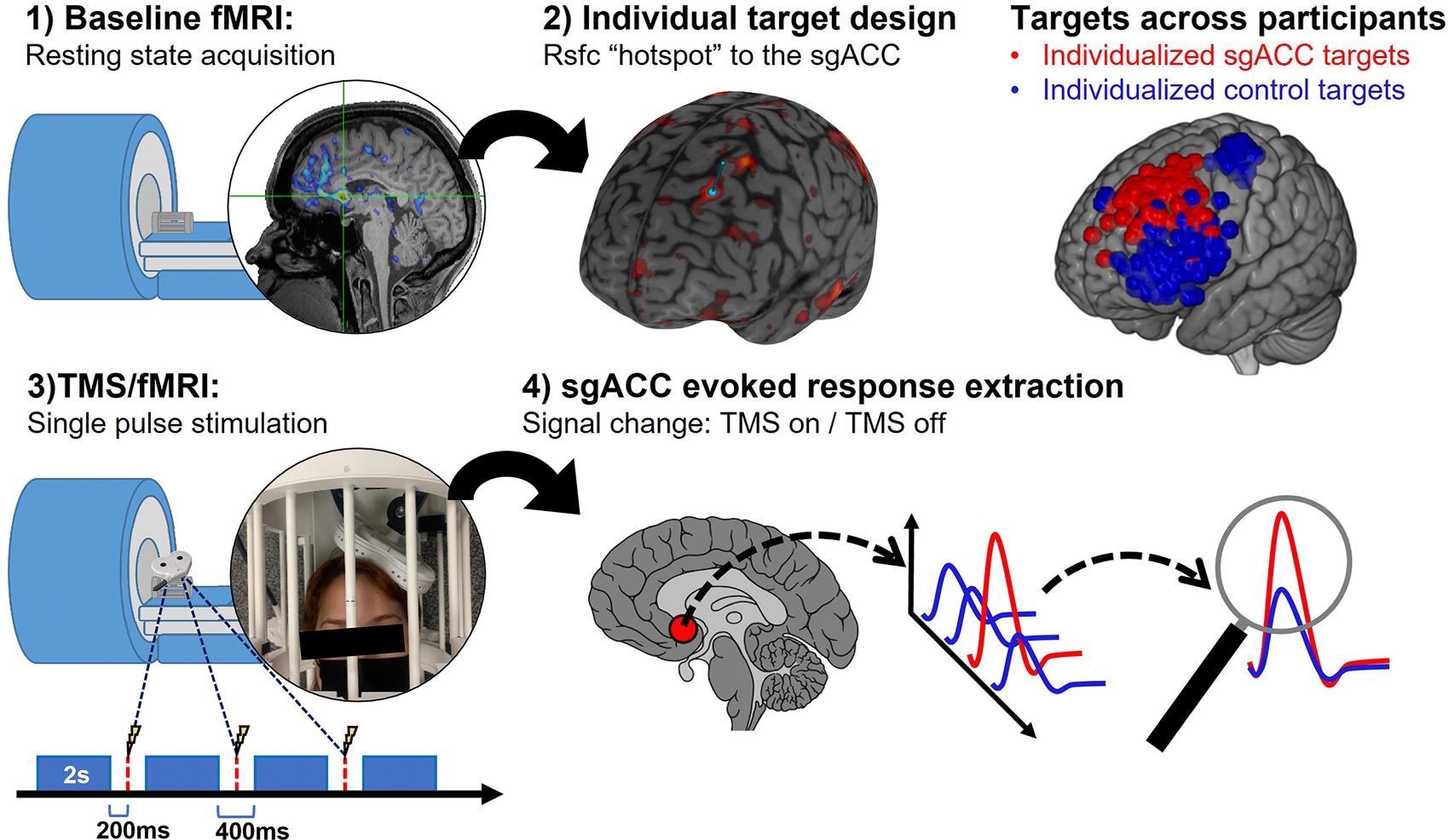
For each participant (N = 115, 34 depressed patients), a peak rsFC cortical 'hotspot' for the sgACC and control targets were identified at baseline. Single pulses of TMS interleaved with fMRI readouts were administered to these targets to evoke downstream fMRI blood-oxygen-level-dependent (BOLD) responses in the sgACC. Generalized estimating equations were used to investigate the association between TMS-evoked BOLD responses in the sgACC and rsFC between the stimulation site and the sgACC.
RESULTS
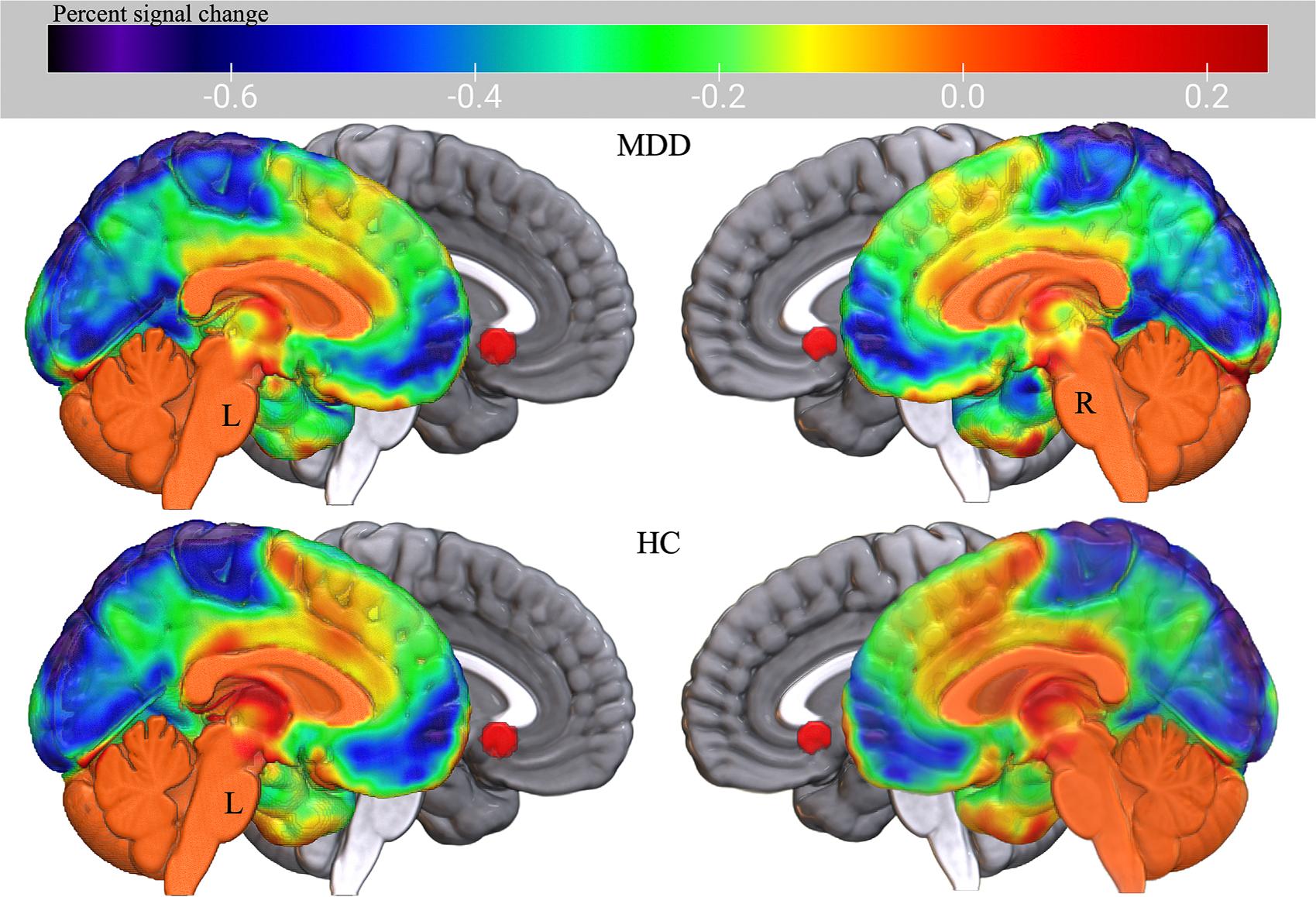
Stimulations over cortical sites with high rsFC to the sgACC were effective in modulating activity in the sgACC in both healthy controls and depressed patients. Moreover, we found that in depressed patients, sgACC rsFC at the site of stimulation was associated with the induced evoked response amplitude in the sgACC: stronger positive rsFC values leading to stronger evoked responses in the sgACC.
CONCLUSIONS
rsFC-based targeting is a viable strategy to causally modulate the sgACC. Assuming an anti-depressive mechanism working through modulation of the sgACC, the field's exclusive focus on sites anticorrelated with the sgACC for treating depression should be broadened to explore positively-connected sites.
背景
当重复经颅磁刺激(rTMS)靶向于与膝下前扣带回皮质(sgACC)具有高(负性)静息态功能连接(rsFC)的皮质区域时,治疗后的抑郁缓解往往更有效。然而,sgACC与皮质之间的rsFC和sgACC中TMS诱发反应之间的关系仍在探索中,尚未在抑郁症患者中得到证实。
目的
在本研究中,我们调查了健康对照者和抑郁症患者中sgACC与皮质(刺激部位)之间的rsFC以及sgACC中诱发的反应之间的关系。
方法
对于每位参与者(N = 115,34名抑郁症患者),在基线时确定sgACC的rsFC皮质“热点”峰值和对照靶点。将与功能磁共振成像(fMRI)读数交错的单脉冲TMS施加于这些靶点,以诱发sgACC中fMRI血氧水平依赖(BOLD)的下游反应。使用广义估计方程来研究sgACC中TMS诱发的BOLD反应与刺激部位和sgACC之间的rsFC之间的关联。
结果
对与sgACC具有高rsFC的皮质部位进行刺激,在健康对照者和抑郁症患者中均能有效调节sgACC的活动。此外,我们发现,在抑郁症患者中,刺激部位的sgACC rsFC与sgACC中诱发的反应幅度相关:rsFC正值越强,sgACC中的诱发反应越强。
结论
基于rsFC的靶向是因果调节sgACC的可行策略。假设通过调节sgACC起作用的抗抑郁机制成立,该领域在治疗抑郁症时仅专注于与sgACC呈负相关的部位的做法应予以拓宽,以探索正相关的部位。


 Zotero 插件