
体外光化学疗法预防肺移植术后排斥反应:一项前瞻性随机对照试验。
Extracorporeal photopheresis for the prevention of rejection after lung transplantation: a prospective randomised controlled trial.
作者信息
Benazzo Alberto, Cho Ara, Auner Sophia, Schwarz Stefan, Kovacs Zsofia, Ramazanova Dariga, Kolovratova Vera, Branka Manuela, Muraközy Gabriela, Hielle-Wittmann Elisabeth, Aigner Clemens, Hoetzenecker Konrad, Wekerle Thomas, Worel Nina, Knobler Robert, Jaksch Peter
机构信息
Department of Thoracic Surgery, Medical University of Vienna, Vienna, Austria.
Department of Dermatology, Medical University of Vienna, Vienna, Austria.
出版信息
Eur Respir J. 2025 Feb 6;65(2). doi: 10.1183/13993003.00733-2024. Print 2025 Feb.
BACKGROUND
Lung transplant recipients have the worst long-term outcomes of all solid organs due to acute rejection and chronic lung allograft dysfunction (CLAD). Our objective was to investigate the efficacy of extracorporeal photopheresis (ECP) as a prophylactic treatment to prevent acute cellular rejection (ACR), cytomegalovirus (CMV) infections and reduce the risk of CLAD.
METHODS
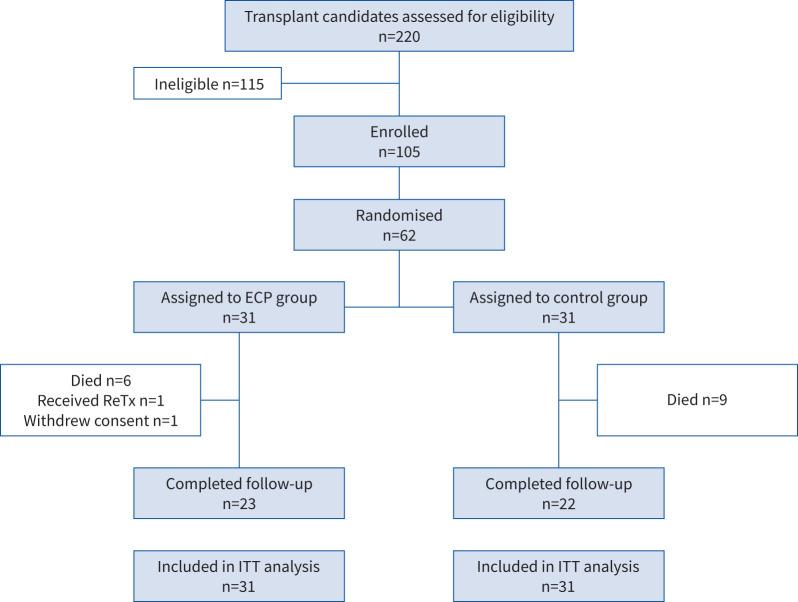
This was a single-centre prospective randomised controlled trial conducted at the Medical University of Vienna (Vienna, Austria) between 2018 and 2020. It included 31 COPD recipients per group. The treatment group underwent ECP in addition to a standard triple-drug immunosuppression protocol after lung transplantation. The control group received standard triple-drug immunosuppressive therapy. The primary outcome was a composite outcome defined as incidence of high-grade ACR, CMV infection or CLAD within 24 months after lung transplantation.
RESULTS
In the control group, 19 patients (61.3%) achieved the primary combined end-point compared with only six patients (19.4%) in the treatment group (p<0.001). Freedom from high-grade ACR was significantly greater in the ECP group (p=0.045). Cumulative A scores were significantly lower in the ECP group than in the control group at 3 months (0.18±0.44 0.56±0.94; p<0.05) and at 12 months (0.25±0.48 1.0±1.45; p=0.002). The rate of infections was lower in the ECP group with five cases and 67 cumulative hospital days compared with 22 cases and 309 days in the control group (p=0.002). Freedom from CLAD at 3 years was significantly greater in the ECP group (p=0.015).
CONCLUSION
Adding ECP to standard triple immunosuppression resulted in a significant reduction of the number of ACR episodes and significantly lower incidence of CLAD.
背景
由于急性排斥反应和慢性肺移植功能障碍(CLAD),肺移植受者在所有实体器官移植中具有最差的长期预后。我们的目的是研究体外光化学疗法(ECP)作为一种预防性治疗方法,以预防急性细胞排斥反应(ACR)、巨细胞病毒(CMV)感染并降低CLAD的风险。
方法
这是一项于2018年至2020年在奥地利维也纳医科大学进行的单中心前瞻性随机对照试验。每组纳入31例慢性阻塞性肺疾病(COPD)受者。治疗组在肺移植后除接受标准的三联药物免疫抑制方案外,还接受ECP治疗。对照组接受标准的三联药物免疫抑制治疗。主要结局是一个复合结局,定义为肺移植后24个月内高级别ACR、CMV感染或CLAD的发生率。
结果
在对照组中,19例患者(61.3%)达到主要联合终点,而治疗组仅有6例患者(19.4%)达到(p<0.001)。ECP组无高级别ACR的比例显著更高(p=0.045)。ECP组在3个月时(0.18±0.44对0.56±0.94;p<0.05)和12个月时(0.25±0.48对1.0±1.45;p=0.002)的累积A评分显著低于对照组。ECP组的感染率较低,有5例病例,累计住院天数为67天,而对照组为22例病例,309天(p=0.002)。ECP组在3年时无CLAD的比例显著更高(p=0.015)。
结论
在标准三联免疫抑制基础上加用ECP可显著减少ACR发作次数,并显著降低CLAD的发生率。


 Zotero 插件