
对表皮微环境中EMILINs结构作用的新见解。
New insights into the structural role of EMILINs within the human skin microenvironment.
作者信息
Schiavinato Alvise, Marcous Fady, Zuk Alexandra V, Keene Douglas R, Tufa Sara F, Mosquera Laura M, Zigrino Paola, Mauch Cornelia, Eckes Beate, Francois Katrien, De Backer Julie, Hunzelmann Nicolas, Moinzadeh Pia, Krieg Thomas, Callewaert Bert, Sengle Gerhard
机构信息
Department of Pediatrics and Adolescent Medicine, Faculty of Medicine and University Hospital Cologne, University of Cologne, Joseph-Stelzmann-Str. 52, 50931, Cologne, Germany.
Center for Biochemistry, Faculty of Medicine and University Hospital Cologne, University of Cologne, 50931, Cologne, Germany.
出版信息
Sci Rep. 2024 Dec 5;14(1):30345. doi: 10.1038/s41598-024-81509-5.
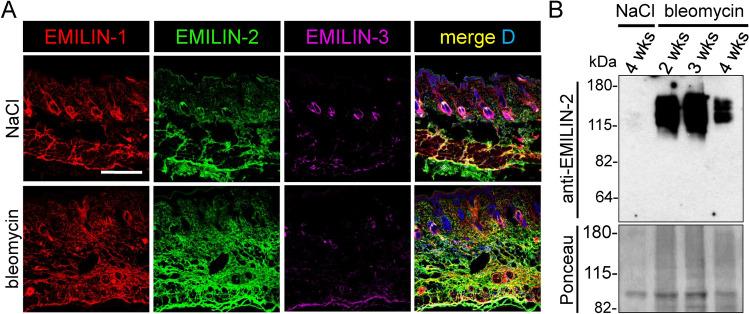
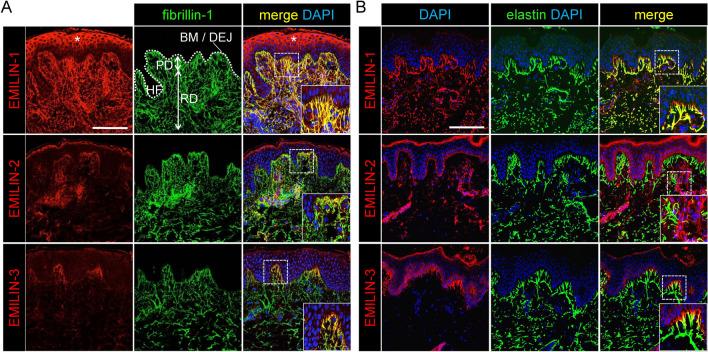
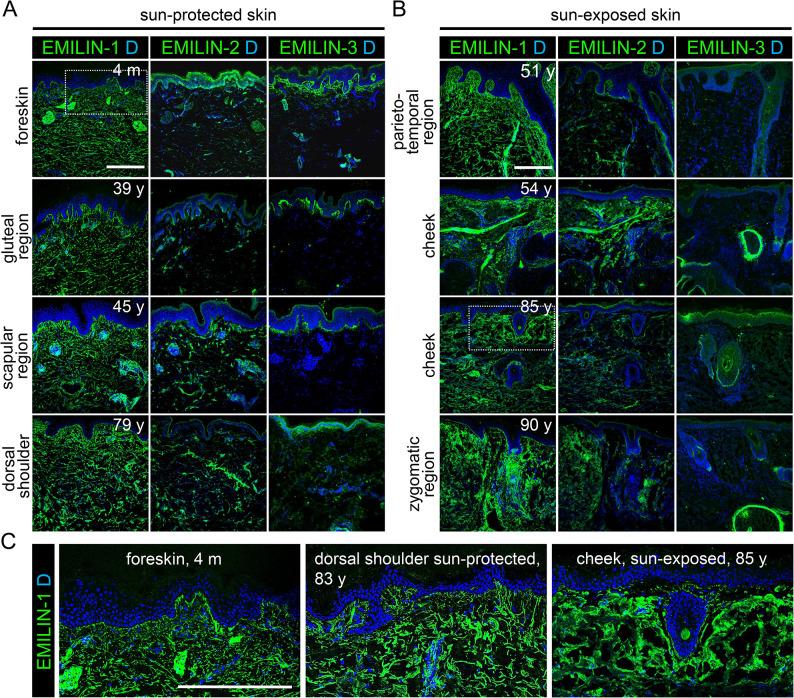
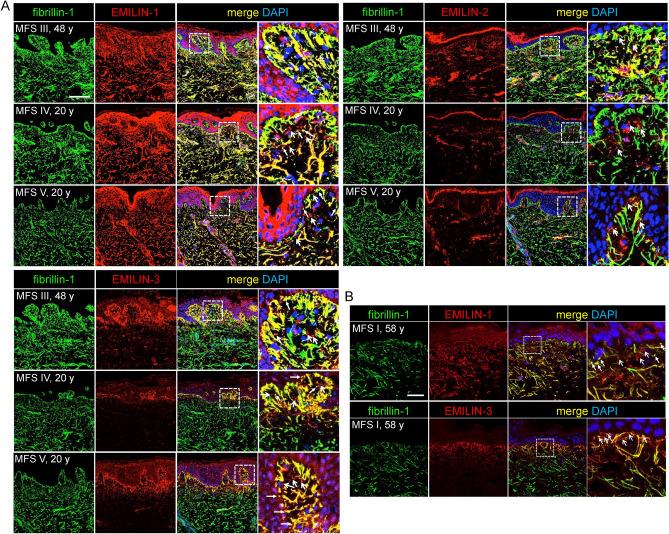
Supramolecular extracellular matrix (ECM) networks play an essential role in skin architecture and function. Elastin microfibril interface-located proteins (EMILINs) comprise a family of three extracellular glycoproteins that serve as essential structural components of the elastin/fibrillin microfibril network, and exert crucial functions in cellular signaling. Little is known about the structural nature of EMILIN networks in skin. We therefore investigated the spatiotemporal localization of EMILIN-1, -2, -3 in human skin induced by aging, UV-exposure, fibrosis, and connective tissue disorder. Confocal immunofluorescence and immunogold electron microscopy analysis identified all EMILINs as components of elastic fibers and elastin-free oxytalan fibers inserted into the basement membrane (BM). Further, our ultrastructural analysis demonstrates cellular contacts of dermally localized EMILIN-1 positive fibers across the BM with the surface of basal keratinocytes. Analysis of skin biopsies and fibroblast cultures from fibrillin-1 deficient Marfan patients revealed that EMILINs require intact fibrillin-1 as deposition scaffold. In patients with scleroderma and the bleomycin-induced murine fibrosis model EMILIN-2 was upregulated. EMILIN-3 localizes to the tips of candelabra-like oxytalan fibers, and to specialized BMs engulfing hair follicles and sebaceous glands. Our data identify EMILINs as important markers to monitor rearrangements of the dermal ECM architecture induced by aging and pathological conditions.
超分子细胞外基质(ECM)网络在皮肤结构和功能中起着至关重要的作用。弹性蛋白微原纤维界面定位蛋白(EMILINs)由三种细胞外糖蛋白组成,它们是弹性蛋白/原纤维蛋白微原纤维网络的重要结构成分,并在细胞信号传导中发挥关键作用。关于皮肤中EMILIN网络的结构性质知之甚少。因此,我们研究了衰老、紫外线照射、纤维化和结缔组织疾病诱导的人皮肤中EMILIN-1、-2、-3的时空定位。共聚焦免疫荧光和免疫金电子显微镜分析确定所有EMILINs都是插入基底膜(BM)的弹性纤维和无弹性蛋白的氧化弹力纤维的组成部分。此外,我们的超微结构分析表明,真皮中定位的EMILIN-1阳性纤维通过BM与基底角质形成细胞表面有细胞接触。对来自原纤维蛋白-1缺乏的马凡综合征患者的皮肤活检和成纤维细胞培养物的分析表明,EMILINs需要完整的原纤维蛋白-1作为沉积支架。在硬皮病患者和博来霉素诱导的小鼠纤维化模型中,EMILIN-2上调。EMILIN-3定位于烛台样氧化弹力纤维的尖端,以及包裹毛囊和皮脂腺的特殊BM。我们的数据确定EMILINs是监测衰老和病理状况诱导的真皮ECM结构重排的重要标志物。





 Zotero 插件