
结肠炎和结肠癌的潜在治疗策略:双向靶向STING通路
Potential therapeutic strategies for colitis and colon cancer: bidirectional targeting STING pathway.
作者信息
Qu Jiaorong, Cai Yajie, Li Fanghong, Li Xiaojiaoyang, Liu Runping
机构信息
School of Life Sciences, Beijing University of Chinese Medicine, 11 Bei San Huan Dong Lu, Beijing, 100029, China.
School of Chinese Materia Medica, Beijing University of Chinese Medicine, 11 Bei San Huan Dong Lu, Beijing, 100029, China.
出版信息
EBioMedicine. 2025 Jan;111:105491. doi: 10.1016/j.ebiom.2024.105491. Epub 2024 Dec 6.
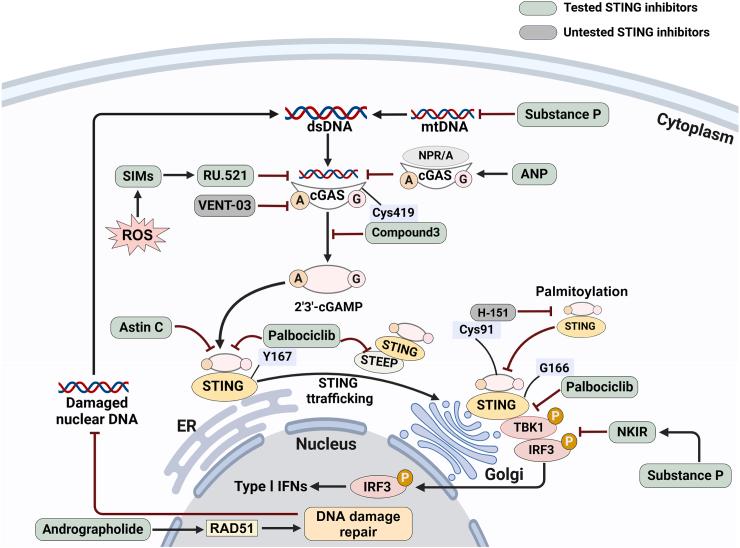
The cyclic-GMP-AMP synthase (cGAS)-stimulator of interferon gene (STING) pathway has emerged as a promising therapeutic target for colitis and colon cancers. Notably, inhibiting STING may mitigate the progression of colitis, whereas activating STING can enhance anti-tumor immune responses against colon cancer. This duality suggests that the development of STING agonists and inhibitors possesses significant clinical translational potential. In this review, we provide a comprehensive overview of STING inhibitors/agonists that have been systematically evaluated in the contexts of colitis and colon cancer and their specific molecular mechanisms. Other well-characterized STING inhibitors/agonists may also hold considerable promise for the treatment of these conditions, although efficacy validation remain necessary. Additionally, we delve into the latest advances concerning STING oligomerization, degradation and phase separation-dependent self-regulation, proposing potential druggable targets that could inspire the development of novel STING agonists or inhibitors. In Summary, targeting STING appears to be a promising strategy for the treatment of colitis and colon cancer.
环磷酸鸟苷-腺苷酸合成酶(cGAS)-干扰素基因刺激因子(STING)通路已成为治疗结肠炎和结肠癌的一个有前景的治疗靶点。值得注意的是,抑制STING可能会减轻结肠炎的进展,而激活STING则可增强针对结肠癌的抗肿瘤免疫反应。这种双重性表明,STING激动剂和抑制剂的开发具有显著的临床转化潜力。在这篇综述中,我们全面概述了在结肠炎和结肠癌背景下经过系统评估的STING抑制剂/激动剂及其具体分子机制。其他特征明确的STING抑制剂/激动剂可能对治疗这些疾病也有很大前景,尽管仍需进行疗效验证。此外,我们深入探讨了有关STING寡聚化、降解和相分离依赖性自我调节的最新进展,提出了可能启发新型STING激动剂或抑制剂开发的潜在可成药靶点。总之,靶向STING似乎是治疗结肠炎和结肠癌的一种有前景的策略。


 Zotero 插件